Friday, August 7, 2015
India: CRPP Statement condemning the judicial murder of Yakub Memon for satisfying “collective conscience” Capital punishment is the most premeditated of murders. -Albert Camus What says the law? You will not kill. How does it say it ? By killing ! - Victor Hugo
CRPP Statement condemning the judicial murder of Yakub Memon for satisfying “collective conscience” Capital punishment is the most premeditated of murders. -Albert Camus What says the law? You will not kill. How does it say it? By killing! -Victor Hugo
July 31, 2015 The CRPP strongly condemns the judicial murder of Yakub Memon who was hanged to death on 30 July 2015 at 7 in the morning after a prolonged drama in the Supreme Court till the wee hours of the same day.
The media was abuzz with stories about how vibrant the Indian democracy and its legal apparatus are as the jurists burnt the midnight oil to consider even the last bit to see if Yakub Memon can be reprieved so that his death sentence be commuted to life.
If in Mohd. Afzal Guru’s case every procedure was violated by the State, in that of Yakub Memon the Supreme Court made a farce of all the procedures while pretending that even it sat into the early hours of the 30th July to consider the last minute plea of someone who was facing the gallows the same day at seven in the morning.
The Supreme Court even made its own judgements redundant when it had commuted the death sentence of many citing the reasons of undue delay which in itself amounts to torture for those condemned to death.
Still it is difficult to ascertain what lurks behind this haste to take away the life of someone whose ‘offence’ had been proved only through the confession of another person. The haste with which the two executive authorities of the State—Maharashtra Governor and the President of India—rejected Yakub Memon’s mercy petition overnight without giving him time at all to challenge in the court further shows the political and premeditative nature of the decision to take away the life of someone.
The political nature of the decision becomes all the more evident when one looks back through memory lane. In 1987, forty two Muslims were picked up by the Provincial Armed Constabulary (PAC) from Hashimpura town near Ghaziabad in Uttar Pradesh—arguably within shouting distance from New Delhi, dotted at present with flashy malls and multiplexes—and killed one by one at almost point-blank range.
The victim Muslims were thrown out of a PAC truck like gunny bags and, as they fell, were showered with bullets until they died.
This was the precursor of the Rath Yatras led by the BJP leadership under LK Advani that finally resulted in the demolition of the Babri Masjid in December 1992.
The build-up towards the demolition of the Babri Masjid through rath yatras punctuated with communal riots saw scores of Muslims getting targeted including the town of Meerut where Hashimpura is located.
After almost 28 years, all the policemen who remained till date to see the trial end were left scot free for want of evidence.
Post-Hashimpura, the build up towards the destruction of Babri Masjid and its aftermath saw hundreds of thousands of people perishing in communal riots most of them Muslims. Muslim women were targets of Hindu fundamentalists and their property also became easy targets of destruction.
All those perpetrators, masterminds of such crimes against humanity were set free.
When we move ahead in our memories to the days of the Gujarat carnage no less than 2000 Muslims lost their lives and the scale of destruction of their property knows no bounds.
But the top police officials, administrative officers, who oversaw the crime of social engineering—that ensured Narendra Modi rule Gujarat for more than a decade and finally reach Delhi riding on the pulpit of bones of the slain—are out on bail and back in their posts.
The most glaring example is the bail given to Maya Kodnani and Babu Bajrangi. By 2015 we have passed a long road where we could see a series of blasts triggered by Hindu fundamentalist forces in public places, mosques, trains etc.
This was more or less admitted by the mastermind Aseemananda himself. The likes of Colonel Purohit and his organization Abhinav Bharat also established a well-knit network of Hindu fundamentalist forces with specific plans to target the most vulnerable sections of the society to foment hatred against the minorities and finally realize a Hindu-fundamentalist state.
But we are also witness to the present government going slow in expediting such cases. It is not to say that these people should be given death penalty.
But the emphasis is to expose the outright prejudice towards the Muslim community patronized both by the Congress and further championed by the BJP and RSS so as to deepen the fangs of communal fascism in the subcontinent.
Successive governments in Delhi have failed miserably to deal with any of the pressing problems of the broad masses of the people and not a single political party in the parliament is shying away from playing shadow games to facilitate the full fledged expropriation of the wealth and resources of the peoples in the subcontinent by the multinational corporations.
The policies of successive governments at the centre and the states have inflicted ever more hardships on the lives of the general masses (more than seventy percent of the largest democracy) with rural India becoming graveyards for the peasantry.
The ever-growing spectre of unemployment is threatening to engulf the length and breadth of the subcontinent.
In such a scenario where politics and the talk of good governance have been reduced to spectacles of rhetoric with the expectations of the aspiring middle class hitting its nadir, the only way out for the ruling classes is to whip up the politics of a so-called ‘collective conscience’, a euphemism for jingoism that can get satiated only through the blood of the minorities, the other—especially the Muslims.
The build-up towards the pre-meditated murder of Yakub Memon is nuanced with a parallel narrative of the possibilities of his death sentence getting commuted to life by a vibrant democracy that vouches on the rule of law.
The plot further gets thickened with the sudden dovetailing of the so-called “terrorist” attack in Gurdaspur which, as usual, will be shrouded in intrigue till all of us lose our memories and our criticality to know as to who was behind this “attack”?
The terror theatre of Gurdaspur successfully dovetailed the narrative of the ideology of ‘war against terror’ into the common sense of the people so much so that the consent for the hanging to death of Yakub Memon or all ‘traitors’ become absolute and unquestionable.
The politics of retribution and revenge once again took centre stage with death penalty becoming the ideal deterrent and the marker of a stronger, resolute national security state.
Death penalty in a class divided society like India with national, regional, communal and casteist prejudices can only result in further strengthening the ideology of a Hindu Brahmanical social order where death penalty is reserved as the right of the minorities—Muslims, Kashmiri Muslims, Dalits, and other oppressed nationalities.
As long as the social and economic basis for this ideology of appropriation, oppression, domination, discrimination and exploitation prevail and pervade the social fabric of the subcontinent, justice itself gets periodically hanged!
Death and destruction become the markers of a society that claims to be the largest democracy in the world.
The CRPP calls upon all democratic and freedom-loving people of the subcontinent to see through this politics of retribution and hate and reject the ideology underlying it lock stock and barrel. In Protest, SAR Geelani President Amit Bhattacharyya Secretary General MN Ravunni Vice President Sukhendu Bhattacharjee Vice President Sujato Bhadra Vice President P. Koya Vice President Rona Wilson Secretary Public Relations
************
PUDR Statement on Yakub Memon’s Hanging July 22, 2015 PEOPLE’S UNION FOR DEMOCRATIC RIGHTS
On 15th July, the Maharashtra government announced that it has initiated the process for hanging Yakub Memon.
On 30th July, 2015 ‘he is to be hung by the neck till dead’. The announcement seemed inevitable after the Supreme Court had rejected his review petition on 10th April this year.
Except that Yakub Memon has still not exhausted all legal remedies as he has a curative petition due to be heard in the Supreme Court on 21st July.
While the state government is treating the matter as already dried and dusted and making a mockery of the justice system, there are some very valid reasons for drawing attention to Yakub’s case for upholding our faith in the judicial process:
1. Controversial arrest: The police claimed to pick Yakub up from the New Delhi Railway Station on 5th August 1994. In a letter written to the Supreme Court in 1999, Yakub stated that he came to India on 28th July 1994. He had been detained on 24th July at Kathmandu airport and then handed over to the Indian agencies.
2. Implicated and sentenced for trying to help: Yakub has maintained all along that he had no foreknowledge of and had no hand in the conspiracy leading to the Mumbai blasts of 1993. He was working towards voluntarily returning to India to clear his name. He co-operated with the investigating agencies and provided vital leads which have been acknowledged. However, the Court never regarded these as mitigating factors.
3. No justice under TADA: The Supreme Court in its 2013 judgement confirming death sentence awarded by the TADA court in 2007, held that Yakub officiated for Tiger Memon in Mumbai in the planning of the attacks in the latter’s absence.
The Court accepted that Yakub was nowhere directly involved in the execution of the blasts, but his responsibility was greater as he was one of the planners.
It said that he “was constantly present at the Al Husseini building, where the major part of the plan was made and executed”, interacted with ‘Tiger’s men’, managed Tiger’s “ill-gotten money,” arranged for air tickets to Dubai and vehicles which were used in the attacks.
He was convicted under TADA (now lapsed), IPC, Arms Act, Prevention of Damage to Public Property Act, and under sections of the Explosive Substances Act on retracted confessions, on the statements of approvers and on the confession of co-accused.
4. “Special Stigmatizing”: Yakub had returned in 1994 believing that there would be a fair trial. He was proved wrong. The judgement decreed capital punishment for him because of his “position of dominance” and the “gravity of the crime”. Significantly, the Court commuted the sentences of the 10 others who had been awarded capital punishment by the trial court.
5. Rejection of mitigating factors: The Supreme Court deliberated on the aggravating and mitigating circumstances while awarding the quantum of punishment to all the death row convicts. Notably, in Yakub’s case, the Court noted none other than the fact that he did not have a prior criminal record. However, in the case of the other 10 others sentenced to death, the Court noted several other mitigating factors like lengthy incarceration, good behaviour, co-operating in the investigation, dependent family members etc. which were equally applicable to him. In Yakub’s case, the beginning and end of his being awarded death penalty then is clearly his relationship with Tiger Memon.
6. A discriminated convict: While confirming the death sentence on Yakub, the Court disregarded the fact that he suffered from depression from 1996. Ironically, a year later, while commuting the death penalty of 15 death row convicts in 2014, the same Court noted: “incarceration, in addition to the reasonable time necessary for adjudication of mercy petitions and preparation for execution, flouts the due process guaranteed to the convict under Article 21 which inheres in every prisoner till his last breath.”
7. Incarcerated for 21 years: For 21 years Yakub has lived with the “brooding horror” which “haunts” a condemned prisoner. To hang him now is neither fair nor just as it is punishing him twice over. It is plain vengeance which the state shows towards a condemned and defenceless man.
8. Denial of reform: A chartered accountant by profession, Yakub was known to be a silent observer during court proceedings. In 21 years of which he has spent 8 years in the death row, he has completed two MAs, one in English and the other in Political Science from IGNOU. Several recent judgments have emphasised the importance of reform and rehabilitation based on conduct. However, Yakub’s efforts have never been recognized.
9. A political hanging: The judicial process through which Yakub has been pronounced guilty and deserving of capital punishment has failed to bring to justice the main perpetrators of anti-Muslim carnage in December 1992 and January 1993, despite the Srikrishna Commission of Inquiry identifying a host of police officers and politicians belonging to Shiv Sena for their role.
In the last one year, a similar trend is observable in the investigations into attacks committed by Hindu terror groups. 15 witnesses have turned hostile in the Ajmer Dargah blast (2007), the NIA has closed the Modasa case (2008) and has pressured the special prosecutor to ‘go soft’ on the investigations into the Malegeon blasts (2008).
The impending hanging of Yakub Memon raises certain very significant concerns regarding the role of the state and rights of people. As the above points illustrate, Yakub’s ‘crime’ is that of guilt by association and he is a scapegoat who has been conveniently caught and convicted as ‘most guilty’. Yakub Memon returned as a conscientious Indian citizen, albeit with a ‘criminal’ family background.
If he is now hanged, the government must take responsibility for sending out the message that a Muslim cannot be a good citizen. It is also imperative to ask as to what justice will be served through such an execution?
Such regressive judicial pronouncement yet again convinces us that death penalty is not only prejudiced but also irrational. Fraught with the possibility of judicial error, the irreversibility of the punishment makes it totally condemnable.
Globally, there is a move within countries to progressively do away with this regressive form of punishment.
PUDR therefore urges the authorities including the judiciary in this case that in the interests of justice to commute his sentence, and in light of his 21 year-long incarceration to release him.
Megha Bahl, Sharmila Purkayastha Secretaries,
PUDR 20th July 2015 - See more at: http://sanhati.com/articles/14003/#sthash.rNqliCa4.dpuf
Wednesday, August 5, 2015
British Army Gurkha's - Dissolving Imperialism's Residue by Peter Tobin
Next year will mark the 200th anniversary of the 1816 Treaty of Sugauli brought about by the defeat of Nepal in the Anglo-Nepalese war that began in 1814.
Among the many onerous clauses, including substantial territorial loss and the general reduction of the country to neo-colonial status, was one retrospectively sanctioning the recruitment of Nepalese nationals – as ‘Gurkhas’ into the British Army, a process already underway on an ad hoc basis from the previous year.
(After 1846 the Rana leader, Jonge Bahadur, negotiated a price per recruit, acting as a glorified gallaawallah (recruiting officer) for the British.)
The British establishment and military top brass have therefore decided that 1815 marks the beginning of this arrangement and are celebrating it with events throughout the year, including a march-past Buckingham Palace.
EXEMPLARY SOLDIERS
In the intervening two centuries Gurkha brigades have fought and died in almost every British war or major military engagement and have earned admiration for their professionalism, toughness and martial spirit. From Hindu Rao’s house at the Siege of Delhi during the 1857 Sepoy Rebellion to Hangman’s Hill at Monte Cassino in 1943 and subsequent breaking of the Wehrmacht’s Gustav Line on the Italian front during the Second World War, Gurkha units demonstrated breath-taking courage and tenacity in holding vulnerable positions against greater odds and in each case suffering near annihilation.
These two examples, among many more, show why Gurkhas are pro rata the most decorated soldiers in the British Army. The warlike ardour that so impressed the British when they fought them at Nalapani in 1814 never dimmed, even in the service of an empire over which ‘the sun never set’ (‘because God didn’t trust it in the dark!’ as one Irish republican added)
IMPERIAL SERVICE
Fighting for a progressive cause as in the Second World War was however an exception to the rule for Gurkha brigades as their typical military exertions over the two centuries have been in the service of the British Empire; from the predatory colonial wars in India of the 19th century, to the anti-communist counter-revolutions throughout Asia in the 20th, and including the invasions of Afghanistan and Iraq in this century. In the reduced imperial circumstances of these last martial imbroglios the British establishment skin-crawlingly re-imagined itself in a ‘Special Relationship’ with Washington that justified enthusiastic toadying and trailing behind a warmongering WASP American empire seeking ‘Full Spectrum Dominance’ as the new global hegemon.
MERCENARIES?
While Gurkhas in the British Army share many characteristics with mercenaries as defined in Article 47, Protocol 1, of the Geneva Convention in selling their services for private gain and originating from countries not parties to specific wars and conflicts in which they engage, they are exempted because under clause (d) as members of UK armed forces they act solely under the authority of that state. Their situation is analogous to that of the French Foreign Legion which was similarly formed to serve France’s equally brutal and rapacious colonial Empire.
ONE-WAY LOYALTY
Like the Legion the Gurkhas have often been used to do the dirty work of empire, but have had to argue and agitate for similar conditions as those agreed by a French government in 2009 where a legionnaire can claim French citizenship after three years’ service and which is granted automatically if wounded in action under the principle ‘Francais par le sang verse’ (spilling blood for France).
Contrast this with the treatment shown to the Gurkhas, past and present, by their British masters who have continually resisted according them equality in the Three Ps; pay, promotion and pensions with British and Irish nationals in army ranks. Even the rights of residence for them and their families only succeeded through an imaginative campaign organised by brigade veterans and fronted by Joanna Lumley that ended in a parliamentary defeat for Brown’s New Labour administration. Pensions also had to be wrung from an ungrateful establishments through the courts with justice for the 35,000 pre-1997 veterans still pending.
Promotions are still a matter of contention as they remain through the ranks, despite having moved on from the original racial division between white officers and Gurkha rank and file. When commissions were conceded there was still a caveat that any Gurkha holding one was subordinate to any British officer regardless of rank and even now there appears to be block to rising above the rank of major.
A brave Lt. Gauchan challenged the promotion system at a tribunal in 2002, where he also exposed the ‘up or out’ clause in Conditions of Service (TACOS) then extant, enabling summary discharge of servicemen, willing or unwilling. Together with peremptory disbandment and merging of brigades, the 200,000 who served in the ’39-45 conflict has been whittled-down to a single brigade of under 4,000 in the British Army with two other 2,000 strong contingents sub-contracted out to Singapore and Brunei. The practice of compulsory discharge was not abolished until 2009.
Even in death there was no equality, as was shown in 1999 when Blair’s government tried to short-change the widow of Staff Sergeant Rai killed on active service in NATO’s Kosovo imbroglio, itself an ignominious stratagem within an ignominious campaign to dismember Yugoslavia under the cover, provided by compliant UN, of a ‘peacekeeping mission’.
As with campaign for rights of UK residence, the political and military elite had to be shamed into putting justice before parsimony, and have continually hidden behind the 1947 Tripartite Agreement, in this they shared the previous Raj’s Gurkha regiments with the new Indian regime , concurring that terms of engagement for Gurkhas in each army would be ‘broadly comparable’. It obviously suited the British to benchmark against the indices of an unreformed, increasingly failing Third World state.
RACIST PATRONISING
Considering that over 250,000 Gurkhas served in both 20th century World Wars and that 45,000 have died in British uniform since 1815, they have been ill-served by masters still imbued with the racism of empire. Sentimentalising them, as the British establishment does, as ‘our gallant friends’, ‘loyal allies’, ad nauseam shows that racism takes condescending as well as confrontational forms. It harks back to imperial delusions about ‘loyal natives’ who, like Kipling’s Gunga Din in the excruciating, eponymous doggerel, without question give their lives faithfully serving the White Sahib.
"Though I’ve belted you and flayed you,
By the living God that made you
You’re a better man than I am Gunga Din!"
And despite all the hard-won improvements in terms and conditions the recruitment of Gurkhas in Nepal remains a blatantly racist exercise. It is a degrading spectacle overseen by a British officer where up to twenty-five thousand Nepalis compete for two hundred places! What happened to one recruit, Bhagat, a few years ago as described by documentary filmmaker is proof that the British cannot break the habits of empire and still want their quota of Gunga Dins:
"I was taking pictures during Central Gurkha Selection in Pokhara, west Nepal, and it was the day of the feared Doko race — a gruelling three-mile endurance run over almost vertical, uneven paths and gravelly roads, mercilessly uphill, carrying a basket, the Doko, containing a 55-pound bag of sand, to be completed in 48 minutes or less. The track is so steep, slippery and full of boulders that it’s even uncomfortable to walk. Bhagat was doing well, but a little over half a mile before the finish line, he went over on his ankle, hard. Desperate to complete the race and not fail the selection, he ignored the exploding pain in his foot, kept running and still finished in 45 minutes, ahead of a large number of his peers. He was accepted into the Gurkhas not only for his exam results but also for the toughness and tenacity he displayed despite a debilitating injury."
All lard-arsed wannabe British squaddies have to do is sign-up over tea and bikkies at the nearest Army Recruitment Centre and once inducted are whipped into shape by army training!] Aspiring Gurkhas still have to jump through hoops meeting, and expected to maintain, exacting physical standards that would cause uproar if applied to UK nationals.
CONCLUSION
Establishing Gurkha regiments in the British Army was always a racist project and remains one, both in structure and deployment. It began as consequence of Bhimsen Thapa’s defeat, flourished under the later neo-colonial humiliation of the Rana century that ended in 1950 and since then has continued under Nepal’s successive reactionary monarchical and parliamentary regimes.
The campaign to end it is without prejudice to the accrued rights of serving and veteran Gurkhas, or outstanding claims against the British government. We presently support the claim for equal terms and conditions with British soldiers while opposed in principle to the British Army’s Gurkha contingents, wanting to them abolished as soon as is politically possible.
There can also be no criticism of past and present Gurkha soldiers who due to socio-economic realities in the mother country see service in a foreign army as a viable option. It is the same stark choice that has in recent years seen a surge in Nepali youth migrating to work abroad for the same want of opportunity at home. Where once the Ranas sold Nepalese as cheap soldiers for the British Empire, the Brahminocracy of today sell them as cheap workers into helotry under international capitalism. The overwhelming irony for the latter is that many are building the infrastructures of other counties when that of Nepal was either non-existent, primitive or crumbling, even before the terrible Quake, and still is after twenty-five years of corrupt, aphno manche ‘democracy’.
It is also a vivid illustration of the relentless, vampiric nature of modern imperialism that sucks even the living from Third World failed states in collusion with their suborned, ruling comprador classes, or castes. By keeping such societies under-developed and aid-dependant, IMG debtors it can take its pick of the flower of their young peoples, who are consequentially surplus to domestic requirements.
Ironically the one sector of growth in Nepalese society has been in the military and paramilitary arms of the state apparatus, each seeing an exponential increase in modern weaponry and numbers since the turn of the century. The NA, for example, has increased in this period from 45,000 to nearly 100,000 today, the paramilitary Armed Police Force (APF) from 15,000 to 45,000 in same period. That is 150,000 armed and highly visible members of the state repressive apparatus in a country with a population under 30 million. Since 9/11 the Americans have stuffed the Nepali Army with dollars and modern weaponry, including replacing obsolete .303 rifles with the much-improved M 16s.
Consequently NA top brass have built a flat up Washington’s arse in addition to their existing apartment up New Delhi’s. NA’s officer class, like their koi hais Indian Army homologues, are mostly Sandhurst trained and therefore pre-conditioned to act as comprador soldierly; lavish funds without strings are provided by foreign interests to ensure that the army has the numbers and equipment sufficient for internal repression when necessary. Consequently the military is the only sector in Nepalese society that has been specifically modernised in order to block the modernisation of all the others.
This writer had an object lesson in the skewed priorities of Brahminical Nepal when driving to Dolokha, 150 kilometres from Kathmandu to attend a meeting calling for a boycott of the phoney election in 2012. Part of the highway had been built by the Swiss, (for obvious topographical reasons.) in the 1960s and had not been maintained since then! Consequently it was cracked, pot-holed and in many places had crumbled away. Yet picking our way over this broken road we were stopped, questioned and inspected at four army roadblocks, manned by squads of well-armed, smartly turned-out soldiers.
There is something topsy-turvy in a society where the military apparatus is a major domestic avenue of employment for the work-starved in a country with a majority youth demographic. When I lived in Nepal, one Friday a few years ago the NA held a recruitment drive for 300 places and, like the Brit charivari described earlier, thousands of hopefuls crowded onto Tundikhel Park in central Kathmandu. A few weeks later thousands more crowded around the city’s South Korean embassy in an equally desperate pursuit of the few hundred work permits on offer. These applicants had studied Korean (Nepalese are great linguists) in the same way the myriad Gurkha and NA hopefuls came already physically and psychologically prepared to their ignominious selection contests. All are making rational choices within the existing system that wastes their native wit and commitment because it’s compromised ruling castes, Brahmin and Chetri, have made a Faustian pact with powerful ‘foreign devils’ that perpetuates underdevelopment and its corollary, underemployment. In a concentrated form Nepal embodies all the afflictions visited upon a Third World in thrall to presently prevailing international reaction and shows graphically why revolution is necessary.
In the case of Nepal specifically, the challenge to patriotic forces requires removing the useless, peculating, comprador, Brahminical ruling elite that rode to power on the back of the 1990 Andolan and have since deepened the nation’s neo-colonial subservience to Indian Hindutva expansionism and Anglo-Saxon imperialism or its satrapies. To unleash productive forces in Nepal would mean breaking these chains and acting as a sovereign nation developing a domestic economy that harnesses its vigorous and numerous youth to the tasks of, inter alia, creating a nationwide modern infrastructure. This would initiate land reform in order to end the present backward subsistence/semi-feudal agricultural system through a ‘land to the tiller’ programme, and also large engineering schemes to exploit hitherto untapped, vast hydro resources and finally establish protected domestic industries.
The youth and people of Nepal would rise to such a national challenge, as the majority who leave the homeland under the present dispensation to serve as either soldiers or workers in foreignclimes, for foreign masters, like émigrés throughout history, do so with the utmost reluctance.
It is also a paradox that many who have encountered ‘things as they are’ as soldiers under the international ascendancy of imperialism have experienced life-changing occasions of comprehension that are contrary to the specific expansionist projects they sign-up to.
An example is Jeremiah O‘Donovan Rossa from among the countless thousands of Irishmen who, like their Gurkha comrades took the ‘King/Queen’s Shilling’ to escape poverty and want. His experience serving the British Raj in the mid-19th century turned him into an early Fenian rebel whose military nous was crucial to the revival of armed struggle against English colonial occupation of Ireland. This is from a ballad attributed to him and signals his awakening:
"I thought to be a pauper was the greatest human curse,
But fighting in a robber’s cause, I felt it ten times worse
I helped to plunder and enslave those tribes of India’s sons
And we spent many a sultry day blowing sepoys from our guns."
Better a real Mangal Pandey than a confected Gunga Din!
Lal salaam. P Tobin, Aug, 2015
Postscript
A 2012 parliamentary report to the Nepalese government recommended phasing out Gurkha recruitment, not on principle but in a fit of pique that remittances to the Nepalese exchequer had significantly declined as a result of Gurkha veterans winning British residency. Remittances, especially those from migrant workers contribute 25% to Nepal’s GDP and helps fund the status quo’s corrupted domestic inertia.
OPPOSE IMPERIALIST ARMY RECRUITMENT - MEETING ON 16th AUGUST @ MARX HOUSE - LONDON
Robert Conquest by Grover Furr
Robert Conquest, after Leon Trotsky arguably the chief anticommunist and anti-Stalin propagandist of the 20th century, has died. Naturally, the capitalist media are fawning over him.
A lot could be said about Conquest. I'll say a
bit at the end.
Here are some facts -- I have checked them --
concerning Conquest's most famous book _The Great Terror_:
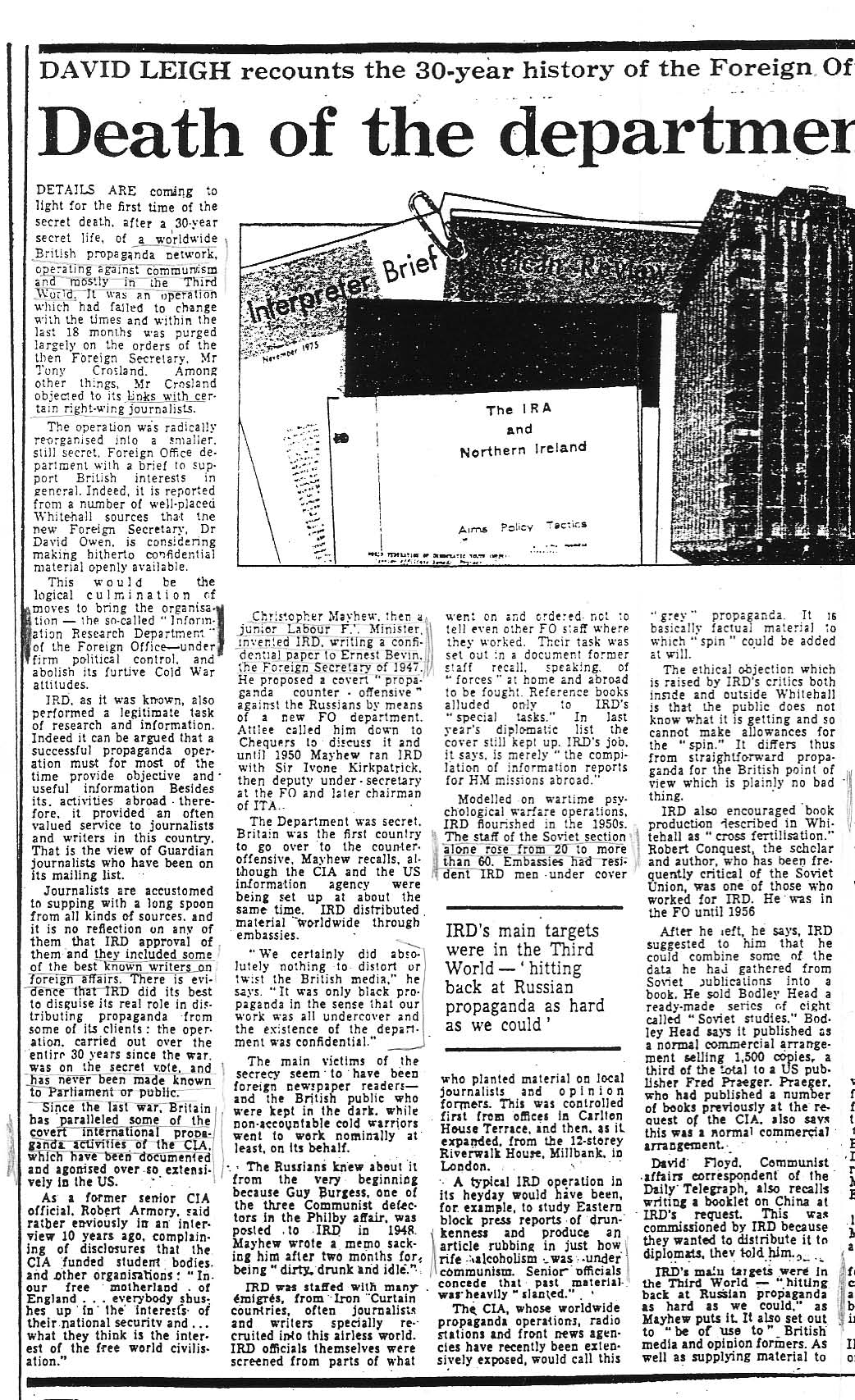
Robert Conquest has also been identified as having worked for the IRD from when
it was set up until 1956. The Information Research Department (IRD), was a
section set up in 1947 (originally called the Communist Information Bureau)
whose main task was to combat Communist influence throughout the world by
planting stories among politicians, journalists and others in a position to
influence public opinion.
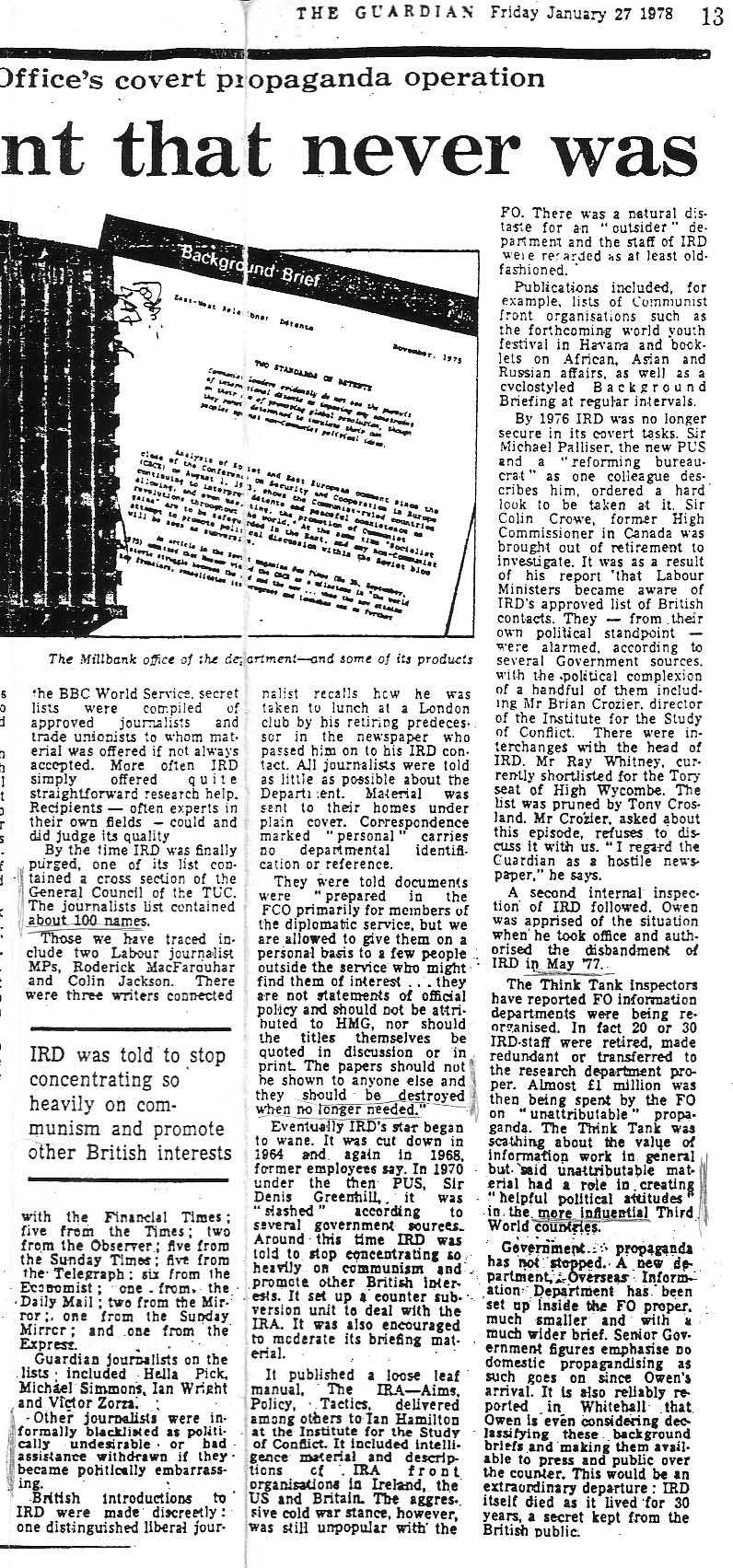
A 1978 story in the The Guardian alleged that Conquest's work there was to contribute to the so-called "black history" of the Soviet Union -- in other words, fake stories put out as fact and distributed among journalists and others able to influence public opinion.
After he had formally left the IRD, Conquest continued to write books suggested by the IRD, with Secret Service support. His book The Great Terror, a basic anti-communist text on the subject of the power struggle that took place in the Soviet Union in 1937, was in fact a recompilation of text he had written when working for the secret services.
The book was finished and published with the help of the IRD. A third of the publication run was bought by the Praeger Press, normally associated with the publication of literature originating from CIA sources. Conquest's book was intended for presentation to "useful fools", such as university professors and people working in the press, radio and TV. Conquest to this day remains, for anti-communist historians, one of the most important sources of material on the Soviet Union.
A 1978 story in the The Guardian alleged that Conquest's work there was to contribute to the so-called "black history" of the Soviet Union -- in other words, fake stories put out as fact and distributed among journalists and others able to influence public opinion.
After he had formally left the IRD, Conquest continued to write books suggested by the IRD, with Secret Service support. His book The Great Terror, a basic anti-communist text on the subject of the power struggle that took place in the Soviet Union in 1937, was in fact a recompilation of text he had written when working for the secret services.
The book was finished and published with the help of the IRD. A third of the publication run was bought by the Praeger Press, normally associated with the publication of literature originating from CIA sources. Conquest's book was intended for presentation to "useful fools", such as university professors and people working in the press, radio and TV. Conquest to this day remains, for anti-communist historians, one of the most important sources of material on the Soviet Union.
The article from _The Guardian_ in 1978
documents the propaganda activities of the IRD:
and
In his Ph.D. dissertation, but not in the book
that he wrote from it, Arch Getty pointed out:
The
dominant tendency [in writing the history of the "purges"] has
been automatically to believe anything an emigre asserted while automatically
denying the truth of everything from the Stalinist side. If one wanted a
balanced picture of Tsar Ivan IV, ("The Terrible"), one would
not accept at face value the descriptions of the exiled Prince Kurbsky in
Poland, during a period of Russo-Polish war.
If one wanted a balanced picture of
Mao Tse-Tung's regime in China, one would not accept Chiang Kai-Shek's version
in the early 1950's as essentially reliable.
If one were not interested in such
a view, one would. The apparent monstrosity of Stalin's crimes and a generation
of Cold War attitudes have contributed to what would be considered sloppy
scholarship in any other area of inquiry.
Getty also pointed out that Conquest specialized in anticommunist propaganda masquerading as scholarship while working for British intelligence.
Sometimes, the "scholarship" had
been more than simply careless. Recent investigations of British intelligence
activities (following in the wake of U.S. post-Watergate revelations), suggest
that Robert Conquest, author of the highly influential Great Terror, accepted
payment from British intelligence agencies for consciously falsifying
information about the Soviet Union. Consequently, the works of such an
individual can hardly be considered valid scholarly works by his peers in
the Western academic community.
-
Getty, "The Great Purges Reconsidered," Ph.D. disseration, Boston
College, 1979, p. 48.
In 1980 I interviewed Professor John Hazard of
Columbia University, at the time the world expert on Soviet law.
Hazard told me that people in the Soviet
studies field had told him that British intelligence was still doing Conquest's
research for him.
...Conquest (Terror, 754) ...
makes the astounding statement that "Truth can thus only percolate in the
form of hearsay." And, further, "On political matters basically
the best, though not infallible, source is rumor ... ". He believes that
the best way to check rumors is to compare them with other rumors--a
dubious procedure given the fact that emigres read each others' works. Of
course, historians do not accept hearsay and rumor as evidence in any
other field of history.
- Getty, "The Great Purges Reconsidered," Ph.D. disseration, Boston College, 1979, p. 64 note 57.
Already in 1979 Getty concluded:
The
point of view adopted here is that the standard interpretations of the
"Great Purges", such as those by Fainsod and Conquest, are seriously
flawed, cannot account for the
available evidence, and are thus no longer tenable. (53)
A good reply to Conquest's dishonesty is the
article by Robert W. Thurston,
"On Desk-Bout Parochialism, Commonsense
Perspective, and Lousy Evidence: A Reply to Robert Conquest," in Slavic
Review 1986, 238-244.
I don't see any other scholar officially in
the field of Soviet history ever daring to attack Conquest head-on in print, in
a mainstream journal.
Conquest replied in kind, trashing Thurston's
book on the history of the USSR in the 1930s when it was published by Yale
University Press in 1996. Thurston's book was by far the best book on this
period up to that point and is still the best because he rejects the knee-jerk
anticommunist, anti-Stalin line and sticks to the evidence, with only a handful
of lapses.
Thurston also published an excellent article
showing the dishonesty of the term "Great Terror" by pointing out
that very, very few people were in fact "terrorized."
"Fear and Belief in the USSR's 'Great Terror': Response
to Arrest, 1935-1939." Slavic Review 45 (1986), 214-234.
(This article elicited a hostile but very weak
response by Conquest, to which Thurston replied with the article about
"loosy evidence," quoted above.
After Conquest's book on the Ukrainian famine,
_Harvest of Sorrow_ was published in the 1980s the anticommunist experts in the
Soviet history field universally rejected it. You can read some qutatoins from
them in the article by Jeff Coplon, "In Search of a Soviet Holocaust. A
55-year-old Famine Feeds the Right." _Village
Voice_ January 12, 1988. Coplon's article, with quotations from the
anticommunist scholars, is at
Of course there was no deliberate famine. Quite
the opposite: Collectivization put an end to famines in Russian - Ukraine.
Conquest later retracted his view that Stalin
had deliberately caused the famine. I have the quotation from him in my book
_Blood Lies_.
* * * * *
After my book _Khrushchev Lied_ was published
in Russia I was interviewed by _Literaturnaia Rossia_, a literary-cultural
journal. The interviewer asked me some tough questions, which was fine!
Part of my reply was about Conquest's book _The
Great Terror_:
As a
graduate student from 1965-69 I opposed the US war in Vietnam. At one point
somebody told me that the Vietnamese communists could not be the "good
guys", because they were all "Stalinists", and "Stalin had
killed millions of innocent people."
I
remembered this remark. It was probably the reason that in the early 1970s I
read the first edition of Robert Conquest’s book The Great Terror when it was
published. I was shaken by what I read!
I
should add that I could read the Russian language since I had already been
studying Russian literature since High School. So I studied Conquest’s book
very carefully. Apparently no one else had ever done this!
I
discovered Conquest was dishonest in his use of sources. His footnotes did not
support his anti-Stalin conclusions! Basically, he used any source that was
hostile to Stalin, regardless of whether it was reliable or not.
-
"The Sixty-One Untruths of Nikita Khrushchev. " At
https://msuweb.montclair.edu/~furrg/research/litrossiainterv0608_eng.html
Conquest -- with the help of the British
intelligence service --took the lies about the Stalin period concocted under
Khrushchev and by him, added more lies from anticommunist sources in the West
like Alexander Orlov and Walter Krivitsky, and presented this as
"history."
Lots of footnotes, which are intended to fool
the educated but naive reader. But those same footnotes made it possibel for me
to discover that Conquest used phony evidence and _never_ proved "any_ of
his anticommunist, anti-Stalin claims.
25 years later, when Gorbachev took up
Khrushchev's anticommunist and anti-Stalin lies, repeated them, and added more
lies of his own, Conquest issued a new edition of _The Great Terror_ and told
everybody "I was right."
He wasn't "right." Gorbachev was
simply telling the same kinds of lies, and often the very same lies, about the
Stalin period that Khrushchev and his people had told.
* * * * *
Conquest got a lot of honours from the
mass-murdering imperialists, from Margaret Thatcher to Ronald Reagan and
beyond. He earned their praise. He also got a cushy, high-paying post at
the Hoover Institution.
Such are the rewards for telling lies on behalf
of the anticommunists.
We should realize that no one so honoured by the
chief mass murderers of world history can ever be telling the truth.
See Also :
http://democracyandclasstruggle.blogspot.co.uk/2015/06/losurdo-on-stalin-review-by-roland-boer.html
http://democracyandclasstruggle.blogspot.co.uk/2015/05/american-professor-grover-furr-told.html
Racism is Never Red : Statement of Serve the People - Norway
Racism is never red
There is nothing "red" or "left" with wanting to close the borders and stop immigration
We are concerned at what seems like a growing trend; people who call themselves red or leftist and and want to stop immigration.
It is old news that self-proclaimed socialists will stop social dumping with stricter border controls.
But it seems that the trend is growing, at least about discussions and statements in the media and on the Internet is representative.
Hans Rotmo's vulgar racist exclamation against Muslims does not come from thin air.
It seems like there are more people who share his basic attitude. Serve the People have no sympathy for this. EU and Schengen states have built a wall around Europe against the poorest and most desperate people.
It is outright killings of refugees as they do not see other ways out than to risk their lives in small boats across the Mediterranean.
And politicians agitation against beggars and attempt to harass these off the streets, show that within Europe movement be completely free - except for for poor people.
Serve the People struggles consistently against all attitudes that puts working people against working people, the poor against the poor. We are not afraid of refugees - we know them, we live together, we are refugees.
We are not afraid of migrant workers, they are our fellow workers. And we are not fighting to preserve the "welfare state" but to smash capitalism and create real security and welfare for everyone - not just those who live work in Norway.
The red attitude, the radical attitude, is basic anti-racist. It is based on proletarian internationalism, of solidarity and cohesion.
What we think of course does not mean that immigration solves social problems.
We do not believe that 8,000 refugees from Syria solves the problem of war and destruction in the Middle East.
Only Revolutions, only communism can solve these system issues. But for 8,000 people this will mean far more security than they could get if they "helped where they are".
Being able to flee war and persecution is no privilege, but should be a human right.
We think of course does not mean that Norwegian politicians are humanists.
On the contrary - they are responsible for their grotesque abuse against other people (Afghanistan, Libya) and for the inhumane asylum policy; the state racism.
We see the terrible hypocrisy of the politicians who let thousands die, negotiating the few to escape from the war they themselves contribute to (Syria).
But just as immigration and 8,000 refugees do not resolve capitalism's problems, closed borders or racism does not lead us a centimeter closer to solutions. Closed border cannot even stop social dumping.
Privatization, lower social security, crisis and liberalism comes not from immigration or refugees.
And capitalists do not need a single immigrant to lower real wages to people.
It is the very useful to these, that people turn their anger against immigrants instead of against the bourgeoisie
Racism is never red - there are no "immigration-critical" socialism.
It is at best a dead end, at worst a deeply reactionary and terribly dangerous policy that is only suited for splitting the people and preserve capitalism.
Serve the People - Norway
29/06/2015
See Also :
http://democracyandclasstruggle.blogspot.co.uk/2015/08/calais-migrant-solidarity-refugee.html
http://democracyandclasstruggle.blogspot.co.uk/2015/07/injustice-and-migrant-no-justice-in.html
Tuesday, August 4, 2015
Interview with Victor Shapinov by Alexander Chalenko : "Most imported Russian fascists are now fighting on the side of Kiev, especially since the DNR finally kicked out the fascist Petersburg Milchakova gang, which was a disgrace to the whole country and militia"
Alexander Chalenko: So Victor, you are here in Donetsk and Lugansk, in conversation with Russian volunteers who came to fight in the Donbass. Have you raised this topic with them: to what degree have their preconceptions of the Russian people in Donetsk, Lugansk, Alchevsk and other towns in the region coincided with reality? In this respect, what have they done to open themselves?
Victor Shapinov: Yes, I’ve raised it. Even laughing together, Russian volunteers jokingly say: "We thought it was the Russian people whom the Ukrainians were oppressing, and here in the Donbass it is native Ukrainians." Indeed, the average Ukrainian is more like a resident of Donbass than, say, a Galician.
Many came to defend the "Russian world,” and ended up in the midst of a civil war in Ukraine, where among the militas there may be people from Ivano-Frankivsk (I've met some), and even among the Russian-speaking majority, many are poorly understood.
And you know, the most bloodthirsty enemies of the DNR and the LC [Donetsk and Lugansk People's Republics] in Ukraine are emigrants from the Donbass, who supported the Maidan in Kiev. It is them, first of all, who call for killing their fellow countrymen, who are seen as "cattle" and “sheep.” So this is a civil war that has a socio-political nature, and the national and language questions are actually not so important.
AC: You yourself are a citizen of Russia. You've had the experience of living in Moscow. For a long time you lived in Kiev. Then after Euromaidan you lived in Kharkov and Odessa. Then in Crimea. And now in war-ridden Donbass. What are the differences between Moscow, Kiev, Kharkov, Odessa, Crimea and the Donbass? Can we say that the same Russian people live in all these cities?
VS: If one people lives in all of these cities, that people is not Russian, but Soviet. Head of the DNR Alexander Zakharchenko spoke straightforwardly on television of the "Soviet world," not "Russian.” Yes, this "Soviet world" was formed largely on the basis of Russian culture and the Russian language as the language of international communication, on the traditions of classical Russian literature and the Russian liberation movement -- from the Decembrists to the People and the Bolsheviks. But not only that. It combined the best, progressive traditions of all the peoples of the USSR.
It's like Soviet cuisine, created under the leadership of Stalin's Commissar Anastas Mikoyan, which included Ukrainian borscht and Uzbek pilaf, Caucasion shish kebab and Russian soup. The Soviet Union had a great mission of modernization. Incorporating the katsap with a balalaika and a shirt and crest with embroidery and trousers, they created the Soviet Ukrainian and Soviet Russian.
Now we see they are trying to bring back this national wildness and instill chauvinism and feudalist traditions. In Ukraine, this barbarism has taken on a truly national scope, and Dobass rebelled against that, in many respects. In Russia it is easier, but even there a lot of forces dream of a [Russian] Orthodox Taliban. Among those people in Russia who rightly hate Ukrainian fascism, there sometimes develops a hatred for everything Ukrainian; they deny the existence of the Ukrainian language, start to chatter that the Austrian General Staff invented the Ukrainians as a nation. These people do not realize that they are acting like the Ukro-fascists they hate. These people are absolutely wrong.
In its time, Germany was struck by a terrible social disease, Nazism, and a large part of the German people supported Hitler, the Germans killed and robbed the peoples of Eastern Europe. But when the Red Army drove the new barbarians back to the borders of the Reich, many said that it was necessary to destroy Germany as a nation, to kill the Germans on the grounds of nationality.
In 1944, Ilya Ehrenburg, the famous Soviet writer, wrote an article in which he called for "the complete destruction of Germany." Stalin replied, with what became a well-known saying: "Hitlers come and go, but the German people and the German nation remains." Likewise, we -- the opponents of the Kiev junta -- should say, "Poroshenko and Yarosh come and go, but the Ukrainian people remain."
AC: Can you name the differences between Ukrainians and Russians?
VS: It's a different but very similar people. But even the Ukrainian version of the Russian language is somewhat different from the Russian version. Although I have not delved much into this topic, you can reach conclusions without appeals to measuring skulls, and "blood and soil." The development of nations is a long historical period, but it is coming to an end. Humanity will sooner or later make national divisions obsolete, and the Soviet Union made important steps in this direction, forming the "Soviet people." I think the future is this, rather than finding and cultivating national differences.
AC: I repeat: Spell out the differences between Ukrainians and Russians? Let me help you. Spell out the national differences between us: you, a native of the Moscow region, and me, a native of Donetsk, who spent 30 years in Kiev, where the Soviet passport bore the name "Ukrainian.”
VS: The difference is that you are Ukrainian, and I am Russian. Once again, I'm not going to “measure skulls," but if I met you on the streets of Moscow and did not know you personally, I would have just thought you were Ukrainian. I think that, in appearance, character and temperament, is hard to imagine a more typical Ukrainian than you.
AC: If I understand correctly: I speak the "Ukrainian variant" of the Russian language, and you speak the "Russian variant” the Russian language. Could you give me examples from my speech or my articles of what you call the “Ukrainian variant” of the Russian language?
VS: Having lived for 10 years in Ukraine, I speak some mixture of these. I am not a linguist, so it is difficult for me to speak on this topic, but I think that all who have lived in both Russia and Ukraine feel the difference. I understand that you want to prove that Ukrainians do not exist, but it is not true. Among Belarusians 90 percent speak Russian and their version is closer to the Russian than the Ukrainian. However, for some reason, no one denies the existence of the Belarusian people, and Ukrainians are denied.
AC: The Russian-speaker, with little understanding of the Ukrainian language, and the Right Sector, are all, in your opinion, Ukrainians?
VS: Among the Right Sector there are Russian-speaking Ukrainians and Russians. Again, I do not think that it is a primarily national confrontation in Ukraine. Whoever thinks so, should consider all Ukrainians Right Sector and all the Russians militia. In fact, the civil war in Ukraine has divided all the people living in the country.
AC: You are a Marxist and a communist. You believe in class struggle. But the uprising in Novorossiya still goes primarily under Russian slogans, as well as under the Soviet, which, not in words but in actual fact, is mostly Russian. So the question is: why do you leftists, in this case, support the "Russian Spring", and don't consider it petty-bourgeois or bourgeois Russian nationalism?
VS: Marxists and communists have always supported the struggle against national oppression, so we are on the side of the Donbass. But there is the struggle against national oppression, and there is nationalism as the superiority of one nation, and the oppression of others. Here we are also against Russian nationalism, and if someone in the Donbas wants to oppress the Ukrainians, Jews, Tatars, or some other nation, for us they would be the same enemy as the Ukrainian fascists, trying to ban Russian language and Russian culture.
But I have not seen that in Donbass. But I have seen among the militia Tatars, Azeris, I've even met a militiaman with a Pashtun. They are fighting for the region while remaining internationalists, imbued with the spirit of friendship of peoples, which has always been the case in the Donbass.
And those in Donetsk who consider themselves Russian nationalists are more fighters against national oppression, something like the Irish Republicans or national liberation movements in the Third World.
Most imported Russian fascists are now fighting on the side of Kiev, especially since the DNR finally kicked out the fascist Petersburg Milchakova gang, which was a disgrace to the whole country and militia.
I do not think that Soviet slogans bring out the Russian nationalists. Soviet carries a strong conotation of social liberation, of anti-capitalism. This conotation was very strong in the Donbass uprising from the beginning. In the words of the late Alexei Mozgovoi: "The main enemy is the oligarchs and bureaucrats." This is a testament to the legendary brigade commander.
The very name "people's republic" comes from the “Soviet world," where there was the socialist Polish People's Republic, the People's Republic of China, etc. They revoluted not only against Kiev but against their own oligarchs. Against the "Donetsk oligarchy”: against Taruta, against Akhmetov, who tried to suffocate the revolt “in an embrace” and then "negotiate" the surrender of Donetsk to Kiev.
We, the communist left, support this original focus of the uprising, we don't want the name of the "people's republics" to remain just words. People will not fight for the restoration of the Romanov empire, these shadows of the past "don't stick." But to bring back all the gains that have been taken away from the people since 1991 – they will.
AC: But you leftists, what do you think about "spin," [looting] "basements" [detention by militia] and such practices as "shooting the leg,” which existed among the "people's commanders," behind the backs of the authorities of the DNR and LC?
VS: Regarding "spin.” There is looting, for which it is necessary to shoot. Then there is confiscation of the assets of fugitives on the side of Kiev among the bourgeoisie and officials. These are different things. "Basements" arose when the government and the legal system collapsed. Each commander became the court and prosecutor, policeman and jailer. Of course, such a system, spontaneously born from the revolution, could not be without defects and excesses. And among the “authorities of the DNR and LC,” who are themselves from among the national commanders, such excesses are not fewer than those of other militias. As far as I know, these phenomena reflect the struggle.
AC: But in the biography of Alexei Borisovich Mozgovoi were such practices as "basements" and "spin."
VS: Everyone used the “basement.” How else to punish a bully or a fighter who drank on duty? They were put for a certain period of time "in the basement,” where they engaged in socially useful work, such as digging trenches or scavenging. That certainly was the case with Mozgovoi's “basement.”
Now, once a legal system is established, the need for "basements" disappears. Alexei Borisovich Mozgovoi, and this is confirmed by my colleagues in the Ghost Brigade, was a political and honest man, with no “spin” behind him.
AC: What do you think the people in Donbass want: incorporating the DNR and LC into Russia or separate socialist republics?
VS: It is difficult to say. But I think that the question is not so urgent. It became clear a year ago that nobody in Russia was going to integrate the DNR and LC into its structure. To build socialism in such a small area with an export-dependent economy is almost impossible.
I believe that until the overthrow of the Kiev regime there will be independent states with some elements of the welfare state, a powerful public sector and nationalization of the banks. This is the most that can be expected. But when greater Novorossiya or the whole of Ukraine is liberated, then we can think about changing the capitalist model to something less cannibalistic.
Translated by Greg Butterfield
SEE ALSO:
http://democracyandclasstruggle.blogspot.co.uk/2015/05/busting-myth-of-fascists-for-donbass.html
http://democracyandclasstruggle.blogspot.co.uk/2015/07/lugansk-communist-donbass-is-in-great.html
Monday, August 3, 2015
India: Punjab - Red Salue for Comrade Karora Singh by Harsh Thakor
COM. KARORA SINGH CREMATED WITH FULL REVOLUTIONARY HONORS
A pioneer of revolutionary democratic movement, one of those who strived to free trade union movement from the narrow confines of economism and being appendage of parliamentary parties, Com Karora Singh steadfastly and devotedly worked amongst the electricity employees, dalits and poor peasants.
During the period of Khalistani terrorism in Punjab, when electricity employees were ordered to disband Technical Services Union and stop criticising Bhindranwale's communal fascist activities, he actively associated with the activities of ZABAR & FIRKAPRASTI VIRODHI FRONT (Front Against Communalism & Repression) and mobilised the electricity employees massively against killing of innocent people by Khalistani terrorists and repression unleashed by police on masses in the name of combating militancy and fake police encounters.
When Lok Morcha Punjab was formed, he as a leading activist of Revolutionary Democratic Front of Electricity Employees joined in its mass campaigns exposing the sham Indian democracy, autocratic character of Indian state and pro-imperialist economic policies.
Along with Lok Morcha Punjab, he vehemently projected peoples alternative, i.e. a society free of oppression and exploitation, based on equitable distribution of national wealth.
On his cremation a large number of revolutionary democratic organisations, trade unions and mass organisations, covered his body with their flags, and paid floral tributes raising slogans in his memory.
Com Karora Singh is immortal. We will cherish his memory, the revolutionary work done by him and very high standards of social behaviour set by him.
Calais Migrant Solidarity : Refugee protests at Eurotunnel in Calais met with police repression
During the night of the 1st to the 2nd of August, 2015 a group of migrants went to the Eurotunnel to try and cross to England. They were confronted by the Gendarmerie as they demanded freedom of movement and to be let through to the UK. After being refused and gassed at the fence, they regrouped
Calais Migrant Solidarity
Documenting police harassment of migrants in Calais and strengthening resistance against the border regime
Visit https://calaismigrantsolidarity.wordpress.com/
For more information read :
http://www.huffingtonpost.co.uk/2015/07/31/calais-migrants-crisis-myths-facts_n_7910350.html?utm_hp_ref=tw
http://mashable.com/2015/07/29/migrants-calais-uk-myths/
http://l.facebook.com/l.php?u=http%3A%2F%2Fwww.mirror.co.uk%2Fnews%2Fuk-news%2Fnot-migrant-hordes--people-6165167&h=XAQHJChOC&s=1
http://democracyandclasstruggle.blogspot.co.uk/2015/07/injustice-and-migrant-no-justice-in.html
For more information read :
http://www.huffingtonpost.co.uk/2015/07/31/calais-migrants-crisis-myths-facts_n_7910350.html?utm_hp_ref=tw
http://mashable.com/2015/07/29/migrants-calais-uk-myths/
http://l.facebook.com/l.php?u=http%3A%2F%2Fwww.mirror.co.uk%2Fnews%2Fuk-news%2Fnot-migrant-hordes--people-6165167&h=XAQHJChOC&s=1
http://democracyandclasstruggle.blogspot.co.uk/2015/07/injustice-and-migrant-no-justice-in.html
Subscribe to:
Posts (Atom)