Thursday, July 18, 2013

India : ‘After falling in love, I saw the reality of caste’: E. Ilavarasan

ilavarasan_divya-350_070513040519


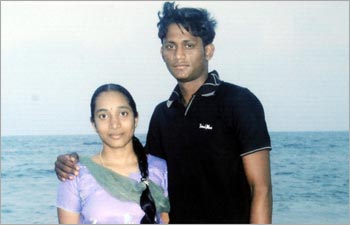
Dalit youth E. ILAVARASAN, whose marriage to a Vanniyar girl had resulted in caste violence in Tamil Nadu last year, was found dead on a railway track .


Given below is an interview Ilavarasan gave to KAVIN MALAR and was published in the Tamil edition of India Today magazine.


This translation is by PRAKASH VENKATESAN.


Did you realise you were going to be in the headlines in TN when you got married?
 
No. Certainly not. I thought ours would be just like any other marriage. Divya thought so too. We thought they (Divya’s parents) would be angry initially but can be eventually reconciled. We simply did not expect these things would happen. I now can really understand the horrendous nature of caste and the heinous things it is capable of after falling in love.
 
Why do you think Divya is suddenly saying now that she wants to go with her mother?
 
Someone is operating behind the scenes. They have threatened that her mother’s life and mine would be in danger if Divya does not return back. Probably that is why she has taken such a decision. She can’t live without me. She won’t be able to take this three weeks separation. She used to tell me often that she can’t live without me even for an hour. The plan to separate us was plotted in PMK’s head office. Now they have executed it.
 
Did you and Divya had any problems after your marriage?
 
No. We were happy. Though we were running from place to place in fear, we were quite happy to be together.
 
When did the marriage happen?
 
I was on my way to Trichy for a football match. When I was in Omalur, I got a call from Divya saying that people in her house are trying to get her married to someone else. She asked me to take her with me. We went to Andhra Pradesh and got married there.
 
How is the relationship between you and Divya’s parents?
 
Ilavarasan found dead on railway tracks yesterday.Photo by N Bashkaran / The Hindu
 
Divya’s father was a good person. He was indifferent to caste. We still don’t believe he committed suicide because of our marriage. Divya’s mother, she was not that opposing either. After our marriage her brothers are not talking to her. But people around her are instigating her. They knew that I was going to get an appointment order to join the police force and filed a case against me and deliberately made efforts against it to get the order cancelled. These were not done by her mother. She is being compelled by people of her caste to do these deeds
 
How did you feel when three Dalit villages were burnt in Dharmapuri?
 
Guilty. We even thought about committing suicide. Not even in our dreams we thought her father would commit suicide. She was deeply affected by her father’s death. She cried a lot.
 
We can not forget that November 7th. People from her side said they want to meet Divya and take her back with them. I told them it is certainly possible to talk. In November 7th, a meeting was arranged between both the sides in Thoppur. Her father was not present there. Divya’s mother asked her to return back but Divya firmly refused. Half an hour after the meeting we got the news of her father’s suicide and villages being burnt. We saw it in TV. The caste in which I was born into is their problem. People who are capable of doing these deeds can go to any extent.
 
What are you going to do to get Divya back?
 
I will keep on fighting. Authorities know who burnt three villages. But they have not taken any action. They have to. They have to publicly announce where Divya is. They have to investigate and publicly announce about the people who are directly and indirectly trying to separate us. The decision to be separated would not have been from her heart. I want to talk with Divya first. After that, am quite certain everything would be okay.

Tuesday, July 16, 2013

Ganti Prasadam - His Legacy Cannot Be Erased by N Venugopal


Assassinated by the enemies of the people on July 4 in Nellore, Ganti Prasadam’s legacy, which has taken root in the political culture of the Maoist movement in Andhra Pradesh, will grow and bear fruit.

N Venugopal (venugopalraon@yahoo.com) is the editor of Veekshanam, a Telugu monthly journal of political economy and society.
 
With the ghastly assassination of Ganti Prasadam, a popular Maoist ideologue, trade unionist, writer and public speaker, on July 4 in Nellore, the state seems to have thought it has succeeded in intimidating those who question its brutalities. The horrifying murder might have been planned as a threat to all those involved in public activity through democratic forums.

However, on his death bed – with two surgeries to remove the three bullets that had pierced his abdomen and spinal cord, and to treat the deep wound on his neck, the result of being hacked with a coconut knife – Prasadam said that the assassins may be able to kill him but his spirit would not die. Thus the assassins and those behind them failed; within a few hours of their dastardly act, the fact that Prasadam’s persistent spirit lived on in the movement was proved in the massive and spirited funeral procession a day later at Bobbili town, 750 kms away from the place of assassination.

Ganti Prasadam’s life stands as an example of human diversity and versatility, and his death, of the state’s violence and viciousness. For more than 45 years of the 64 years of his life, he worked both in legal, open, democratic as well as clandestine organisations. He was implicated in more than a dozen cases (in most of which he was acquitted) and spent about three years in various jails. Beginning his political life as a trade union organiser in Bobbili town in Srikakulam (currently in Vizianagaram) district in 1972, his activities extended to almost all social spheres and spread across the state – among students, youth, writers, workers, relatives and friends of martyrs, and in the party, the underground alternative press and the democratic rights movement, as also among political prisoners. At the time of his death, he was honorary president of the Amarula Bandhu Mitrula Sangham (ABMS, the Association of Relatives and Friends of Martyrs), Andhra Pradesh, all-India vice president of the Revolutionary Democratic Front (RDF) and executive member of the Committee for the Release of Political Prisoners (CRPP).

Born into a middle-class Brahmin family of Chakarapalle in Balijapet mandal in 1949, Prasadam had his education in Bobbili. At a young and impressionable age at the time of Srikakulam struggle, he came under its influence as he finished his graduation in 1970. The town was one of the first industrial centres in the region with thousands of workers in sugar and jute mills and vibrant trading activity. By 1972 Prasadam became an important activist in the town and founded the Kalasi Sangham (porters’ union).

On the Revolutionary Road

Prasadam’s entry into trade union politics synchronised with the reorganisation of Naxalite forces in the state in the aftermath of heavy losses in Srikakulam. Viplava Rachayitala Sangham (Virasam, the Revolutionary Writers’ Association), formed in 1970, and Jana Natya Mandali, formed in 1972, were keeping the torch of Naxalbari politics aflame and naturally Prasadam became active in both these organisations. His mentor, Mamidi Appalasuri was a follower of Charu Mazumdar and was an elected member of the Central Committee of the Communist Party of India (Marxist-Leninist) [CPI (ML)] in 1970. However, the party split after the death of Charu Majumdar, and Appalasuri, along with Kondapalli Seetaramaiah (KS) continued the legacy of the CPI (ML) even though contacts with other states got cut off. By 1974 the contacts with other states were revived and the Central Organising Committee (COC) was formed and Prasadam continued to work in his trade union and in Virasam and JNM under this party’s guidance.

After a couple of arrests and attacks from police and mill owners, Prasadam had to go underground during the Emergency. He was arrested in 1977. By the time he was released, differences were building up between KS and Applasuri finally culminating in the latter remaining in COC and the former setting up the CPI (ML) AP State Committee, which became the CPI (ML) (People’s War) in 1980. Prasadam continued to be with Appalasuri as the latter merged his party with the CPI (ML) Party Unity in 1982. During this time, Prasadam became a popular trade union leader in Bobbili and formed at least 30 workers’ unions in various fields, including among hotel workers, cinema theatre workers, mill workers and khalasis, in the town, and founded a coordination committee of all these unions. With the death of Appalasuri in 1997 and the merger of CPI (ML) Party Unity with the CPI (ML) (People’s War) in 1998, Prasadam became part of People’s War and went underground once again. In the meanwhile, Prasadam’s younger brother Ganti Subrahmanyam (Rajanna, Ramesh) who was with People’s War was killed in a fake encounter in Kopardang in Rayagada district of Odisha in August 1998. Becoming a member of the AP State Committee of People’s War, Prasadam took charge of the party press, particularly Kranti, the State Committee’s monthly organ and continued in that position even after the CPI (ML) (People’s War) became CPI (Maoist), till he was arrested in May 2005.

The CPI (ML) (People’s War) was a banned party then and the ban was relaxed in July 2004 as it was invited for talks by the state government. The first round of talks were held in October 2004 and the second round, scheduled to be held in November of that year, could not take place as the state government went back on its ceasefire agreement and began repression and fake encounters. Finally in January 2005, the party announced that it was also moving away from the ceasefire. In that context, the party gave the responsibility of assessing the existing situation to Prasadam and he in turn wanted to have feedback from various sources sympathetic to the movement.

Since the state had begun heavy repression by that time, he wanted to meet his sources outside Andhra Pradesh and asked a team of four members of Virasam to come to Aurangabad to brief him about the obtaining situation. He met the team at Maharashtra Tourism Guest House in Aurangabad for a three-day conversation and at the end of the second day itself police swooped on them. All of them were blindfolded, tortured and kept in illegal custody for three days before being produced in a court in Nizamabad, charging them in what became the Aurangabad Conspiracy Case. In fact, the party was not banned then and there was nothing illegal or conspiratorial in the meeting. While he was in jail in this case, which was finally struck down in 2010, he was implicated in half a dozen other cases, including an attack on a police station and a failed attempt on a Superintendent of Police, in both of which he was acquitted later.

In the Open Front

While the trials were going on, he came out on bail in late 2006 and since then he had been working openly. He joined the ABMS and became its president. In that position he was always rushing to the spots of fake encounters, exposing the real, cold-blooded nature of the killings, consoling the family members of the deceased, and organising memorial meetings. Thus, he and the other members of the ABMS became a constant threat to the police. As he held the position of the party spokesperson before his arrest, all the mass organisations were also looking up to him for his advice and guidance in their activities. The police could not tolerate this and he was implicated in more cases so as to hamper his movements and engage him more in attending to court matters. To further restrict his movements, the police tried to keep him behind bars in fresh cases.

When a group of people, including Sireesha, the partner of Ramakrishna, Central Committee member of the CPI (Maoist) and one of the chief representatives of the party at the 2004 talks, were intercepted while going into the Odisha forests near Simliguda in Koraput district on 13 October 2010, Prasadam was accused of sending them there and he was implicated in the case under the Unlawful Activities (Prevention) Act (UAPA). When he was in jail, the Malkangiri collector Vineel Krishna was held hostage by the Maoist guerrillas, and during the process of negotiations, Prasadam was named as a probable candidate for continuing the talks. G Haragopal and Dandapani Mohanty, interlocutors at that time, went to meet Prasadam at Bhubaneswar jail. Haragopal recollected that Prasadam was so considerate and humane that even as one of the CPI (Maoist)’s demands was his release, he declined to come out and instead asked for the release of hundreds of tribal persons implicated in false cases.

He came out on bail after a couple of months and not only revived his work in the ABMS, but also began working in the RDF and the CRPP. He became one of the two vice presidents of the RDF at its national conference held in April 2012 in Hyderabad and within a short time the government of Andhra Pradesh imposed a ban on the organisation. He was also active in the CRPP and, in that capacity, contacted and provided for the requirements of political prisoners in almost all the jails in Andhra Pradesh.

A Committed Political Life

Prasadam was also an accomplished writer and cultural activist, beginning his career with poetry and songs and moving into theoretical and polemical writing. He penned a number of essays in Kranti without a by-line and in several other Telugu journals under his own name and various pseudonyms. In the last eight years of his public life, except for a little more than two years in jail, he gave most of his time to mass activity, writing, inspiring and organising people, mobilising people into purposeful activity, addressing meetings, sitting in protests and demonstrations, supervising post-mortems and taking over the dead bodies of those killed in encounters to hand them over them to their families, and organising humane and respectful funerals of all those martyrs, etc.

Indeed, the last three days of his life would explain what kind of life he led. On July 2 he spent hours with railway workers discussing intricate points about the forthcoming negotiations with their management and took a bus to Guntur to address a memorial meeting the next day. On July 3, it was a meeting to pay homage to a senior respected writer who spent at least ten years underground as part of the CPI (ML) (People’s War)’s press team after his retirement as a teacher. After this meeting, he travelled to Nellore where the relatives and friends of those who were martyred in a fake encounter that took place twenty years ago hold a commemorative meeting every year on the same day. Since it was also the formation day of Virasam, the revolutionary writers’ association also holds a seminar on related topics there every year. Prasadam addressed the seminar in the forenoon session and went to see the sister of a martyr who was in a hospital and almost in her last days. He was to come back to participate in the afternoon session, but while he was coming out of the hospital and walked a few yards, an assailant fired at him. To make sure he was dead, another assailant snatched a knife from a nearby coconut cart and hacked him on the neck. He was immediately rushed to the hospital and in two consecutive surgeries three bullets were removed from his body. All through he was alert and conscious, and spoke to the attending doctors.

Given this uninterrupted track record in public activity and steadfast commitment to revolutionary politics, it is but natural that he earned the wrath of the powers that be, particularly the police in Andhra Pradesh. Indeed, the track record of Andhra Pradesh police in eliminating radical voices in public life through extra-judicial methods is quite notorious. They have their own invention of “encounter” killings to “bump off” (these are the exact words used by the then home minister while ordering one of the early killings in 1969) armed cadre after catching them unarmed. For dealing with public personalities who are seen as thorns in their beds to be removed, the police have evolved another method of using hired brute forces without soiling their own hands. The list of public personalities killed in this manner is very long: Gopi Rajanna, Narra Prabhakar Reddy, and T Purushottham, all advocates, A Ramanatham and A Narayana, highly respected doctors, Japa Lakshma Reddy and Kalinga Rao, both farmers and mass organisers, Azam Ali and Kanakachary, teachers, Belli Lalitha and Ilaiah, singers, and Muneppa and Mannem Prasad, dalit activists. One can add dozens of attempts and threats to this list.

While the earliest of these murders took place in 1984 and the latest in 2005, it would be interesting to note that in all these cases, there was no investigation, no trial and no punishment of the culprits. Most of these murders were claimed by one or the other paper-organisation floated for the purpose and the police neither investigated nor publicised who were behind these organisations. It was everybody’s guess that the police bigwigs were the mentors, godfathers and protectors of these mercenaries. Keeping this history in mind, almost everybody pointed at the police for Prasadam’s murder even though a fake organisation staked claim. Strangely, this time around, the AP Police Officers’ Association came out with a statement denying their role, which ended with an open threat.

Prasadam bequeathed his legacy in a number of long-lasting tangible effects – his writings, public speeches, a sturdy organisation, and exemplary human relations. “Save me, I want to live to see the revolution” and “It seems I am going to die, but it will be the death of a single person, not of his spirit” – these were some of the precious sentences he uttered on his death bed. The unmistakable hand of the murderous state will not be able to erase this legacy.

SOURCE: Economic and Political Weekly

Friday, July 5, 2013

Restricted Service unitil 15th July 2013

We will be offering a restricted service until 15th July 2013 because of technical problems

The Indian Press mouthpiece of India State : They Praise a Renegade while they kill a Revolutionary

How Nepali Maoists chose democracy

Prashant Jha, The Hindu
Pushpa Kamal Dahal ‘Prachanda’. Photo: Sushil Kumar Verma
 
Democracy and Class Struggle contrasts the killing of Ganti Prasadam with the praise for Prachanda in the Indian media, nothing can be more stark.
 
The recent Prachanda condolences for Salwa Judam founder we thought was the bottom of the pit from Prachanda, but he always exceeds himself, This time in praise of the Indian Comprador State saying about India "Our relations must be the best example of bilateral ties in the rest of the world.”


Prachanda talks of how his party made fundamental changes to its ideology
 
In August 2010, at the nadir of relations between India and Nepali Maoists, the former Foreign Secretary, Shyam Saran, went to Kathmandu as Prime Minister Manmohan Singh’s special envoy.

With the Maoists blaming India for blocking their ascent to power, Mr. Saran conveyed a clear message to Maoist chairman Pushpa Kamal Dahal ‘Prachanda’: “You can either be a revolutionary force with a coercive apparatus or a civilian party abiding by the discipline of multiparty democracy. Make a choice.”
 
Almost three years later, Mr. Prachanda — at a function chaired by his ‘old friend’ Mr. Saran in the Indian capital on Monday evening — declared that the party had made a choice in favour of ‘democracy’ and ‘progressive nationalism.’
 
The Maoist leader announced that his party, through a national congress in the southern town of Hetauda in February, made three fundamental changes to its ideology.
 
“One, we have accepted peaceful transition, peaceful multiparty democratic politics.” Mr. Prachanda referred to the integration and rehabilitation of the ‘Maoist armed cadres’ as proof, and pointed out, “My party has also given up its ruling mandate, to form a government led by the Chief Justice, to hold elections in a free, fair, and acceptable manner.”
 
The second shift was the ‘focus on economic prosperity and development’ as a party strategy. He thanked India for being Nepal’s biggest development partner, sought investment in a range of sectors, and said, “Economic development is essential for political stability, and a prosperous and developed Nepal will help address the security concerns of our neighbours.”
 
He also floated the idea of ‘trilateral cooperation’ between China, India and Nepal in hydropower and for the development of Lumbini. Mr. Prachanda was quick to add this was a ‘long-term vision,’ not meant to ‘undermine or replace’ bilateral relations between the countries.
 
And three, in a reference to apprehensions about the sporadic ‘anti-Indian’ rhetoric emanating from the Maoist leadership and its broader strategic vision, Mr. Prachanda said, “For the first time, we have criticised narrow nationalism, feudal nationalism and adopted progressive nationalism. We want good relations with India. Our relations must be the best example of bilateral ties in the rest of the world.” He added that on his visit to Beijing last week, where he met President Xi Jinping, the Chinese leadership too encouraged them to have good ties with India.
 
This, Mr. Prachanda said, was where they differed with the “dogmatic and sectarian” view of extremist colleagues like Mohan Vaidya ‘Kiran’, who have split and continue to criticise Indian ‘expansionism’.
 
So why did he not make the choice earlier? In a meeting with National Security Adviser Shiv Shankar Menon on Monday morning, Mr. Prachanda said that had he acted earlier, the “engine would have moved, but the bogies would have got left behind.”
 
“It took time because we were attempting something unique, and needed to get our cadre and machinery along. But now, the choice is made,” he told The Hindu.


Prachanda makes it appear that the turnabout was a political version of a religious experience, but the "born-again bourgeois" actually prepared this reversal and capitulation and betrayal over many years. 

Still, his sugary description of the lure is a near-textbook example of the peaceful road to integration into the bourgeois/feudal state machine and capitulation to India and China and the Western imperialist powers.

Comment from Frontlines of Revoltionary Struggle USA
 

Condemn Strongly the Ghastly Murder of Ganti Prasadam, the Vice President of RDF by State-Sponsored Vigilante Gangs!


COMMITTEE FOR
THE RELEASE OF POLITICAL PRISONERS
185/3, FOURTH FLOOR, ZAKIR NAGAR, NEW DELHI-110025
 
05/07/2013
 
Condemn Strongly the Ghastly Murder of Ganti Prasadam, the Vice President of RDF by State-Sponsored Vigilante Gangs!
 
Constitute Immediately a Judicial Inquiry into the Killing of Ganti Prasadam by Vigilante Goons!
 
 
Ganti Prasadam, the All India Vice-President of Revolutionary Democratic Front (RDF) as well as the Executive Member of the Committee for the Relatives and Friends of Martyrs, succumbed to the brutal and fatal attack on 5 July 2013 on him by unidentified gunmen in Nellore town. He was fatally wounded on his his neck with hunting sickles and later shot at with a pistol on the 4th afternoon. Comrade Ganti Prasadam was at Nellore to attend a public meeting of the Martyrs’ Committee held every year to remember the martyrs of Nellore. He bacame the target of the waiting goons when after the meeting, along with three of his associates of the committee he was on to visit one of the ailing relatives of a martyr at a local hospital. 
 
Ganti Prasadam was operated on after receiving bullet injuries and the doctors were trying in vain to remove the third bullet which was dangerously close to his spinal cord. Comrade Ganti Prasadam this time could not sustain his arduous struggle to keep up his breath.    
 
Given the notorious anti-people track-record of the intelligence agencies in Andhra Pradesh which have resorted to the worst kinds of atrocities on the struggling oppressed people of the region, be it naxalites, adivasis, dalits or Muslims, this murderous operation is reminiscent to the dastardly assassination of people’s political, social and civil rights activists in the past 40 years. Dr. Ramanadham, Purushottam, Jappa Laxmana Reddy, Prabhakar Reddy, Kanakachari, Azam Ali, Belli Lalita are a few examples of dedicated people’s leaders and civil rights activists targetted by the state in Andhra Pradesh in the past. The state government cannot shy away from this glaring fact. All of us are witness to the heinous and pre-meditated ways in which the intelligence agencies of Andhra Pradesh have criminalised and specifically targeted the Muslim youth and their leadership. Specific targeting and criminalising the leading activists of the Telangana movement through false cases and incarceration is also before us. All these desperate designs of the state has never deterred the people of the region from raising their voices for their genuine and just demands.
 
Comrade Prasadam represented this spirit of the people of Andhra Pradesh as he, despite being incarcerated several times behind bars with trumped up cases was one of the tireless voices who became part of every meetings and demonstrations demanding the unconditional release of all political prisoners. While being in the prison in Orissa, he went on a hunger strike demanding the release of all political prsioners in the prisons of Orissa, mostly adivasis, dalits and people working against all kinds of displacement that had gripped the rural areas of Orissa. Any form of dissent in Orissa in these times are deemed ‘unlawful’ and hence to be tried under the worst kind of dracnian laws. As part of further crimialising any kind of political mobilisation that makes a scathing indictment of the anti-people policies of Liberalisation-Privatisation-Globalisation, the Andhra Pradesh government have banned the RDF in which Ganti Prasadam was elected as all India Vice-President.
 
CRPP is one with all progressive and democratic forces to condemn the assassination of Com. Ganti Prasadam. It is important at this juncture to see through the desperate designs of the state and its murderous, lawless agencies—all terrifed with the deepening economic crisis and the ravages that it has created among the powers that be along with the increasing resentment of the people against the dog-eat-policies of the governement—to somehow browbeat the toiling masses of the people into submission. What is of utmost significance is to join hands to defeat such evil designs of the state by once again intensifying our resolve to fight against all anti-people laws, anti-people policies, and the increasing tendencies of the Indian state and their representatives in the Andhra Pradesh government to criminalise all forms of dissent of the people for their struggle for a better future free from all forms of exploitation and oppression. We at the CRPP demand that a judicial inquiry be constituted immediaely into the assassination of Com. Ganti Prasadam and the culprits be brought to book without delay. Only the vigilant masses and their fearless resistance against all anti-people policies and the increasing fascisation of the state can ensure that such evil designs of the state be checked.
 
In Solidarity,
 
SAR Geelani
President
 
Amit Bhattacharyya
Secretary General
 
Bojja Tarakam
President AP Chapter
 
Balla Ravindranath
Secretary, AP Chapter
 
Rona Wilson
Secretary Public Relations
 
Democracy and Class Struggle  Justice for Ganti Prasadam, natural justice - social justice call it what you will the justice that people recognise and want, one of India's best sons has been murdered by his own government and his murders roam free.

There is no justice from the Indian comprador State there is only the justice from the People.

Thursday, July 4, 2013

India: Comrade Ganti Prasadam Vice President of Revolutionary Democratic Front, a popular revolutionary mass leader, attcked by a 3-member state-appointed gang of vigilantes with hunting swords and a pistol.


A cowardly attempt was made late this afternoon in Nellore on the life of the Vice President of Revolutionary Democratic Front, Comrade Ganti Prasadam, a popular revolutionary mass leader, by a 3-member state-appointed gang of vigilantes with hunting swords and a pistol. He is being operated upon in a hospital at Nellore; doctors were last reported to be still trying to remove a third bullet. His condition is extremely critical at the moment. Let us join in condemning this dastardly attack!
 

G N Saibaba

Democracy and Class Struggle calls for solidarity with Comrade Granti Prasadam and demand that the State appointed vigilantes be brought to justice immediately.

Our heart goes out to Comrade Ganti Prasadam and we wish him strength to survive this attack.


Former Naxalite Ganti Prasadam severely injured... by tv9telugu

REVOLUTIONARY DEMOCRATIC FRONT (RDF) – PRESS RELEASE – 4 July 2013

Comrade Ganti Prasadam, the All India Vice-President of Revolutionary Democratic Front was brutally and fatally attacked by some unidentified gunmen in Nellore town today in the afternoon. The attackers first slew him on his neck with hunting sickles and then shot at him with a pistol three rounds. Comrade Ganti Prasadam is critically injured in the assassination attempt and at present he is being operated in a hospital in Nellore.

According to the doctors who are working on him, his condition is extremely critical. Comrade Prasadam has been also serving on the Committee for the Relatives and Friends of Martyrs as an Executive Member. He arrived at Nellore today to attend a public meeting of the Martyrs’ Committee, which is being held every year on 4 July remembering the Martyrs of Nellore. After the meeting, accompanied by three other members of the Committee he went to visit a family member of a martyr, who was hospitalised in a local Government Hospital. An assassination team of three were in waiting to swoop on him when he came out of the Hospital.

In flash of a second they attacked Comrade Ganti Prasadam, before the other comrades realised of what was happening. When they tried to catch hold of murderous gang, they ran away leaving the swords behind. Two bullets have been removed from his body so far in hours-long operation. The doctors have been maintaining that they cannot give any assurance of his safety till they could remove the third bullet, which has entered in a critical position near spinal card. RDF believes that the assassination attempt on our Vice-President is designed and carried out by none other than the state intelligence agencies in charge of anti-Maoist operations in Andhra Pradesh.

The state has clearly involved in the murderous attack, as Comrade Prasadam could not be cowed down by a huge number of cases fabricated on him apart from incarcerating him in prisons from time to time. The state government banned our organisation soon after the first Conference of RDF in Hyderabad in April 2011, in which Comrade Prasadam was elected as all India Vice-President. RDF condemns this assassination attempt in strongest terms and appeals all democratic organisations and individuals to join us in these moments of grief and sorrow, and condemn the attack and its conspirators in unequivocal terms.

The Government of Andhra Pradesh is directly responsible for the attack. In Andhra Pradesh, such attacks of assassination of people’s political, social and civil rights activists have been not uncommon in the past 40 years. Dr. Ramanadham, Purushottam, Azam Ali, Belli Lalita are a few dedicated people’s leaders and civil rights activists who were targetted by the state in Andhra Pradesh in the past. History has proved that such attacks on people’s activists in the past never brought an end to the people’s movement. In fact the mass resistance movement of people in Andhra, Telanagan and in the entire subcontinent is on the rise in the recent months and is going to engulf the anti-people pro-imperialist comprador ruling classes along with their reactionary counterparts in rural regions.

Varavara Rao President, 09676541715

Rajkishore General Secretary, 09717583539

Gilbert Achcar on the Egyptian Army and the Ousting of Morsi from Power


We do not see in Egypt the three magic weapons that Mao Zedong said that are  required for the science of revolution.

The  Revolutionary Maoist Communist Party, the People's Army and the United Front.

There is still no Mao from the Nile Delta so feared by the Nasserists, Islamists and the Imperialists.

However Marxism Leninism Maoism is still young and is a powerful ideology that will grow expotentially in periods of revolutionary crisis like the current one has people seek answers has to why the movements are being hi jacked by the elites.

See Also :
http://democracyandclasstruggle.blogspot.co.uk/2013/07/egypts-morsi-ousted-cairo-explodes.html

http://democracyandclasstruggle.blogspot.co.uk/2013/06/fakeing-revolution-otpor-promoting.html

Wednesday, July 3, 2013

On International Solidarity: Some Questions of Principle by Jan Myrdal


Dear friends!

Palestine and Kashmir are both under foreign military occupation and we all are here to express our solidarity with the Palestinian and the Kashmiri people.  In both cases this occupation and the periodically violent conflict with the occupiers has been going on for more than sixty years. The history of popular solidarity work in metropolitan and other states of our kind with people suffering under colonial and imperial rule is of course much longer. I thus here now want to raise and discuss some experiences.

I will begin by saying something we always ought to be aware of. Solidarity is not a question of doing something for others.  This is not a truth just for the present. You know the words of John Donne from 1624: ”No man is an island…”. In present political terms we know that Marx in the nineteenth century pointed out that the struggle against the oppression of the Irish is necessary for the liberation here in Britain.

But there is a difference between the social and political  work we take part in directly, you in the UK or we in Sweden, and our solidarity work. The solidarity work is has a different agenda. Some here might have come directly from Palestine or Kashmir and are thus a part of that present struggle. But I as a Swede must understand that it is not for me to say how the struggle for national independence in Palestine and Kashmir is to be conducted. I might have opinions. That is another thing. But the decision on how to struggle is not for me.

Nearly two generations ago we built a Swedish mass movement for solidarity with the peoples  of South East Asia in their national struggle against French colonialism and the United States war.  We did it independently and from below, outside parties. We expressed our principle of solidarity  to to the representatives from South East Asia as ”solidarity on your terms”. It was for them – not us to decide.  Why did we express ourselves in this way?  We had summed up the experience of anti-colonial and anti-imperial and peace movements the last more than hundred years! Those of you who are from South Asia know the detrimental effects of well meaning outside advice and interference during the liberation struggle in the nineteen-thirties and forties.

During the first years the solidarity work against the United States war in South East Asia was an uphill struggle Not only the mass media were against us. Militants lost their jobs, both the security police and the regular police were used against us. Towards the end of 1967 the government even – for the first time in Sweden since 1917 – set in had mounted police against our peaceful demonstration. I too was beaten up, jailed and was to be given a four year jail sentence. But we had at that time such a strong following that the government changed policies. If you can’t beat them – join them! And in the next demonstration Olof Palme, then minister for education, later prime minister,  led the demonstration. Of course the United States government was furious at Sweden. Our movement had by keeping a principled line and through talking with people, selling bulletins, demonstrating and holding meetings  grown to a mass movement and thus been instrumental in changing the official Swedish policies. Which was good for our own independence as a nation.

I will say this still more concretely. Twelve years before my birth Norway fought for independence from the union with Sweden. What I could call ”we” in Sweden, the labour movement and the socialist youth league, were not only active but were a determining force in stopping the ruling class in Sweden from going to war with Norway.  The leader of the Swedish Social Democracy, Hjalmar Branting, was sentenced in 1895 for warning the government that their policy could result in ”a bullet” against the or those for war responsible. Ten years later when the crisis became acute the socialist youth league spread the word among the recruits of our conscript army that in case of war against Norway they should turn their guns in the right direction; the officers of the Swedish army had to be shot before they could give any orders. That open threat of civil war scared the ruling class and it did not chose war but let Norway go. But remember – these I rightly can call ”we” did not interfere in Norwegian affairs. They surely were not in favour of the Norwegians opting for monarchy for instance. But that was a decision only for the Norwegians.

As we all know, or should be aware of, the freedom of the media in countries of our type will be restricted when the dominant forces deem it in their interest. The gate keepers of the official media earn their pay by keeping the public misinformed. But still it is normally in our countries not in the strict sense illegal to spread information that is being kept out of the media. Thus the solidarity work to a large extent becomes supplying basic information. I don’t think ordinary people in this country have a clear understanding even of the great crime in Palestine 65 years ago: Al nakba. Then 750 000 Palestinians were driven from their land upon which the state of Israel then  was erected and the evicted Palestinians forcibly, at gun point, were forbidden ever to return.

This crime is continuing as settlers, many of them coming from Sweden or the United States or Eastern Europe, contrary to all international law build their villages on Palestinian land that was occupied by Israeli forces in the last violent annexation campaign. They try to sell the products from this illegaly occupied land in our countries. In Sweden we agitate against this. Inform, demonstrate. Show that the managers of the food chains selling this are in fact receivers of stolen goods.

Now and then governments and politicians from the United Kingdom, the United States and other of our countries mutter. But they do not stop the Israelis.The reason is clear, if you go back to the First World War you find that that the present policies supporting the state of Israel are a continuation of that economic and military Great Game in West and Central Asia. This truth has to be clarified in order to gain popular support in our countries for the freedom struggle of the Palestinian people.

At times there have in fact been attempts through the United Nations to reach a solution that was not a continuing crime against the Palestinian people. But when the Swedish count Bernadotte came forward with such a plan then Yizak Shamir – who later became prime minister of the Israeli state – just had him murdered. It is important for us in Sweden to keep making this murder known. Pro-Israeli groups have after the murder tried to slander him as pro-nazi  He was not. He was a normal member of the royal family, not a revolutionary but as head of the Swedish Red Cross he managed at the end of the war to get Himmler to let at least Scandinavian prisoners out of the German concentration camps. He saved some 15 000 prisoners from different countries. He was murdered 17th September 1948 as he was putting forward a solution that went against the plans of the extreme sionists.

This murder was swept under the carpet. As far as the governments of what is callet ”the west” are concerned there will be no reaction against the continous crimes of the Israeli state against the Palestinian people. If we are not able to organize and put such an internal pressure on them that they have to act that is.

Here we must be able to see clearly with whom can we cooperate in this work. Let me take an example. In the nineten-fifties, during the beginning of the war for national liberation in Algeria I lived in Paris. Who supported the Algerian people in their struggle? Not the big and then still officially revolutionary labour movement and their notables. It was small ultra left groups as the FCL ”Féderation communiste libertaire” and the PCI, ”Parti communiste internationaliste”, a catholic writer, member of the French Academy who had just received the Nobel Prize,  François Mauriac and then different writers and intellectuals generally. There are reasons for this. I can discuss them another time. But the pattern is the same today in the very broad solidarity movement with Palestine in Sweden. Several Christian organizations, many of them inside the Swedish Church are from a humanitarian stand very active in support of the Palestinian people and their rights.  Yes, allies in the solidarity work can often be found in unexpected places. Or as Fidel Castro said when I was in Cuba 1967 making a film: ”A catholic priest taking a stand for the rights of the poor and oppressed is a friend of the people whereas an officially communist party that stands aside is not.”

It is also necessary to also closely watch the contradictions among the ruling circles. That the Swedish government of that time early on took contact with the Algerian liberation movement and then also as a first state established diplomatic relations with Algeria was important.


Egypt's Morsi ousted - Cairo Explodes


Democracy and Class Struggle welcomes the exposure of the Muslim Brotherhood in Egypt but is well aware that other pro - neo liberal contenders are trying to hi jack the people's movement, we have warned about Otpor but they are only one of many organisations and states like Qatar and Saudi Arabia trying to subvert the Egyptian Revolution, until a revolutionary party, a united front and people's army come into existence in Egypt guided by Marxism Leninism Maoism there will be no permanent gains from the struggle.

Democracy and Class Struggle agrees with the 2011 comment of Gilbert Achcar on the Egyptian Military

"Egypt – even more than comparable countries such as Pakistan or Turkey – is in essence a military dictatorship with a civilian façade that is itself stuffed with men originating in the military. 

The problem is that most of the Egyptian opposition, starting with the Muslim Brotherhood, have been sowing illusions about the army and its purported “neutrality" if not “benevolence.”

They have been depicting the army as an honest broker, while the truth is that the army as an institution is not “neutral” at all.

Democracy and Class Struggle says do not forget the  $1.3 billion in annual U.S. military aid to Egypt.

Just in case you thought the Egyptian Military has had a sudden conversion to democracy be reminded who was first to congratulate them  

Saudi King Abdullah Bin Abdul Aziz congratulated the newly-appointed Egyptian interim President, Adly Mansour, on Wednesday.