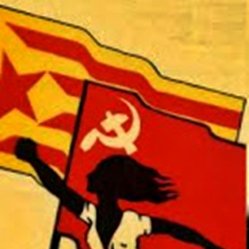
Monday, October 30, 2017

The October Revolution and The National and Colonial Question


Democracy and Class Struggle publishes a chapter of the Marxism Leninism Maoism textbook of the CPI Maoist on the National and Colonial Question.

The recent wave of Imperialist Economism on the Left in Europe around Catalonia has been exposed by Maoist comrades in France and Italy and Spain and shows how critical the national question is when confronting modern revisionism and its trotskyist incarnation and the ideological if not yet organisational strength  of Marxism Leninism Maoism in Europe

The earliest national movements arose in Western Europe. These national movements were mainly led by the bourgeoisie in their fight against feudalism. The main aim of these national movements
was to unite into one nation and state a large territory, which was under the rule of numerous feudal lords. This was necessary for the bourgeoisie to get a single large market and to avoid the harassment and domination of the various feudal lords.

Thus the bourgeois revolution against feudalism and the national movement to establish a single nation-state often combined into one. Thus the national movement was not normally a struggle for independence from oppression by another nation. In the whole of Western Europe, the only place where a national movement for independence took place was when Ireland fought to free itself from Britain.

Marx and Engels lived in this period, when the later national liberation struggles were yet to break out in a major way. They thus did not devote much attention to developing Marxist theory on the national question. Marx however formulated the basic stand in relation to the Irish Question by calling on the English proletariat to support the national struggle of the Irish people and oppose its national oppression.

The next phase of nationality movements came in Eastern Europe, with the spread of capitalism, and the weakening of the Austro-Hungarian and Russian empires. Nationality movements and organisations starting growing in the whole of East Europe, including Russia. 

It was necessary for the international proletarian movement and the RSDLP to have a proper understanding and stand on the question. It was during this period that Stalin, in 1913, made the first systematic Marxist presentation on the national question. Stalin himself was a Georgian, a member of an oppressed nationality in Russia, where a national movement was rapidly developing.

In Georgia it was therefore doubly necessary to present the correct Marxist understanding and take the correct political stand. This is what Stalin attempted to do in his pioneering work, Marxism and
The National Question.

In his work Stalin started by defining what is a nation. He defined a nation as “a historically evolved, stable community of people, based upon the common possession of four principal attributes, namely: a common language, a common territory, a common economic life, and a common psychological make-up manifesting itself in common specific features of national culture.” Stalin rejected the concept of nation based merely on religion or culture, like the Jews. 

He insisted that a community should have all the above characteristics to be called a nation. Stalin proposed that all such nations should have the right to self-determination. 

This right of self self determination however cannot be limited to autonomy, or to linking up in a federation, as some other parties of that time were proposing. 

The right of self-determination had to include the right of  secession, i.e. to separate and exist as an independent state. However Stalin pointed out that how to exercise the right depended on the concrete historical circumstances at a particular point of time. 

It was up to the revolutionaries to try and influence the nation’s decision regarding self determination.


The decision of the revolutionary party would be based on whether autonomy, or federation, or secession, or any other course would be in the best interests of the toiling masses, and particularly the proletariat.

Though Stalin’s presentation clarified many questions, it was still incomplete because it did not link the national question to imperialism and the question of colonies. 

This was only done after Lenin’s analysis of imperialism in 1916. On the basis of an analysis of imperialism, Lenin linked the question of self-determination of nations to the national-liberation struggles being waged in the colonial countries. 

Thus it came to cover the vast majority of the world’s peoples. It did not remain merely an internal state problem of a few countries, which had oppressed nationalities within their boundaries. 

The national question became a world problem, a question of the liberation of the oppressed peoples of all dependent countries and colonies from the burden of imperialism.

Thus when Lenin, in 1916, presented his Thesis on The Socialist Revolution and The Right of Nations to Self-Determination, he included all the countries of the world in his analysis. 

He divided the countries of the world into three main types:

First, the advanced capitalist countries of Western Europe and the United States of America. These are oppressor nations who oppress other nations in the colonies and within their own country. 

The task of the proletariat of these ruling nations is to oppose national oppression and support the national struggle of the peoples oppressed by their imperialist ruling classes.

Secondly, Eastern Europe and particularly Russia. The task of the proletariat in these countries is to uphold the right of nations to self determination. In this connection the most difficult but most important task is to merge the class struggle of the workers in the oppressing nations with the class struggle of the workers in the oppressed nations.

Thirdly, the semi-colonial countries, like China, Persia, Turkey, and all the colonies, which then had a combined population amounting to a billion. With regard to these colonial countries, Lenin took the stand that socialists must not only demand the unconditional and immediate liberation of the colonies without compensation, but must also give determined support to the movement for national liberation in these countries and assist rebellion and revolutionary war against the imperialist powers that oppress them.

This was the first time within the international socialist movement that such a clear stand had been taken on the national and colonial questions. There was naturally thus some debate and confusions.

One such argument was that support to self-determination and national liberation went against proletarian internationalism. It argued that socialism aimed at the merger of all nations. 

Lenin agreed that the aim of socialism is to abolish the division of mankind into small states, to bring nations closer together, and to even merge them.

However he felt it would be impossible to achieve this by the forced merger of nations.

 The merging of nations could only be achieved only by passing through the transition period of complete liberation of all oppressed nations i.e. their freedom to secede. 

While presenting the party programme in 1917 Lenin said, “We want free unification, that is why we must recognise the right to secede. Without freedom to secede, unification cannot be called free.” 

This was the proletariat’s democratic approach to the national question, which stood opposed to the bourgeoisie’s policy of national oppression and annexation.


The Great October Socialist Revolution


Democracy and Class Struggle publishes the chapter from the Marxism Leninism Maoism textbook of CPI Maoist on the October Revolution

The period after the defeat of the 1905 Revolution was a period of extreme repression and reaction under the leadership of the Tsar’s Prime Minister, Stolypin. The working class was made the main target of attack. 

Wages were reduced by 10 to 15 per cent, and the working day was increased to 10 to 12 hours. Black lists of worker activists were drawn up and they were not given jobs. Systems of fines on workers were introduced. Any attempt to organise was met with savage attacks by the police and goondas organised by the Tsar’s agents.

In such a situation many intellectuals and petty bourgeois elements started retreating and some even joined the camp of the enemy.In order to face this new situation, the Bolsheviks changed over from offensive tactics (like general strike and armed uprising used during the period of the 1905 Revolution) to defensive tactics. 

Defensive tactics meant the tactics of gathering together of forces, the tactics of withdrawing the cadres underground and of carrying on the work of the party from underground, the tactics of combining illegal work with work in the legal working-class organisations. Open revolutionary struggle against Tsardom was replaced by roundabout methods of struggle.

The surviving legal organisations served as a cover for the underground organisations of the party and as a means of maintaining connections with the masses. 

In order to preserve their connections with the masses, the Bolsheviks made use of he trade unions and other legally existing people’s organisations, such as sick benefit societies, workers’ co-operative societies,clubs, educational societies and even parliament. The Bolsheviks made use of the platform of the State Duma to expose the policy of the Tsarist government, to expose the liberal parties, and to win the support of the peasants for the proletariat. The preservation of the illegal Party organisation enabled the party to pursue a correct line and to gather together forces in preparation for a new rise in the tide of the revolution.

In implementing these tactics the Bolsheviks had to wage struggle against two deviations within the movement – the Liquidators and the Otzovists (Recallists). The Liquidators, who were Mensheviks,
wanted to close down the illegal party structure and set up a legal ‘labour’ party with the consent of the government. The Recallists, who were from among the Bolsheviks, wanted to recall all the
Bolshevik members of the Duma, and also withdraw from the trade unions and all other legal forms of organisation. They wanted only the illegal form of organisation. 

The result of both sets of tactics would have been to prevent the party from gathering together the forces for a new advance of the revolution. Rejecting both deviations, the Bolsheviks used the correct tactics of combining both legal and illegal methods and were able to gain a strong presence in many workers’organisations and also win over a number of Menshevik worker organisations. This strengthened the party and prepared it for the next upswing in the revolutionary movement,which started from 1912.

The Bolsheviks held a separate Party Conference in January 1912 and constituted themselves as a separate party – the Russian Social-Democratic Labour Party (Bolsheviks) [RSDLP (B)]. 

At this conference itself they assessed the rise in the revolutionary movement which was seen from the rise in the number of strikers in 1911. At this conference and at later meetings of the Central Committee, new tactics were decided upon according to the new situation. This involved extending and intensifying the struggles of the workers.

An important aspect of the tactics during this period was the starting of the daily newspaper, Pravda (Truth), which helped to strengthen the Bolshevik organisations and spread their influence among the masses. Earlier the Bolsheviks had a weekly paper, which was meant for advanced workers. Pravda, however, was a daily mass political newspaper, aimed at reaching out to the broadest sections of the workers. 

Started on 5th May 1912, it lasted for two and a half years. During this period it faced numerous problems and heavy fines from the government’s censors.

It was suppressed eight times but reappeared again each time under a slightly changed name. It had an average circulation of 40,000 copies. Pravda was supported by a large number of advanced workers – 5600 workers’ groups collected for the Bolshevik press. Through Pravda, Bolshevik influence spread not only among the workers, but also among the peasants. 

In fact during the period of the rise of the revolutionary movement (1912-14) the solid foundation was laid for a mass Bolshevik party. As Stalin said, “The Pravda of 1912 was the laying of the corner-stone of the victory of Bolshevism in 1917.”

With the outbreak of war in 1914, the revolutionary situation further ripened. The Bolsheviks did extensive propaganda among the workers against the war and for the overthrow of Tsardom. Units and cells were also formed in the army and the navy, at the front and in the rear, and leaflets distributed calling for a fight against the war. 

At the front, after the Party’s intensive agitation for friendship and brotherhood between the warring armies’ soldiers, there were increasing instances of refusal of army units to take the offensive in 1915 and 1916. 

The bourgeoisie and landlords were making fortunes out of the war, but the workers and peasants were suffering increasing hardships.

Millions had died directly of wounds or due to epidemics caused by war conditions. In January and February 1917, the situation became particularly acute. Hatred and anger against the tsarist government spread.

Even the Russian imperialist bourgeoisie, were wary of the Tsar, whose advisers were working for a separate peace with Germany. They too, with the backing of the British and French governments,
planned to replace the tsar through a palace coup. However the people acted first.

From January 1917 a strong revolutionary strike movement started in Moscow, Petrograd, Baku and other industrial centres. The Bolsheviks organised big street demonstrations in favour of a general strike. 

As the strike movement gained momentum, on March 8, International Women’s Day, the working women of Petrograd were called out by the Bolsheviks to demonstrate against starvation, war and Tsardom. 

The workers supported the working women with strikes and by March 11, the strikes and demonstrations had taken on the character of an armed uprising.

The Bureau of the Central Committee on March 11 issued a call for continuation of the armed uprising to overthrow the tsar and establish a provisional revolutionary government. 

On March 12, 60,000 soldiers came over to the side of the revolution, fought the police and helped the workers overthrow the Tsar. As the news spread, workers and soldiers everywhere began to depose the Tsarist officials. 

The February bourgeois-democratic revolution had won. (It is called February Revolution because the Russian calendar at that time was 13 days behind the calendar in other parts of the world and the date of the victory of the revolution was February 27th according to the Russian calendar).As soon as Tsardom was overthrown, on the initiative of the Bolsheviks, there arose Soviets of Workers’ and Soldiers’ Deputies.

However, while the Bolsheviks were directly leading the struggle of the masses in the streets, the compromising parties, the Mensheviks and Socialist- Revolutionaries (a petty-bourgeois party which was a continuation of the earlier Narodniks) were seizing the seats in the Soviets, and building up a majority there. 

Thus they headed the Soviets in Petrograd, Moscow and a number of other cities. Meanwhile the liberal bourgeois members of the Duma did a backdoor deal with the Mensheviks and Socialist-Revolutionaries and formed a Provisional Government. The result was the formation of two bodies representing two dictatorships: the dictatorship of the bourgeoisie, represented by the Provisional Government, and the dictatorship of the proletariat and peasantry, represented by the Soviets of Workers’ and Soldiers’ Deputies. Lenin called this dual power.

Immediately after the bourgeois revolution Lenin whiled still in Switzerland, wrote his famous Letters from Afar, where he analysed this dual power. He showed how the Soviets were the
embryo of the workers’ government, which had to go ahead and win victory in the second stage of the revolution—the socialist revolution. Their allies in this would be the broad semi proletarian and small peasant masses and the proletariat of all countries.


On April 16, 1917, Lenin arrived in Petrograd after a long period of exile, and the very next day presented his famous April Theses before a meeting of Bolsheviks. He called for opposing the
Provisional Government and working for a Bolshevik majority in the Soviets and transferring state power to the Soviets. He presented the programme for ensuring peace, land, and bread.

Lastly, he called for a new party Congress with a new party name, the Communist Party, and for building a new International, the Third International. 

The Mensheviks immediately attacked Lenin’s Theses and gave a warning that ‘the revolution is in danger’. However within three weeks, the first openly held All-Russia Conference (Seventh Conference) of the Bolshevik Party, approved Lenin’s report based on the same Theses. It gave the slogan, ‘All Power to the Soviets!’ It also approved a very important resolution, moved by Stalin, declaring the right of nations to self-determination, including secession.

In the following months, the Bolsheviks worked energetically according to the Conference line,convincing the masses of workers, soldiers and peasants of the correctness of their position. The
Sixth Party Congress was also held in August 1917 after a gap of ten years. 

Due to the danger of attack from the Provisional Government, the Congress had to be held in secret in Petrograd, without the presence of Lenin. Stalin presented the main political reports, which called for the preparation for armed uprising. The Congress also adopted new Party Rules which provided that all Party organisations shall be built on the principles of Democratic Centralism.It also admitted the group led by Trotsky into the Party.

Soon after the Congress, the Commander-in-Chief of the Russian Army, Gen. Kornilov, organised a revolt of the army in order to crush the Bolsheviks and the Soviets. However the soldiers of many divisions were convinced by the Bolsheviks not to obey orders and the revolt failed. 

After the failure of this revolt the masses realised that the Bolsheviks and the Soviets were the only guarantee for achieving peace, land, and bread, which were their urgent demands. 

Rapid Bolshevisation of the Soviets took place, the tide of the revolution was rising, and the Party started preparing for armed uprising.

In this period, Lenin, for security reasons, was forced to stay in Finland, away from the main arena of battle. During this period, he completed his book, The State and Revolution, which defended and
developed the teachings of Marx and Engels on the question of the state. 

While particularly exposing the distortions on this question by opportunists like Kautsky, Lenin’s work then had tremendous theoretical and practical significance at the international level. This was because, as Lenin saw clearly at that time itself, the Russian February bourgeois revolution was a link in a chain of socialist proletarian revolutions being caused by the World War I. 

The question of the relationship between the proletarian revolution and the state was no longer merely a theoretical question. Because of the revolutionary situation created by the war it was now a question of immediate practical importance and it was necessary for the international proletarian movement and the masses to be educated as to correct understanding regarding this.

As the revolutionary tide rose Lenin again landed in Petrograd on October 20, 1917. Within three days of his arrival, a historic Central Committee meeting decided to launch the armed uprising
within a few days. Immediately representatives were sent to all parts of the country and particularly to the army units. 

On becoming aware of the plan for the uprising, the Provisional government started an attack on the Bolsheviks, on November 6, 1917, the eve of the holding of the Second All- Russia Congress of Soviets. The Red Guards and revolutionary units of the army retaliated and by November 7, 1917, state power had passed into the hands of the Soviets.

Immediately the next day the Congress of Soviets passed the Decree on Peace and the Decreeon Land. It formed the first Soviet government—the Council of People’s Commissar of which Lenin was elected the first Chairman. 

The Great October Socialist Revolution had established the dictatorship of the proletariat.

It was however a long battle before the workers’ power was consolidated. Firstly the war with Germany had to be ended. This was finally done by signing the Brest-Litovsk Treaty in February 1918.

This too however did not bring a lasting peace. As soon as the World War I ended, the victorious imperialist powers of Britain, France, Japan and America started direct and indirect intervention and help to the old ruling classes of Russia to wage a civil war against the Soviet state.This civil war lasted till the end of 1920. The Soviet state emerged victorious but at the end of the war the economy was in ruins.


Sunday, October 29, 2017

The Anti Fascist War in Spain 1936 - 1939 - How the People Armed Themselves

PCm Italy on Catalonia – Some Notes and Instruments for a Revolutionary and Class Stand To Guide the Internationalist Action and Solidarity.


Democracy and Class Struggle welcome this contribution from Italian Maoist Comrades

Catalonia – Some Notes and Instruments for a Revolutionary and Class Stand To Guide the Internationalist Action and Solidarity. PCm Italy.

unofficial translation


In order to correctly contextualize the issue of Catalonia, in no way we can see only the aspirations for independence of a large part of the Catalan masses or the peculiar characteristics that can make Catalonia a nation.

This, however necessary, would not explain why here and now this contradiction has come to a fundamental point, it has so sharpened that to put for the Spanish State the alternative between a new-Francoist dictatorship on Catalonia with a sort of military occupation, or the national independence lead by a fraction of the Catalan national bourgeoisie and the middle bourgeoisie.

Marx and Engels taught us that we must go beyond this, we have to identify the existing nexus between the development of the bourgeoisie in the Spanish State and in Catalonia and the economic and social conditions that are the ground of the current sharpening clash.

It is therefore impossible to properly frame the issue without considering the economic and global crisis, the inter-imperialistic contradictions and the role of the Spanish State, within the scenario of a Europe under the German leadership and not only.

A first point that needs to be noted is that the aspiration to be established as nation and to assert the nation's factor is first and foremost a need of the bourgeoisie, particularly in situations within imperialist countries. It is the bourgeoisie that strives to develop economically, progressively breaking obstacles and barriers, and demands a territorial unity to lash the working masses and the progressive mass movement to its cart.

In the case of Catalonia, the problem is not so much the feudal residuals, but the rule of the Spanish State which contains in itself a "feudal" fraction, i.e. the monarchy and post Francoism which, while not being feudalism in the strict sense, plays a role of obstacle and brake for the development of the Catalan bourgeoisie.

Another element, which is always common in national issues and in Spain in particular, is the weight of the organization of the Church, that in Spain is the Vatican, the Roman Curia which, as it had firmly taken side with Franco, now firmly takes side with the Spanish monarchy and the Spanish State, and therefore interacts, feeds the aspiration for independence of Catalonia.

Another necessary element for the analysis of the contradiction in Catalonia is, as Marx and Engels taught us, the deep study of the existing nexus between the national issue and the development of the workers' movement.

Here our point of reference can only be that of France in 1848; that is to say, in Catalonia we are seeing an imperialist rule on an oppressed people of the third world, but a situation in which Catalonia itself is a capitalist country, not completed in terms of existing as autonomous nation. The necessary entrance of the working class in this contention requires it to fall into the field as an autonomous force in the struggle for political power.

The need for the proletariat to enter the field in the current struggle in Catalonia is within a precise definition and a precise limitation, starting from what Marx and Engels stated in the Manifesto: “The working men have no country. We cannot take from them what they have not got. Since the proletariat must first of all acquire political supremacy, must rise to be the leading class of the nation, must constitute itself the nation, it is so far, itself national, though not in the bourgeois sense of the word.”

Thus, it is evident that the proletariat in Catalonia is interested in a Catalan nation as a ground for the seizure of political power; and in this sense, even in the current clash, its being on the side of the independence for Catalonia is radically different from that of the bourgeoisie.

In Catalonia too, the proletariat must be aware that a Catalonia in the hands of the bourgeoisie is not their country, it would be the homeland of the bourgeoisie and the strata of middle and petty bourgeoisie allied, and therefore also in such a Catalonia, also in this struggle for independence the working class must conduct its struggle on the trade union and economic fronts, as on all fronts, to topple the current ruling class.

Even within the struggle for the independence of Catalonia, the working class is internationalist and aims at a society in which the economy is organized on a global scale and where not only the exploitation of a nation by another but the antagonism of the nations as such disappears, because these exploitation and antagonism are always characteristic of the capitalist and imperialist economies.

The working class addresses the national issue as a class struggling for the political power, taking on itself all the problems of national life and, in the case of Catalonia, the issue of independence. But this is not a struggle apart, but an integral part of the more general struggle to seize the political power and for the emancipation of the proletariat. (see Marx on Italy/Austria, letter to Laube, May 1848, quoted on "Marxism and national and colonial question",Stalin)

The working class - as Marx and Engels taught us - takes part in national struggles, as in the case of Catalonia, not only as a social question but as a matter of democracy. Indeed, the referendum and the right to declare the independence of Catalonia, are democratic issues, supported by a fraction of the bourgeoisie itself.

It is clear - and Marx and Engels taught us - that the position of the communists and the working class can not be the same of the false communists, who disregard or even oppose the national issue of Catalonia, taking with socialist arguments the side of the Spanish State. 

The struggle of the working class develops better in a situation in which there is not the oppression of one nation on another, also, in the concrete case, in an imperialist country.

But, the working class also takes part for another important reason. The participation of the working class as an autonomous force in the struggle in Catalonia deeply changes the terms of the problem, highlighting the existing contradiction between the class interests of the Catalan bourgeoisie and the interests of the masses. That because always, also in the present-day Catalonia, the bourgeoisie subordinates, and will further subordinate, the interests of the nation to its own interest.

It is important to mention the quotation of Marx and Engels of 1849 on the NRZ (quoted in Marxism and the national and colonial question, Stalin), where they point out that in Italian contention, Italian independence could be lost not so much because of the military power of Austria as for the cowardice of Piedmontese monarchy. 

We can and will compare that with the attitude of the current premier Puigdemont in Catalonia.

This is also important to grasp the substance of Marx's and Engels's point, who did not merely uphold the class action as an autonomous force but also called to draw its conclusions in the conflict "The mass insurrection, revolutionary war, guerrillas everywhere are the only means with which a small people can win a bigger one and with which a weaker army can cope with a stronger and better organized army."

If the proletariat as autonomous class comes into the field and takes these as the means to deal with the contention in Catalonia, it is likely that the bourgeois fraction currently leading the movement "rather than alliance with the people will prefer to broker the peace with its worst enemy."

Marx and Engels teach us that in the current context of the struggle in Catalonia, the participation of workers is greatly important, even if they were not fully conscious and even if they were small groups.

Why is this important? Because it can be the opportunity to open the way and prepare the ground for the struggle for the proletarian power in Catalonia, for a socialist Catalonia.

In essence, in a developed capitalist society, and Catalonia is so, even in front of the national oppression by the Spanish State, the workers have no country, but in such a contention they take part and side to advance in the national dimension of Catalonia the struggle for the liberation of the working class, which excludes any oppression and exploitation of a nation by another. 

This position is different from the bourgeois nationalism, that aims to continue oppressing the working class and the masses in a national context. 

This participation of the working class is against the positions that, about Catalonia, regard the national question as extraneous to the working class.

Again, considering the situation in Catalonia, emerges the need for communists who want to lead the working class as an autonomous force to resolutely fight both the right opportunism and the "left" opportunism.

The former uphold the cause of the Spanish State, coming to the view that the Spanish State is the true frame of the class struggle, which naturally leads them to do anything but to take advantage of the Catalan crisis to intensify the class struggle in the Spanish State.

The latter distance the working class from the liberation struggle in Catalonia, leaving the field free for the bourgeoisie and contributing to keep this national struggle in the camp of the inter-bourgeois contradictions.

They both break in fact the unity of the working class, that right in the situation of the Catalan crisis, would have all the opportunity to get concrete and weigh on the Spanish State and in Catalonia, and then achieve the goals of proletarian power and socialism.

At the same time, it is absolutely necessary in the current struggle for the national independence of Catalonia not to allow room it in any way to a position considering Catalonia something different from a developed capitalist country. 

This would give a side to a view of Catalonia as a proletarian nation because it is oppressed, which is always a characteristic of the bourgeoisie and its reactionary wing.

Therefore, it is decisive the struggle of communists against those who prevent the working class from taking part in this contention, both in the Spanish State and in Catalonia, particularly against those who paint themselves as Left and or communists.

Lenin teaches us that the if communists today give up the immediate and decided struggle for the democratic issue of the independence of Catalonia, they will play the game of the bourgeoisie, both in the Spanish State and in Catalonia itself. 

In the Spanish state, because they weaken the progressive struggle for the independence of Catalonia, which without the role and participation of the working class can not win; in Catalonia, because they leave the bourgeoisie free to lash the masses to its cart. 

On the contrary, the role and participation of the working class will allow to formulate and implement the claim independence of Catalonia in a revolutionary and non-reformist way, and to open the way, we repeat, to a socialist Catalonia.

For this reason, even in front of the current sharpening of the contradiction between the Spanish State, led by the Rajoy’s government, supported in various forms by the other parliamentary parties in Spain, and the Catalan government of Puigdemont, we should not be deceived by the slogans of bourgeoisies; these tend or sooner or later to settle or line up behind other imperialist powers to achieve their goals

PS The Highlighting in text is done by DCS


SOURCE http://dazibaorojo08.blogspot.co.uk/2017/10/italia-documento-del-pc-maoista-de.html

Hezbollah – Capabilities And Role In The Middle East


Democracy and Class Struggle rate the technical and military analysis of South Front but frankly their pro Kremlin politics is crap and they have even indulged in Pro Trumpian insanities.

With that caveat a report on Hezbollah would be useful from South Front if it is Technical and Military  analysis and free from crap political judgement.

Hezbollah has better political judgement than South Front on Trump.

https://democracyandclasstruggle.blogspot.co.uk/2017/02/hezbollah-leader-trump-is-idiot.html

https://democracyandclasstruggle.blogspot.co.uk/2017/05/a-high-ranking-figure-of-lebanese.html

Saturday, October 28, 2017

Start of Celebrating 100 Years of Bolshevik Revolution - EINA BANDERAS ROJAS ENLUTADAS - The flags have returned to fold their wings, to deploy them tomorrow again to the fight. This is the only great war of all the wars we experienced in history.


Start of Celebrating 100 Years of Bolshevik Revolution with EINA


1 - Honor and glory, Bolsheviks!
2 - The revolution is not made, it is organized
3 - Hydroponic culture
4 - October fire
5 - The guns of mother load
6 - The law of the pendulum
7 - The heart of the beast
8 - Endurated red flags


Celebrating State and Revolution with EINA - Catalan Revolutionary Music


THE STRUGGLE FOR WORKING CLASS DIRECTION OF THE INDEPENDENCE STRUGGLE BEGINS IN OCTOBER 2017 

LETS BE REALISTIC AND ACHIEVE THE IMPOSSIBLE

RED SALUTE TO CATALONIA

The first charges have been filed in Special Counsel Robert Mueller’s investigation into possible collusion between the Trump campaign and Russia,


The first charges have been filed in Special Counsel Robert Mueller’s investigation into possible collusion between the Trump campaign and Russia,

At least one person could be taken into custody as early as Monday, the Wall Street Journal reported, citing unnamed sources.

It wasn’t immediately clear who could be charged or for what.

Richard Hibey, attorney for former Trump campaign chairman Paul Manafort, told Fox News that neither he nor any of his colleagues representing Manafort had been informed of any indictment of their client.


Catalonia Vows to Resist Madrid's Direct Rule says Sebastiaan Faber of Oberlin College