Monday, January 2, 2012

Here is the New Document by Comrade Kiran - On the Problems of the Party and their Resolution


Democracy and Class Struggle are pleased that a translation has been made of Comrade Kiran's report to the Central Committee of UCPN Maoist. We also thank comrade Lamsal and the Next Front has we have been told this was a particularly difficult document to translate.


We at Democracy and Class Struggle  particularly welcome the following statement from Comrade Kiran in the Report below and now look forward to action from Nepalese comrades based on these clearly expressed views.

"In this entire process, the principal leadership has adopted the strategy of tricking and lying to the revolutionary rank and file against the revolutionary political line, playing one against the other, presenting itself  in an opaque and abstract manner, adopting the policy of weakening others, enticing the leaders and workers with false promises and assurances and later betraying. This type of strategy only benefits the class enemy and has been benefiting them"


Kiran : On problems of the party and their resolution
1.       Need for a new report:
Now, the class struggle is at a serious juncture and this class struggle has been reflected on our party’s two-line struggle. The history of Nepal’s new people’s democratic revolution and communist movement is at a new turning point.  We are in the grave type of labor pain. While, on the one hand, the conspiracy to liquidate the process of great people’s war initiated in 1996 into parliamentary quagmire is being consolidated; the revolutionary line, on the other, has emerged more effectively against this trend with a new commitment to give continuity to the Nepali new people’s democratic revolution.
In the history of Nepali people’s revolution and communist movement, a chapter has come to an end and a new chapter has begun. And this process is moving ahead. In order for us to carry forward and complete the task of Nepali revolution, a new historic necessity has emerged in the class struggle and two-line struggle of the party that requires us to face newer and more serious challenges. History has sought a clear-cut and straight answer from us whether to resolutely march forward facing and overcoming these challenges or to surrender before the reactionaries.
But our revolution continues. In this crucial period, the sacrifice and contribution and the stories of unprecedented courage and bravery of our great martyrs, disappeared and injured warriors and the people demonstrated in the entire Nepal’s revolution and great People’s War must be remembered with especial significance and due respect. The great ideals and dreams of people’s liberation and revolution are linked together as integral part of the fierce class struggle and two-line struggle in the party. And we can never forget these ideals and dreams.
The political report  entitled “Brief Political Report on Emerging Crisis: Their solution and Future Programmes”  presented by Chairman comrade Prachanda on December 24, 2011 in the central committee meeting has not recognized and acknowledged this complexity and reality of the class struggle and the two-line struggle. This has, hence, necessitated a separate political report.
 2.       On report presented by Chairman Comrade:
The main issues and principal trends raised in the report presented by Chairman Comrade can be briefly summed up as below:
 The fourth point of the report has mentioned about existing uniformity and polemics in the party. The reports says: “There is no formal dispute in the party on MLM/Thought (Marxism-Leninism-Maoism/ Mao Thought) as the directive principle of revolution and the defence, application and development of its fundamental propositions; socialism and communism as party’s ultimate goal and maximum programme; new people’s democracy as party’s strategy and its programme as the minimum programme; adopting the people’s federal republic and federal republic as party’s main tactics in the present objective situation of the country;  and going for mass insurrection with especial focus on national liberation and federal republic. But contradictions and disputes have often taken place on issues concerning the tactical steps to achieve the above mentioned goals, which have attracted and had impact on party’s overall ideology on certain conditions”.  It is, therefore necessary to raise some of the issues mentioned here.
On guiding principle of the party, there should not be parallel and confusing phrases like Marxism-Leninism-Maoism/ Mao Thought. There had been long debate on this issue and it had been agreed to resolve this issues with completing certain procedures. In this connection, we had registered our views that it would be appropriate to resolve this issue through certain procedure and use the phrase ‘Maoism’.
It is clear that we have adopted new people’s democracy as party’s minimum programme and strategy; and socialism and communism as our maximum programme.  But Chairman Comrade in various media outlets and more particularly in an interview to Kramvanga magazine (Volume 2, November/December 2011 Issue) has said that demarcation line between new people’s democratic revolution and socialist revolution is getting thinner and the task of completing new people’s democratic revolution and the task of completing the socialist revolution have been centralized into a single task. These views of the chairman have created a big confusion and serious ideological question on the issue concerning the phases, programmes, strategy and tactics of the revolution.  If Chairman’s views are at all true, his concept regarding new people’s democratic revolution is guided by comprador, bureaucratic and capitalist orientation. These views are not compatible with the reality of a country like Nepal which is in semi-feudal, semi-colonial and neo-colonial condition.
In this quotation, it is stated that there is no dispute over people’s federal republic and the federal republic as party’s principal tactics of the party.  But the party, as stated in the quote, has never adopted two phrases as parallel tactics of the party simultaneously. This clearly indicates a mutual contradiction.
The fifth point of the report has stated that the two line struggle or the main issue of dispute is gradually being dragged into the debate whether the achievements of the tactics of federal republic should be established or they are to be destroyed dubbing them as partial reforms in the reactionary system.  This is not a question of dismantling the achievements but the real question is whether to stick to parliamentary system accepting democratic republic as party’s strategy or march forward for the establishment of people’s federal republic. The above mentioned report that states ‘establishment and destruction’ is directed against the position of federal republic the party had adopted in the Chunbang meeting of the central committee which states ‘reactionary class and their parties will try to transform the democratic republic into a bourgeoisie parliamentary republic whereas the proletariat’s party like ours will transform it into new people’s democratic republic’.
Similarly, in the beginning of the same report, the tactics basically relating to peace, constitution and the government has been taken as a focal point of the current internal struggle and contradictions within the party. It has also stated that this issue has been dragged into ideological debate concerning party’s ideology and strategy. This is true to a large extent. But our issues on ideology and strategy are based on mutually two opposite perspective and values.
Peace, constitution and government are definitely linked as an integral part of the ideology and strategy.  In the view of Chairman Comrade, the meaning of peace is disarming the People’s Liberation Army, surrender and liquidate the people’s democratic revolution; meaning of the constitution is writing of a parliamentary constitution and the meaning of government is the acceptance of slavery of the old state machinery.  Compromises (‘Give and take’) are made in negotiation. But in this entire process, he has only given everything but not taken any thing. This is not only a compromise but a total surrender and capitulation. Circumstances have shown that the Constituent Assembly is being taken not as a tactics but strategy. In this way, efforts have been made to end and liquidate the new people’s democratic revolution and mass insurrection.
In the fifth point of the same report, Chairman Comrade has stated that mass insurrection could not immediately materialize despite repeated and conscious attempts. But this is not true. This is only his claim. In fact, he had never been effortful and oriented towards that direction.
Now right revisionism has posed a serious threat to communist revolution both at home and abroad. But, the fifth point of Comrade chairman’s report has stated that the ‘threat of right revisionist’ will be countered and the ‘mechanical and sectarian outlook’ would only serve the counter revolution. It can be easily understood that the attack has been directed against the revolutionary line in the present two-line struggle of the party.
Chairman Comrade’s report has portrayed party’s condition in a very pessimistic way. Stating that the party is dangerously heading towards dissolution and liquidation, it has said ‘the party is in fact dying’. Stating that the collective decision, individual responsibility, democratic centralism, levy system, quota, financial transparency and sacrifices and commitment are being bulldozed by personal interest, he has said that personal interest and selfish motive have become dominant in the party.   By raising these issues he has tried to divert and dilute the main issues and problems. But, in reality, he is the archetype and focal point of all these trends, tendencies, problems and self interest. Similarly, while the report has attempted to hide the contradiction between the existing affluent class of the party and the working class on the one hand, it has, on the other, stated that the entire party is dying. This is distortion of the fact because only the old and conservative force was dying but the entire party.  In reality, the old party is dying and a new party is being born.
In the fifth and eighth point of the Chairman Comrade’s report, it is stated that the handover of the keys of the containers and four-point and seven-point agreements had been unanimously endorsed by the concerned committees and bodies of the party. This is a white lie. The reality is different. In the meeting of the standing committee of the party, note of dissent had been registered on issues concerning army integration, four-point agreement and on the phrase of democratic republican constitution that was mentioned in the four-point agreement. Reservation had also been expressed on some issues. Quite surprisingly, the departmental in-charge of the people’s Liberation Army had also not been informed while handing over the keys of the containers. In addition to this, it has been clearly stated in the letters submitted by Comrade Kiran and comrade Badal to the central committee on these issues. Chairman’s report has not given any satisfactory answer and clarification on these issues.  The eighth point of the report has mentioned the issues we had raised in our letter to the central committee concerning four-point agreement, keys of the containers, seven-pint agreement, return of the property, BIPPA ( Bilateral Investment Promotion and Protection Agreement made signed with India) but has not acknowledged the mistakes. And most lately, the report has not even mentioned the letter submitted to the Chairman with a request to address the issues of People’s Liberation Army. The report has totally ignored and undermined the seriousness of the issues.
In the ninth point of the report presented by Chairman Comrade, ten point suggestions have been presented in order to solve the existing problems of the party. On the surface, these suggestions seem to be appropriate. But, in essence, they have not realized the crux of the problem.  The existing problems of the party are related mainly to the outlook and procedures. Problems related to outlook are linked with ideology, strategy, programmes and political line. Problems related to procedures have relation mainly with democratic centralism. National congress has been proposed as the central remedy to solve the problems.  It would be difficult to create an atmosphere of trust in the party without conducting intensive debate on all issues, without making correct analysis and review, without making self-criticism and without opting for self-transformation by correcting all mistakes, weaknesses and shortcomings. Without doing this, the national congress cannot solve the problems. In order to maintain discipline and establish democratic centralism, in the first place, the party must make sure that its policies, programmes and political line are revolutionary and that an environment of trust must be created in the leadership. There has been encroachment into and violation of party’s discipline and procedures from the comrades of principal leadership and some other responsible comrades. Against this background, it is essential on the part of the leadership to pay special attention to the seriousness of the situation and express commitment to be transformed.
The concluding part of the report contains ‘organizational consolidation and people’s mobilization programme’. The programme concerning the mobilization of the people is abstract. And it has not paid attention to the programme related to struggle. Although some of the points of this programmes are correct, this type of programme will be meaningless unless the fundamental problems are resolved.
What is most notable in the report which is worth contemplating is the fact that it has not put forward any programmes in a solid manner against imperialism and expansionism and in favor of national independence. Instead, it has indirectly supported the BIPPA.
I n the entire report, Chairman Comrade has made a vain effort to look for a principal reason of the existing crisis of the party somewhere else. In fact, the epicenter of this type of crisis inherently lies in the principal leadership itself. In overall summation, the political report presented in the central committee meeting is based on eclectic style and oriented towards rightist opportunism. In conclusion, this report cannot solve the current problems and crisis of the party.
 3.       On problems of party and the revolution:
Organizational problem:
Now everything is in a mess in the party including democratic centralism, system of criticism-self criticism, collective decision-making process, individual responsibility, committee and leadership system, working style and procedures, financial procedures, policy about the people, policy about party workers and international fraternal relationship.  The principal reasons behind this mess in the life of the party are: the rift between the upper class and lower class in the party; party being used as a tool of reformism and compromise instead of using the party as a tool for revolution and class struggle; bureaucratic and compromising and anarchic tendency that has developed in some responsible comrades in the leadership; and violation of the party’s decision by the principal leadership instead of their strict implementation.  It is, thus, necessary firstly for the principal leadership and also for the entire leadership to be transformed by correcting all mistakes and weaknesses.
b.     On Peace and Constitution:
We are all for peace and constitution.  But we are not in favour of peace and constitution that are against the interests of the country and the people.  In order for the establishment of peace in favour of the country and the people, formulation of national security policy, framing of people’s constitution and army integration in a dignified manner are necessary. But, instead of paying serious attention towards these issues, the People’s Liberation Army is being dissolved in a humiliating and insulting way.  The integration of People’s Liberation Army is being done in DDR (disarm, dissolve and rehabilitate) model on the basis of individual recruitment and disarmament, instead of opting for SSR (security sector reforms) model. Writing of the constitution in favour of people shall mean the people’s federal republican constitution with anti-feudal and anti-imperialist essence that accordingly ensures state restructuring, guarantees the rights of the people including workers and peasants, ensures special rights for women, dalits ( oppressed) and Muslim communities, accepts the right to self-determination for ethnic nationalities and Madhesi communities and establishes ethnic self-rule.
Now the possibility of framing this type of constitution is getting thinner. This is because domestic and international reactionaries are hatching serious conspiracy to push the Unified CPN (Maoist) into the quagmire of parliamentary politics and national capitulation and to once again deceive the people. In this situation, there is no possibility of the peace process to advance ahead in favour of the people and the country.  The possibility of framing the constitution is also getting thinner and thinner.
On streets, parliament and the government:
We have adopted the decision to advance the peace and constitution framing process in favour of the people and, should that fail, we need to use the fronts of streets, parliament and government for the preparation of a new revolution.  But these fronts have not been properly used.
In recent days, there has not been any programme of struggle. The streets are virtually getting empty. Despite the fact that some comrades have played meaningful and adequate role in framing the constitution in parliament or Constituent Assembly, the principal leadership has not at all played effective role for the interest o the people. Instead, the leadership has acted against the people.  The party had unanimously decided that Chairman comrade should not remain in the dispute resolution sub-committee of the Constituent Assembly and due attention of the Chairman comrade had been repeatedly drawn not to continue to remain in the said sub-committee when he ignored the party decision. Even now he has been in this sub-committee against the decision of the party and has arbitrarily abandoned the propositions of the party. Chairman Comrade has arbitrarily obliterated some of the issues from the documents that had been adopted amidst struggle by majority of our members of Constituent Assembly. The domination of bureaucratic and comprador capitalist class is growing and Chairman Comrade himself has been backing this class.  If this situation continues, the validity of the Constituent Assembly has almost come to an end.
While in power, the government, instead of working for the interest of the people, the country and the revolution, has acted against the interest of the people, country and the revolution. Despite agreement reached to withdraw and annul the cases charged against the Maoist leaders and workers during the People’s War, no effort has been made in this regard. As a result, conspiracy is being hatched to entrap Maoist leaders and workers in cases filed against them during the People’s War.  Instead of safeguarding national independence while in power, the Bilateral Investment Protection and Promotion Agreement (BIPPA) has been signed in the interest of expansionism. This has posed an additional obstacle in building independent national economy.  The people are being evicted from the land they captured during the great People’s War without making an alternative arrangement for them on the basis of revolutionary land reforms.  Instead of working for the interest of workers, they are being deprived of their right to protest. The comrades who are in the leadership of the government are presenting themselves in an anarchic manner grossly ignoring the political line, decisions, directives and mechanism of the party. In this situation, there is no justification of the party to remain in power.
 On two-line struggle:
Two line struggles is underway for a long time in the party which has gone through many stages. The crux of the two-line struggle is whether we should remain satisfied with the democratic republic or march ahead for people’s federal republic; whether to dissolve the revolution into parliamentary system or make preparation for mass insurrection; whether to defend our national independence or opt for national capitulation; whether to opt for peace process with dignified army integration while resolving the fundamental problems related to people’s self-rule and livelihood or kneel down before the old state power; and whether to frame a constitution with the essence of anti-imperialism and anti-feudalism  or write a parliamentary regressive constitution.
In the party, this two-line struggle has gone through many ups and downs. Until the period when central committee meeting was held soon after the Palungtar plenum, the party had adopted revolutionary political line. When question was raised for the implementation of this political line, the situation started reversing. In the central committee meeting held in April 2011, party’s revolutionary political line suddenly rendered into minority status. Coming to the present time passing through the process of formation of the government under our party’s leadership, the situation has completely taken a U-turn.  The decision on army integration made in the standing committee in May 2011, four point agreement signed with the Madhesi parties, decision on handing over the keys of containers, instruction given to the local administration on the return of land and property seized during the People’s War , BIPPA, and seven-point agreement including army integration are the result of this U-turn.
The principal leadership has decisive role to play as to which direction the two-line struggle has to be taken. Like the class struggle, the principal leadership has to play a revolutionary role in both strategy and tactics also in two-line struggle. But in the present two-line struggle, our principal leadership played just the opposite role in strategy and tactics.  It played the role exactly against Mao’s ‘three dos and three don’ts’.  In this entire process, the principal leadership has adopted the strategy of tricking and lying the revolutionary rank and file against the revolutionary political line, playing one against the other, presenting itself  in an opaque and abstract manner, adopting the policy of weakening others, enticing the leaders and workers with false promises and assurances and later betraying. This type of strategy only benefits the class enemy and has been benefiting them.
In the similar manner, the principal leadership has been trying to make the two-line struggle unhealthy. Chairman Comrade has been saying that Dhobighat understanding was an ‘unholy alliance’.  But it is now clear as to whom and what type of relation he is developing. He has labeled unfounded charges against the comrades who have opposed his political line. He has accused the revolutionary leaders and workers of being dissatisfied because of not getting ministerial portfolio and position. In this way, he has undermined the two-line struggle that is being launched on the basis of ideology, principle and policies. It is known to all how frightened and worried he was when the Dhobighat understanding was reached. He feared that his position would be weakened or lost if Dhobighat understanding materialized.  Thus, the question now is not about the position but for the revolution, principle and policies.
Now the two-line struggle in the party is being transformed into the struggle between the affluent class and deprived class. Revolutionary line is being weakened and defeated while the opportunist line is getting victorious. The party is being swiftly directed and oriented towards rightist opportunism and national capitulation. We still have time. It is urgent on our part to play special role to save the party from disaster and transform the party into revolutionary line. And we must do it.
In the present age of globalized imperialism and proletarian revolution, the process of upgrading the class status of the leaders of proletarian class, infiltration of class enemies into the party, ideological and political sterilization takes place in a swifter manner.  All of us must be alert against this trend
On prospect of new people’s democratic revolution:
Despite the establishment of democratic republic and institutionalization of federalism and secularism, and despite the formation of the government under our party’s leadership, Nepal is still in semi-feudal and semi-colonized state. The state power is still at the hands of comprador and bureaucratic capitalist and feudal class.  Now it is clear that the contradiction between comprador bureaucratic capitalist class and Indian expansionism on the one side and the Nepalese people on the other has become the principal contradiction.
At this point of time, there is a serious question and challenge before us. The question is whether we should bow down before parliamentary reformism and national capitulation or struggle for people’s federal republic and national independence.  In the present circumstances, there is no concrete possibility of framing a people’s constitution, protection of national independence and resolution of fundamental problems of people’s livelihood. Against this background, we must stand firmly in favour of the country, people and the revolution. There is no alternative other than this.
New People’s Democratic Revolution in Nepal is necessary as well as possible. If we advance the preparatory works in an effective manner, there are ample conditions for mass insurrection.  In this connection the following issues are worth mentioning: Firstly, people want to live not in an old style but in a new ways.  People are seeking change and transformation. People will be forced to come to the street for struggle if the constitution was not framed in their interest. Secondly, the question relating to the defence of national independence is becoming more serious and challenging. Nepal has its historic role and tradition in the fight against imperialism. Nepalese people want liberation from all kinds of imperialist and Indian expansionist intervention and domination. Thirdly, crisis is deepening and intensifying in all political, economical and cultural fronts. This is the crisis of reactionary state power. This crisis has impacted all classes and sectors. People are not in the position to bear this crisis. Fourthly, there has been stiff struggle and fighting among the Nepalese parliamentary and reactionary forces for power and position. The entire state power and mechanism has been affected by these kinds of contradictions.  Fifthly, there is a stiff competition among some international powers to use Nepal for their own interest.  But some countries tend to respect Nepal’s sovereignty and national dignity and have been doing it.  Sixthly, our party is the center of people’s hope for their bright future. But there are several and serious deviations in the party and these deviations have deepened. The two-line struggle is, hence, getting very strong and powerful. Today’s need is to unite and unify the party with due transformation by making country, people, and the revolution as a focal point; by conducting the two-line struggle in a healthy and friendly manner; and by freeing ourselves from all kinds of deviation. It is clear that the party would be very powerful and will be able to lead the revolution only when we are able to accomplish this historic need.
Programmes, policies and political line:
The essence of our programmes, policies and political line is to advance towards the path of achieving the great goal of socialism and communism by liberating the country from semi-feudal and semi-imperialist condition through the new people’s democratic revolution. Our principal tactics is to make preparation for the establishment of people’s federal republic, defence of national independence and resolution of fundamental problems related to people’s livelihood. The decisions adopted in the central committee meeting held after the expanded meeting in Palungtar on party’s future political line and action plans are fundamentally correct even now.  Based on these decisions, we need to move ahead with additional modifications.
 On minimum programme to resolve the problems:
The following propositions are made to resolve the existing problems:
  1. Should move ahead on the basis of political line adopted by the central committee meeting held immediately after the Palungtar expanded meeting with some modifications.
  2. Should address and resolve with correct analysis the problems and issues raised and presented  at different dates to the headquarters by party’s vice chairman and general secretary comrades on four-point agreement; handing over the keys of containers;  instruction to local administration concerning the return of the seized land and property; army integration; the seven point-agreement;  BIPPA; demands of ‘ disqualified’ PLA members; appropriate package for PLA warriors working in YCL and volunteer Squad;  payment of allowances that had earlier been deducted from the allowances of members s of PLA working for the security of the leadership;  categorization of injured warriors and provision of their  pension, employment and the dignified support package for them.
  3. Should withdraw party representatives from the government. Should conduct parliamentary front more effectively and accord priority to the street front.
  4. Should frame a constitution based on people’s federal republic with anti-feudalist and anti-imperialist essence. To guarantee the interests and representation of workers’ and peasants’ class; special right to women, dalits and Muslim communities; theoretical acceptance of ethnic  autonomous rule with the right to self-determination to nationalities and Madhesi communities; state restructuring on new basis; and rights of people with fully proportionate representation and inclusive system.
  5. If there is no guarantee of advancing the peace process for the interest of the country and the people as well as the framing of the people’s constitution, the task of integration of PLA and framing of the anti-people constitution should not be taken forward. The revolution is to be advanced in a new approach in the different situation.
  6. Should be serious on issues concerning the protection of country’s national independence and  sovereignty; and pursue struggle taking up the issues like abrogation of all unequal treaties and agreements including the 1950 treaty, framing of the people’s constitution, revolutionary land reforms and other burning issues related to people’s livelihood.
  7. Democratic centralism, committee system and collective decision-making mechanism should be established in the party.
  8. The dissenting views in the party related to the public concerns should be made public and the principle of ‘freedom in criticism and uniformity in action’ should be implemented.
  9. A minimum standard should be formulated and immediately implemented to revitalize party’s cultural, political and organizational life and a base should be created to build a new type of the party.
  10. At present, priority should be accorded to solve the issues concerning the class struggle and make preparation for party’s national congress only after these issues are addressed and resolved.
  11. Special attention should be accorded to pay due respect and provide relief to the families of the martyrs and disappeared warriors and ensure appropriate arrangement for the treatment of and relief to the disabled and injured warriors and make the status of the disappeared warriors.
  12. Should make party’s financial and accounting transaction and procedures scientific , up to date and transparent; make accounts and financial transaction of cantonments public, The provident and other property in kind of People’s Liberation Army should be made transparent and arrangement should be made for their judicious distribution.
  13. Future programmes and action plan:
 The future programmes and action plans are related to four preparations. These can be presented this way:
Ideological and political preparation:
-    Resisting comprador and bureaucratic capitalism, feudalism , imperialism and expansionism, strong people’s base should be created in favour of new people’s democratic revolution, people’s federal republic and national independence
-        Developing reliable internal fraternal relationship and accordingly build public opinion for independence and liberation of the country and the people.
-       Launch of effective ideological struggle against all kinds of revisionism and especially rightist revisionism; national capitulation and neo-revisionism.
-          Party schooling is to be started. Arrangements are to be made for political schooling.
 Organizational preparation:
 Party:
- Correcting mistakes, weaknesses and shortcomings, party should be unified with transformation
- Conducting two-line struggle in a healthy and friendly manner
-Development of a new procedure for the conduct of two-line struggle.
 People’s volunteers:
-People’s volunteers are to be mobilized in an organized way from the central to the local level
- With formulating concrete programmes, the people’s volunteers are to be involved in people’s service and mobilization of the people.
 United Front:
-          At the central level, a united front is to be created comprising patriotic, republican and leftist people
-          At the local level, united front is to be created based on the local situation and need.
 d.      Three means:
At the local level, the tasks of the party, people’s volunteers and the united front’s are to be advanced in an organized manner
 e.      Problems of the cadres:
-          All resources of the party are to be distributed equitably and judiciously
-          Economic plans are to be prepared at the center, states and district levels and productive activities are to be launched.
 Preparation related to struggle:
The tasks of struggle and mobilization of people are to be advanced on the following issues:
  1. Constitution framing
  2. Defence of national independence; abrogation of 1950 unequal treaty, agreement on upper Karnali and Arun III and BIPPA. Demand for new treaties on the basis of mutual equality and understanding and protest against border encroachment are to be intensified
  3. Addressing people’s burning problems like the ones related to their livelihood and protest against inflation ( price hike), black market
  4. Resolution of problems related to  domestic servants  ( hali, gothala and haruwa), landless squatters and kamaiyas ( bonded labourers) with focus on revolutionary land reforms
  5. Relief package or pension to disqualified members of the People’s Liberation Army; relief to the PLA warriors who had left the cantonments and are currently working in the YCL.
  6. Resolution of the problems of families of the martyrs and disappeared warriors; and resolution of the problems of injured warriors.
  7. Withdrawal or dismissal of all charges and cases filed against the Maoists during the People’s War.
 Other Preparations:
Other preparations are related to and based on various subjects
 Programme Schedule
Organization aspect:
-       Immediately after the meeting of the central committee, meetings at the state and district level should be held and action plans be formulated
-          Schooling is to be conducted at various levels.
 Aspect related to struggle:
-        Concrete programme of struggle to be prepared
-      The struggle is to be advanced on phase wise. The concretization of tasks concerning organisation and struggle are to be determined in the headquarters or at the meeting of the standing committee

December 27, 2011

Sunday, January 1, 2012

Occupy Wall Street - 2012 - Whose Year ? Our Year


The Occupy Wall Street movement made a surprise invasion of Zuccotti Park last night while the police focused on New Year's Eve celebrations elsewhere in New York.
Around 800 demonstators piled up metal barricades, hoisting American flags and banners while scuffles broke out between activists and police.
Shortly before midnight, 100 NYPD officers had surrounded the park in downtown Manhattan with reports of pepper spray being used.

Remembering Kishanji his impact on West Bengal by Amit Bhattacharyya

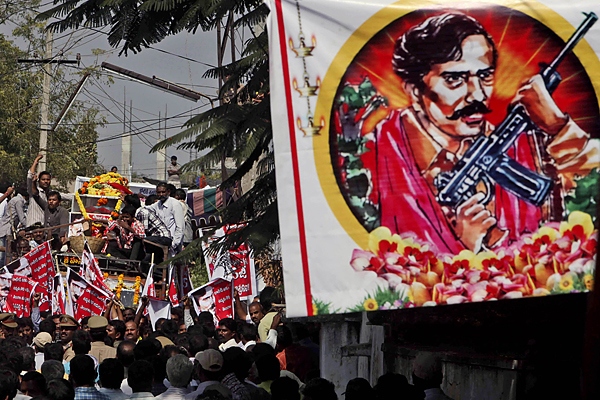
Relatives and supporters accompany the body of Kishenji, a senior Maoist rebel leader killed by government forces in eastern India, during his funeral procession at Peddapally village in Karimnagar District of Andhra Pradesh, India, November 27, 2011.


On 24 November 2011, the body of the Maoist leader Kishanji, with multiple injuries all over the body, was found in the Burishole jungle of the Jhargram area of the West Medinipur district of West Bengal. One of the main operatives of the Chidambaram-Mamata joint forces, Mr. Vijay Kumar, the DG of the CRPF, described it as a ‘clean and successful operation’. The mutilated body bore marks not only of bullet wounds, but wounds of four types. One was the bullet wounds; the second was the wounds caused by sharp weapons; the third was wounds caused by burning; and the fourth was the wound caused by pounding parts of the body such as fingers by heavy instruments. Facts such as these drive home the truth that Kishanji was captured in some other place, tortured to death and then his dead body was placed on the spot and a drama concocted in defence of the so-called encounter theory. The WB chief minister, after keeping mum for three days came out with a theory at a by-election campaign meeting that the joint forces told Kishanji over the microphone to surrender before shooting him down—a claim refuted by the villagers themselves in their conversation with the 22-member investigation team formed by civil rights bodies that visited the spot and adjoining areas on 1 December 2011. And this so-called encounter was engineered at a time when the process of dialogue between the government interlocutors and the Maoist state leadership of WB was on. The revolutionary intellectual, Varavara Rao, one member of the group that came to take Kishanji’s body to his native Peddapally town in Karimnagar district, declared that for the last 43 years he had been witnessing dead bodies—killed either in real or fake encounters—but never before was he the witness to a body that bore marks of so much injury. This brutal killing of the Maoist leader, Kishanji by the Chidambaram-Mamata combined forces will go down in history as a crime against humanity.
The 37-year long revolutionary political life of Mallojula Koteswar Rao could be narrated and analyzed only by those who had been his close comrades-in-arms in times of adversity and joy. For a person like me, who basically belongs to an academic world, who seeks to study the Maoist movement from a distance, and did not have any opportunity to have exchange of views with him, to write on Kishanji is inevitably to confront  a lot of difficulties in this attempt.. I would request the readers of this small piece of mine to keep that limitation of mine in mind.
After the death of Kishanji, people of different walks of life have been expressing their opinion about the whole thing, most of which are about his political line. I would not write on his political line(this is not the context for it also), because Kishanji’s political line is no different from CPI(Maoist)’s political line. And comments on the political line should best come from those who themselves take part in revolutionary practice to make those meaningful. While stating so, I also acknowledge the fact that truth and wisdom can also lie in socially-conscious, sensitive people. I do not know much about the context against which the Maoist leader was arrested and killed. In the editorial of Bandibarta(Prisoners’ Bulletin, a journal in Bengali) no.4(November-December 2011 issue), I have expressed my opinion on it. In this piece, I will write on some aspects of the fallen hero and the impact that he as a revolutionary Communist leader had on West Bengal.
Mallojula Koteswar Rao was born in 1954 in Koddapally town in the Karimnagar district of Andhra Pradesh. As a high school student, he actively took part in the movement for a separate Telangana state in 1969. Like many of his contemporaries, the Naxalbari struggle of 1967 and the Girijan struggle in Srikakulam that came in its wake influenced his mind profoundly. He was then a graduate student at SSR College at Karimnagar. In 1974, after the end of the first phase of the CPI(ML) struggle, he joined the party as an activist. He joined the RSU(Radical Students’ Union) and went underground during the emergency under Indira Gandhi regime. He worked in the villages and played an active role in exposing the 20-Point programme of the ruling Congress party. The second conference of the RSU was held in February 1978 and the first conference of the RYL(Radical Youth League) in May 1978. These two gatherings were important in young Koteswar Rao’s political career. He took part in the “to the village” movement—a movement that was initiated after  Naxalbari by Charu Mazumdar when he gave the call to the youth and students to go to the village and integrate with the poor and landless peasants as a preliminary step towards revolutionary transformation—a step that subsequently became part of revolutionary communism in India. That appears to be Kishanji’s first step towards baptism in the process of integration with the peasantry. In September , 1978, he took part in a peasant movement known as “Jagityal Joitrajatra”  (Victory March to Jagityal) which was the culmination of the mass movement for occupying the land by landless peasantry in as many as 150 villages covering Karimnagar and Adilabad districts.  It was this movement that gave birth to such future Maoist leaders as Ganapati, Kishanji and others. He was, by then, the secretary of the CPI(ML)COC, in Karimnagar district. According to media reports, he was associated with the Adilabad-Karimnagar joint committee, Karimnagar district committee, AP state committee as the secretary and took organizational and military responsibilities in many parts of Dandakaranya. From the mid-1990s, he assumed the leadership of the movement in the Jangalmahal region of West Bengal as also in other states. It is said that Kishanji was personally involved in both Singur and Nandigram movements. All of us have heard about his leading role during the historic movement centring Lalgarh. From then on, the name of Kishanji became a household name in West Bengal.
Kishanji called the Lalgarh movement “the second Naxalbari”. From the historical point of view, Naxalbari is unique—a watershed in the history of India. That movement was short-lived in the place of its birth. However, the message of that rising—that of the revolutionary transformation of Indian society through the path of agrarian revolution under the guidance of Mao Tse-tung Thought—spread far and wide. The Lalgarh movement spread throughout the Junglemahal region and was a qualitative leap forward after Singur and Nandigram. What we witnessed in Lalgarh is the blending between the democratic movement of the adivasis, dalits and other lower class people on the one hand, and the armed revolutionary struggle, on the other. A large variety of steps were initiated—such as the formation of the People’s Committee Against Police Atrocities(PCAPA), equal representation of men and women within the PCAPA, men and women youth wings of the PCAPA, fight for dignity despite brutal state repression, anti-liquor movement, fight for a new culture with songs and poems reflecting the struggles of the people and drawing sustenance from the past adivasi rebellions, fight against environmental pollution caused by the establishment of sponge iron factories, adoption of new methods of struggle, flexibility, and along with these, alternative models of development—land distribution, making of dams for irrigation, construction of roads, planting of tube-wells, setting up of health centres and free coaching centres—all these bear the imprint of the DK Maoist model of development. Whether historians or social scientists accept it or not, they keep a safe distance from those movements and are sustained in their intellectual pursuits by such movements and actually owe a lot to those who are the real creators of history.
Two years back, Kishanji became a much-talked about man and media played a role in it. Instances such as Kishanji’s telephonic conversation with the media, the abduction of Atindralal Roy, the OC of Sankrail PS, release of 15/16 women prisoners–hailing from the Junglemahal area—from the Medinipur Central Jail in exchange of the release of the police officer, Kishanji declaring Roy as a prisoner of war and releasing him before the media, appearance of Kishanji in front of the media with one aged adivasi woman whose family has been subjected to police harassment and torture before the release of Roy—all these now have become part of history. That was a time when youngsters sat before the TVs to listen to the voice of Kishanji. Telugu-speaking Kishanji’s Bengali accent, his speech and responses to the media, his boldness, his dedication to the cause he had been fighting for and his self-sacrifice made a deep impression among people irrespective of their views; people treated him with respect, awe and admiration. There was a time when Kishanji was the most attractive personality in the eyes of the media. Some honoured him with the title “Man of the Year”; as he covered his face with a towel for security reasons, he was described also as “the ghost who walks”. There were several reports about where he was or what he was planning to do. There were reports about he being injured in an alleged encounter in the Bankishole jungle.
I can distinctly remember my days at Presidency College, Kolkata in the early 1970s, when Charu Mazumdar became a legend during his lifetime. Many stories were in circulation among the media about his whereabouts. ‘Today he was in Behala, next day he was in Puri; he has narrowly escaped police dragnet’ and the story went on. Charu Mazumdar died in the Lalbazar police lock-up on 28 July 1972. Charu Mazumdar died during a regime that initiated fake encounter killings. Today, Kishanji is killed under a regime that takes its cue from that earlier regime. Since then till 24 November 2011, almost four decades have gone by. No other revolutionary leader during that long period since 1972 could make such an indelible impression on the minds of the people of West Bengal. One may agree or disagree with the ideology and the methods of struggle advocated by Kishanji; however, all the democratic-minded and honest, sensitive people of the country will hold him in high esteem for his unflinching dedication to his cause, his heroic self-sacrifice, intrepidity and martyrdom with the noble aim of creating a new society where human values would triumph over the lust for profits. In the true sense of the term, Kishanji was a leader of the oppressed people; at the same time, he was also one of them—who treated the sufferings of his countrymen as his own; it was his integration with the people and his personal qualities that must have made him what he really was.
A person like me who is both a student and teacher of History, and is engaged in research in the Maoist movement in its present phase, will face utmost difficulty. One of the main architects of the Maoist movement has departed from this world “like”—to borrow Kabir Suman’s words— “a hero”. Personally I wished to take his interview and to have a lengthy discussion with him over several issues relevant to the contemporary political scenario. That possibility no longer exists. It has thus been an irreparable loss to the study of history.
It is not possible for me to assess the extent to which the death of Mallojula Koteswar Rao would affect the Maoist movement. However, the point is that this Naxalite-Maoist movement has been continuing for forty four years in the face of state brutality of the cruelest kind and also gaining in strength. There must have been a strong social base, strong feeling for basic social transformation among the people, a very solid mass base that made it so long-lasting. Otherwise we can never explain this longest surviving communist revolutionary movement in our country. The basis of this movement lies in the people’s resistance against domestic oppression and domination by foreign capital over our economy and plunder of resources by them in collusion with domestic ruling classes. As long as this ground reality exists, people’s hunger for change will not subside. The killing of a revolutionary leader cannot change this general trend of history. This is the law of History.

Source:http://www.icawpi.org/


Geo-politics versus revolution by Wilhelm Langthaler - Analysis of the Revolts in North Africa and the Middle East


Picture Wilhelm Langthaler

Democracy and Class Struggle publishes this series of articles on the Arab Revolts by Wilhelm Langthaler of the Anti Imperialist Camp because it is concrete analysis of concrete conditions of the Arab Revolts during 2011 and not just the dominant pseudo revolutionary rhetoric.

Langthaler starts from the point of the agency of the people in the making of history.

His quotation tertium non datur affirms that a third way is possible in true dialectical fashion and rejects the Aristotlean either/or of history.

Aristotle states it as a principle in the Metaphysics book 3, saying that it is necessary in every case to affirm or deny,and that it is impossible that there should be anything between the two parts of a contradiction like many who employ Aristotle's pseudo revolutionary rhetoric on the left today.


Capitalism continually poses false dicotomies and uses binary logic, it is time to employ and re energise the materialist dialectic has Wilhelm Langthaler has done in practice in his analysis here.


We have problems with some parts of this article by Langthaler in particular his labelling the Soviet Union has being geo-political and Stalinist.

The Soviet Union's politics and foreign policy was guided by class struggle and not geo-politics between the 1920's to the early 1950's.

Geo-politics has a history in guiding Nazi politics via Karl Ernst Haushofer and its foreign policy and in guiding the foreign policy of US Imperialism the inheritor of nazi geo-politics.

Nickglais

1st January 2012


Part I of Syria, Turkey and the Arab revolt

by Wilhelm Langthaler
Among some anti-imperialist trends, we are facing a mindset whose sole criteria are geo-political. This method is inherited essentially from the Stalinist Soviet Union, which in its turn took it from the pre-1919 global ruling elites. To this mindset, the masses are nothing, only the rulers count. 

Additionally, given the continued overwhelming supremacy of imperialism there cannot be any doubt for our geo-politicians that whatever regime comes into conflict with the imperial centre must be supported – regardless of its relation to the popular masses. Tertium non datur!
During the last two decades this geo-political position did not differ much from the social revolutionary one. Imperial power has been at its highest, unfolding ruthlessly and attacking resisting regimes that represented old gains of long-gone popular struggles. Outstanding examples were Yugoslavia and Iraq, where the popular masses essentially remained passive while only politically advanced sections supported the regimes’ resistance against imperialism.
Popular resistance movements like those in Palestine, Afghanistan and later Iraq were directly facing imperialism or puppet regimes. As they quickly had to assume military forms under difficult conditions, they often also turned militarist and neglected popular mass struggle. The main conflict within the global anti-imperialist movement was, however, over the Islamophobic approach by many parts of the geo-political trend. These parts failed to support the Islamic resistance forces as they remained prisoners of the pre-1989/1991 narrative of political Islam as a tool of imperialism. Too often they were passive bystanders. Eventually most had to accept that, for example, Hamas had taken over the banner of the Palestinian resistance while the secularists had capitulated. Until now, however, they could not grasp the anti-imperialist symbolism of Islam.
Regarding the Eastern European coloured revolutions there had been a certain congruence as well. While there were indeed some popular mobilisations also by poorer classes, the movements explicitly called for capitalism and affiliation with imperialism. Our difference with many pro-Soviet geo-politicians was that we condemned neither the democratic demands nor the right to national self-determination, let alone did we support the repression. On the other hand, we could not support the movements, which were essentially politically reactionary regardless of their social composition.
More recently a special and difficult episode was provided by the Green movement in Iran, which cannot be included among the coloured revolutions. While many of its demands for political rights were legitimate, it essentially was a movement by the urban middle classes, with no support from the poor classes. Furthermore it allied with the liberal capitalist wing of the elites, which tended towards compromise with imperialism. Despite condemning the repression and calling for democratic reform, we had to conclude that the anti-imperialist momentum in the regime outweighed its repressive character. One should not forget that Iran has been the main state challenging the empire.
Up to this point the geo-political and the social revolutionary brand of anti-imperialism were more or less on the same side of history. (The differences on the role of the masses in the historical process have always been felt during these decades. One expression of it was the struggle over political Islam. The geo-political trend kept supporting an empty French-type secularism against a religious enemy, which reappeared as anti-imperialism resistance. It could also be felt when it came to the apologies the geo-politicians used to offer for the regimes they defended. Any criticism was immediately evaluated as treason.) Then came the Arab revolt.

State of the Arab democratic revolt

Part II of Syria, Turkey and the Arab revolt

by Wilhelm Langthaler
We are facing a democratic popular revolution directed against the old imperial order. It was a spontaneous revolt without a prepared political leadership. It is not by accident that the strongest popular political force across the region, political Islam in all its variants, neither initiated nor lead the upheaval. It has been rather a general leftist sentiment that inspired the first line of combat.
The Arab ancien regime
The Middle East has always been a neuralgic point of the imperialist world system. To simplify: there is Israel and petroleum. It is not by accident that the Palestinian resistance continued while after 1989/1991 nearly all other popular movements against the imperial capitalist elites ceded.
Under these extremely unfavourable conditions this continued resistance, however, suffered deformations. In the absence of mass movements there was militarism. The other deformation was culturalism tending towards sectarianism. Its highest expression was al-Qaeda type Jihadism with its gesamtkunstwerk [all-embracing, holistic artwork] 9/11. It could deal some important symbolic blows to imperialism but without the masses it could not win.
The old Middle East imperial order was essentially established in 1967 (after the Israeli victory in the seven-day June war) and 1991 (end of the bipolar world with the first attack on Iraq). Nearly all of the central Arab regimes had been products of anti-colonial struggles except on the periphery in Morocco and the Arab peninsula, while Jordan can be interpreted as an Israeli appendix. Under imperialist pressure and permanent military threat by Israel the Arab regimes succumbed to the US empire. Economically they embarked on the worst neo-liberal recipes imposed by the IMF-WB, while politically they built a secularist despotism often assuming dynastical forms. These elites were characterised by extreme nepotism alienating even parts of the social elites themselves.
This is true not only for those who dared to be openly pro-western but also for those still trying to squeeze out the last drop of their nationalist or anti-colonialist credentials of the past like Libya, Algeria or Syria. One should not forget that Qaddafi’s Libya eventually became a preferred business partner of the west; that Algeria’s military staged a coup against electorally successful Islamists with the support of imperialism; and that Syria in return for is support for the US war on Iraq in 1991 was rewarded with a substantial share in Lebanon.
Regarding Syria it remains true that it entered an alliance with Iran, supports the Lebanese resistance led by Hezbollah and offers the Palestinian resistance groups a safe haven. These aspects of the Syrian regime merit support, but without closing our eyes to Syria's role representing the 1967/1991 order. This seems contradictory but actually shows that even in the most reactionary times imperialism is never in total control.
One may look at Iran itself as an example. Despite Iran's deep and real conflict with the very 1967/1991 order, which the Islamic revolution did defy, Tehran supported the US attacks on Iraq in 1991 and 2003. Iran tried to ride the imperial tiger and actually was partially successful in doing so – to the detriment of the popular resistance!
Here come the Arab popular masses
The living conditions of the Arab masses continuously deteriorated. The situation had already become unbearable for a long time: socio-economically and politically as well as culturally. But the explosion needed decades to come. It only came when the US empire displayed severe cracks and weaknesses. Not to forget the heroic struggles as in Palestine, Iraq or Afghanistan, which paved the way for the mass revolt.
The programme of the mass movement is essentially the same all across the region directed against the 1967/1991 elites.
• end despotism – for democratic rights
• social survival and justice
• national and cultural independence from the west
We are facing a democratic popular revolution directed against the old imperial order. It was a spontaneous revolt without a prepared political leadership. It is not by accident that the strongest popular political force across the region, political Islam in all its variants, neither initiated nor lead the upheaval. It has been rather a general leftist sentiment that inspired the first line of combat. The Islamists had to join in later. This is definitely not an Islamic uprising but a democratic one, which the Islamic forces had to embrace because their popular following has been organically participating.
But we are only at the very beginning. The outcome is still unknown. The decisive factor is that the popular masses got in motion. This is an element of paramount importance. Therefore a return to the old system is very unlikely while a re-integration into the imperialist system will have to cope with this new factor. Thus it is impossible without substantial concessions. We are faced with a prolonged phase of conflict and struggle where the ruling elites will be unable to suppress the popular masses in the same way as before and will face great difficulties to establish a new and more sustainable system of domination. The global economic crisis decisively adds to these troubles.
New role for Islamism?
Under the rule of the ancien regime Islamism not only became the strongest popular force but also dominated the anti-imperialist resistances. It would be silly to believe that their inability to lead the democratic revolt would make them disappear or weaken them substantially. It is all too obvious that they will play a pre-eminent role also in the future system setup.
What the democratic movement does indeed show is that the Islamists are not the only ones to represent the popular masses. The triple demand of the movement was even better represented by others: democracy-social survival-independence. Or to put it differently: within the spontaneous democratic revolt a social revolutionary milieu played a decisive role and acquired important popular credit.
Furthermore, there are not only the popular masses. There are middle classes and there are elites in different political formations. All social strata will try to make use of or link up with the Islamic forces to further their interests. Once they are playing the central role within the new political system the forces of political Islam necessarily will divide into different tendencies and be put to a permanent test. “Islam is the solution” will become void as concrete answers will be required very soon.
On the other hand one should not think that the Islamists will simply reproduce the old system as some secularists suspect. They cannot do so as that would be outright treason of the democratic revolt. Such a betrayal would cost them dearly or could even mean political suicide. What makes them different from the old elites is that the Islamic forces are deeply rooted within the popular masses, including the poorest strata.
Together with the despots some geo-political anti-imperialists claim that reactionary Salafism will be strengthened or even prevail, thus bringing back through the back door US rule via Riyadh. More sophisticated ones say that will happen via the Muslim Brotherhood’s Qatar and/or Ankara connection.
Regarding Salafism it must be said that it strongly opposed the revolution in Egypt. The Salafis were the only significant internal force to support Mubarak till the end. Together with their Saudi donors they are opposed to the democratic revolution across the region. They swam against the democratic current. Also in Syria, where the Salafis oppose the Assad regime, they are against the general democratic spirit of the revolt.
But it is also clear that a more democratic system will give the Salifists a certain share of power, which especially in Egypt is significant. People need to test the Salafi promises in politics. This is also the meaning of democracy. There is, however, no danger that the Salafis could become the dominant force. On the contrary, despite opposing elections they became the strongest promoters for the Egyptian elections. Differing from the more liberal Muslim Brotherhood (MB) the strongest single Salafi party in Egypt, Al Nour, supported the Tahrir II movement. Not even Salafis are immune to the contagion of the democratic revolt, which also affects their very poor and uneducated constituencies.
Meanwhile there can be no doubt that the axis MB-Qatar-Turkey will play a decisive role in re-designing the political rule in the region. But we do not believe that it will be a simple reproduction of the old system. A new order will tend more towards the emerging multi-polar global architecture.
American embrace
The US and especially Barack Obama did indeed understand that they could not continue with the permanent and pre-emptive war waged under George W. Bush. Washington partially lost the wars in Iraq and Afghanistan, which taught the global subalterns that resistance does yield results. Then also the crisis of the world capitalist economy came. The risk of an explosion became definitely too high. With his Cairo speech in 2009 Obama changed Washington's tone. The explosion, however, could not be averted. It led to the collapse of the main pillars of the old regional order.
Despite having tried until the last minute to save what could be saved, Washington quickly grasped that the U.S. needed to change their approach. The old secular despots can neither be kept nor reproduced. (The exception of the Gulf, where the tyrants are not even secular, will cause them further troubles.)
So Washington is skeptical of the attempt by the Egyptian military to reproduce the old system. If even Mubarak could not keep it, why then should his much weaker epigones be able to do so, given also the looming economic crisis?
The idea suggests itself to Washington: the Muslim Brotherhood, the most consistent Islamic force with a massive popular following but at the same time dominated and controlled by middle and upper class sections, needs to be embraced and co-opted. Regardless of past conflicts (mainly over Hamas and Israel) there is simply no other option for the US and the west at large.
But will the MB be willing and/or able to build a pro-imperialist regime as in the past? No way! Even the US is aware of this fact. They therefore will not exclusively rely upon the MB. Take Turkey as an example. There a MB family member in a certain way anticipated the democratic demands, implementing them from above. But that meant also to allow more democratic rights and a more balanced foreign policy. On the socio-economic field the AKP was lucky Turkey was experiencing an unprecedented boom – something its Arab neighbours will not benefit from. The social crisis in Arab societies is much deeper and the masses have already come into motion. The next period will thus see many more conflicts there than in Turkey. While political Islam in some countries like Egypt is more influential than in Turkey, its organisational landscape is also much more differentiated. The MB is only one force among many and has stiff competition. The US will not hesitate to pit one group against the other and use also its other allies outside the Islamist milieu. A stable and hegemonic pro-imperialist regime under the MB’s lead therefore will be unlikely.
It is not easy to predict the outcome of the new setup but it is definitely clear that it will need to take the interests of the popular masses more into account than before. Therefore it will be qualitatively less reliable for the US. And what is the most important aspect: the popular masses expressing their interests cannot be quelled as before. This means also that the political liberties of the social revolutionary and anti-imperialist forces will be definitely larger.
Seen from another side: A western embrace might change and co-opt some Islamist factions, which would historically be neither new nor surprising. But it cannot change the entire character of the popular movement as imperialism has nothing serious to offer. There will be no Middle East Marshall plan given also the unbreakable tie to Israel. There is only social misery ahead.
To interpret the Arab spring as a CIA plot or coloured revolution for the implementation of Washington's Greater Middle East plan reflects a paranoiac aggrandizement of the invincible power of capitalist imperialism and a total contempt for the popular masses. To defend the old 1967/1991 regimes miming anti-imperialism is not only betting on the wrong horse, it is a crime against the global revolutionary anti-imperialist movement, for which the Middle East is a decisive place. This time the geo-politicians are definitely on the wrong side of history and a clean break is necessary.
The Libyan case
Did NATO intervene in order to topple an anti-imperialist leader and grab the rich oil reserves of the country? Why then did business run so well before and why was Qaddafi an honoured guest in Paris, Rome and other "human rights capitals"? Something in this explanation doesn't mesh.
We offer a different reading: Qaddafi was the cheapest victim possible in order to whitewash the western record of not only supporting the Arab despots but even creating them. Among his people he was totally isolated and his rule politically was only based on his clan. Furthermore the opposition is without any serious political tradition and therefore deemed to be not dangerous (which later turned out to be not true even in Libya). NATO intervened to take political control of the Arab democratic revolt at its weakest point where it virtually had two impossible and unacceptable alternatives: Either be ruthlessly repressed or to serve as ground troops of NATO.
The MB and other Islamic currents fell into this trap. While in the short run the NATO war was a political victory for imperialism, Libya will not be sustainable. Without a massive military presence, which is highly unlikely, it will be difficult to control the country by way of a puppet regime similarly reliable as Qaddafi. Even under the most favourable possible conditions created by an imperialist military victory, the new setup will need to reflect the interests of the popular masses more than before. The regime will be less repressive (although it remains to be seen whether they are able to build a unified state at all). Despite the political backwardness of the country due to history and the oil rent, imperialist intervention will not succeed in medium and long-term range to keep an anti-imperialist opposition away. But it is also clear that the country will remain a rearguard of the revolution.
Only against this general framework it is possible to judge the Syrian situation.

Syria – who is anti-imperialist ?

Part III of Syria, Turkey and the Arab revolt

by Wilhelm Langthaler
Despite the undeniable historic anti-imperialist traits of the Baath regime (support for the Lebanese and Palestinian resistance, block with Iran) these are by far outweighed by the anti-imperialist momentum represented by the popular uprising in the entire region.
First stage: peaceful and anti-interventionist
When the democratic movement in Syria started, inspired by the advances in North Africa, there was the hope for quick victory as with its precedents. But the Assad regime refused to take the same road as his homologues in Tunisia and Egypt. The succession of Assad junior had evoked hopes for reform, but they have been frustrated since. All during the last decade the Baath apparatus did not allow them. Why then should they do so now? The only strong explanation for this total inability to respond at least partially to the democratic mass movement is the sectarian Allawi character of the Baath regime encapsulating itself.
As in the other Arab countries the Islamist forces played no driving role in this first stage of the revolt. Essentially the motive force was politically, culturally and socially a milieu similar to that in Tunisia and Egypt. The political demands were the same as well. There has been a strong consensus for remaining peaceful, avoiding civil war, against sectarianism and first of all against foreign intervention.
Western hesitation
In this first stage imperialism and especially Israel remained hesitant. Assad formally was their enemy but a calculable and rather toothless one. Meanwhile the Arab revolt seemed incalculable and out of control. While Saudi Arabia is the main promoter of the anti-Iran axis, Riyadh feared the popular revolution at her borders even more. Turkey herself was the architect of the détente with Assad and Iran. So Ankara took the back seat generally embracing the democratic movement but waiting to see how Assad would manage the difficulties. A difference from the Libya experience was that the imperial centre initially did not go for regime change by armed means as the neocons had asked for half a decade ago. The reason is simple: they did not have any favourable alternative at hand.
A direct military intervention as against Libya is still unlikely:
• Assad is not as unreliable and unserious in his relations as Qaddafi was. Beyond the Allawi sect he got the support of the business elite and the passive acceptance by the Christian minority. Internationally Assad is backed by Iran as well as the UN Security Council members Russia and China. An attack would have an enormous impact on the world system within a situation of increasing western weakness. Politically a western military attack could even be of political help to Assad, allowing him to pose as the defender of national sovereignty in a much more credible way than Qaddafi did. An attack even could reverse the political advantage gained in Libya.
• An attack could produce a sectarian civil war also spilling over into Lebanon. In Iraq the sectarian civil war seemed to be at first a US strategy but later turned out to be detrimental to US interests. That close to Israel the US would dislike provoking civil war with unpredictable outcome unless there is no other viable way.
• One of the central western allies, Ankara, would probably be against such an intervention as it would be forced into a central role. Politically the AKP regime cannot afford to appear as an appendix of NATO imperialism.
• There remains a certain military overstretch of the US.
One should not confuse the position of the western corporate media with that of the western regimes. Western media has been set on “humanitarian imperialism” for the last two decades. This is all the more easy in continental Europe where states usually refrain from participating in US aggressions. As compensation they happen to outpace everybody in moral bellicosity.
Certainly there is general congruence between the regime’s media and its policy. But it lies within the system that this congruence is not always total. The state chancelleries a) know that they cannot intervene directly by military force and b) that they have no reliable alternative because the street movement will be difficult to control as it is driven by popular forces hostile to imperialism.
They limit themselves to the spiral of sanctions trying to force Assad into a compromise with the movement. They hold few assets in hand as there is no significant openly pro-imperialist force within Syria – which is different, for example, from Libya.
Turkey as a model and main player
For many in the Arab world Turkey is a model to emulate especially for the MB trend. The AKP anticipated the triple demand of the Arab spring thus pre-empting a revolution.
1) They granted more democratic rights and combined a secular system with Islam.
2) They provided social development while maintaining not only capitalism but also leaving the capitalist elite and their interests essentially untouched.
3) They embarked on a more independent foreign policy (Iran, Gaza etc.) without breaking with NATO.
For a period of after all more than a decade the AKP was able to meet urgent popular demands while remaining within the frame of the imperialist system. They were able to avoid the revolutionary turmoil raging in the Arab world. It is not the scope of this article to discuss the sustainability of this model – we dare to doubt. But we are very sure that for the Arab world the Turkish model is not feasible. On one hand neither the domestic nor the global socio-economic pre-conditions are provided – differently expressed, they are close to catastrophic. On the other hand the elites proved totally unable and unwilling to embark on comparable reform and also their western masters did not advice them respectively. So the masses had to embark on a revolutionary path which cannot be easily switched off.
Actually the outflow of Turkey’s new role was a détente with Syria (as with Iran) in offset to the traditional western line. But the popular revolt completely changed things and subsequently also Turkey’s approach had to be altered.
Like with the other centres of the Arab revolt Ankara had to take side with the Syrian popular movement. (Even Iran, which is in alliance with Assad, was forced to moderate it support for Assad calling upon him to undertake reforms for the very same reason.) If Turkey wants to maintain its pre-eminent role in the region as a model it absolutely needs to go along with the Arab spring.
The embrace of the movement coincides with western foreign policy but not necessarily with the same intention and first of all it cannot follow the same methods. It was no accident that Turkey was reluctant regarding NATO’s attack on Libya. Ankara needs to avoid appearing as a henchman of the US. This is even a precondition of its political intervention.
Turkey is following its own ends. It is aspiring to become the leading power of the region – an approach which has been dubbed neo-Ottomanism. For this purpose Ankara cannot remain an appendix of the US, the EU or NATO but needs to defend the independence and self-determination of the region in the spirit of the multi-polar global design. The Turkish regime will try to use the Arab spring in this sense and not along the western interest to reproduce regimes as much dependent and subservient as possible.
Regarding its comprehensive intervention into the Syrian events, Turkey needs to go along the described path. A Libyan-type NATO intervention is therefore not possible. It needs to be a limited, softer one even if it employs military means (although for the time being they do not know how to be at the same time effective and soft). It will not be imperialist in the western sense. They will neither intend nor be able to impose a pro-imperialist regime as the US tried in Iraq.
The Turkish intervention (political, economical, culturally and military) certainly has an impact on the Syrian popular movement, trying to shape it according to Turkish interests. It is directed against the social revolutionary and anti-imperialist fraction of the movement while favouring the liberal fraction of the MB. But Turkish intervention will not alter the general character of the Syrian popular movement.
Therefore the revolutionary anti-imperialists need to oppose Turkish intervention and criticize Turkey's local Syrian allies. But it is no reason to abandon the popular movement all together let alone change sides, switching over to defend the Assad regime. As long as the democratic revolt remains the driving and dominant force we need to fight for its victory.
The Assad regime
Let us one moment assume that the Assad regime is really attempting to defend Syria from an imperialist takeover. Given its international isolation it would urgently need to rebuild consensus among its own people, regain popular support, respond positively to the popular democratic demands. This is what the people hoped for after the succession from father to son one decade ago and also at the onset of the current popular movement. Some factions of the left even tried to organise dialogue conferences between the movement and the regime.
But the regime did the exact contrary and proved totally unable to make concessions. It resorted to increasing repression and is drowning the revolt in blood. It is unwilling to embark also on the slightest democratic reforms. Thus the hopes of the people eventually got frustrated and very few people continue to insist on reforms, while most have come to the conclusion that the only way out is to topple the regime.
To close our thought experiment: if the regime really was engaged in an anti-imperialist struggle its measures would actively drive people into the arms of the enemy. Without the support of important sections of the lower classes self-defence against imperialism at least in medium and long term ranges is impossible.
Anti-imperialism against the popular masses can indeed occur under specific conditions. Sometimes it can even survive for a longer period of time – and revolutionary anti-imperialists need to defend them against the imperial centre. But in the presence of a powerful mass movement against the imperial order across the region things need to be re-evaluated and weighed. Despite the undeniable historic anti-imperialist traits of the regime (support for the Lebanese and Palestinian resistance, block with Iran) these are by far outweighed by the anti-imperialist momentum represented by the popular uprising in the entire region.
We have been exposing that the regime is based on a neo-liberal capitalist elite like in the rest of the Middle East. They are faced with a social revolt by the lower classes, despite the fact that due to the severe repression the social aspect is poorly politically represented. The democratic aspect plays an overwhelming role which, however, does not change the overall class character of the uprising.
Maybe the main reason why the regime is still in power or could not go for partial withdrawals like in Egypt or Tunisia is its confessional armour, which is pushing the country on the brink of sectarian civil war.
More than its regional homologues Damascus insists on being guardian of secularism against the Islamist danger. However, everybody knows that Assad’s rule is based on the Allawi sect enormously driving confessionalism. The more the conflict with the regime escalates the more also the sectarian civil war does. Allawis and Christians are being compacted with the regime, which excludes the possibility of orderly withdrawal of the regime. Assad tries to link the fate of his own Allawi sect and to a lesser extent also of the Christians to his regime.
Assad bears the full political responsibility for pushing the country into sectarian civil war, which plays in the hands of imperialism (see Iraq). He is also preparing the political ground for foreign military intervention. The difference from Libya is that Qaddafi did not dispose of the sectarian armour and the oil rent remained in the hands of even fewer people than the profits of the Syrian oligarchy.
Second stage: descent into civil war
Meanwhile we are coming close to one year down the road of the uprising. The hopes for quick victory have vanished. The regime seems to keep the support of important sections of society.
Two important changes can be observed: a step by step militarization of the conflict and a growing call for foreign intervention – two aspects linked to one another.
One could be astonished that diehard leftists have continuously insisted the Syrian opposition use peaceful means. History teaches that revolutions, without taking up arms, without forcefully toppling the ruling elite in general, are doomed to fail. Especially the current evolvement of the Syrian events seems to testify for the accuracy of this assumption.
But the more the conflict gets violent the more it gets sectarian. And the more blood is shed the more it evokes the call for a foreign military intervention. The moderate forces and also those inclined to Sunni sectarianism search for a shortcut to avoid or circumvent a full-fledged revolution, which can only be also a social one. This is especially true for the MB and its Turkish and Gulf protectors.
Assad’s ruthless repression, however, turned any peaceful demonstration into a kind of suicide commando. Hundreds if not thousands of democratic activists of the first stage have been killed so far. It is clear that there is a limit to self-sacrifice. It is understandable if the movement turns to armed self-defence against the state slaughter. It is not possible to continue street demonstrations that regularly leave dozens of participants dead.
Then there is the growing phenomenon of mass defections from the armed forces that is politically expressed in the formation of the Free Syrian Army (FSA). Despite the fact that they pledged to refrain from offensive military action the FSA’s appearance is adding to the militarization of the situation.
From a revolutionary anti-imperialist point of view the escalation needs to be tuned down as much as possible while respecting the right to self-defence. The main task for the time being is to increase consensus, to politically decompose the army and to more and more politically isolate the regime. It is all about to prepare for a general insurrection combined with a military coup with a faction of the army. But the time is not ripe yet. The revolution still needs time to grow and to stand on its own feet. Also to politically confront the pressure for foreign intervention, a line of de-escalation is necessary.
The opposition and the Syrian National Council (SNC)
The Syrian opposition movement has been and still is manifold, however, reflecting the general democratic character. The main differences occurred over the legitimacy of foreign representation and whether a reform programme is viable or the regime needs to be toppled all together. In the first phase there was consensus over the refusal of foreign military intervention.
Similar to the other countries of the Arab revolt the uprising was neither inspired nor controlled by Islamist forces despite a general reference to Islam as a symbol of identity. As was the general trend in the region, the Islamists had to follow suit and accept the democratic spirit which tends at the same time to multi-confessionalism. This is especially true for the MB whose more liberal trend embraced the movement.
As the formation of a political representation inside the country was repressed and made impossible by the regime, the building of a front outside became a necessity. But it is also clear that the relationship of forces outside is different and to the detriment of the social revolutionary and anti-imperialist forces. The MB is the only force with an organised network including established contacts to western power. The very fact that they nominated Burhan Ghalioun, an intellectual with leftist anti-imperialist credentials, needs to be interpreted as a reflection of the relationship of forces within the movement. Without the left the Islamic forces cannot move and will definitely not be accepted as the leadership.
There is, however, a shift coming about with the second phase of the movement. The inner democratic grassroots leadership has been eliminated. There is an obvious trend to militarization favouring better organised Islamic forces. The latter tend to favour foreign intervention for support. Given the strong repression one can imagine that there are many people within the movement who want to stop the bloodshed by foreign pressure, including Turkish military power. At least they regard it as a lesser evil also because Turkey is not regarded as a western imperialist force.
The social revolutionary anti-imperialist forces remain on the ground, continue to defend the refusal of foreign intervention and insist on steadfastness. The Syrian revolution can succeed without the support of foreign powers but it needs more time and sacrifices not all are ready to give. They search for the easiest way out.
That the SNC is gradually giving in on the question of foreign intervention reflects this development. Still it does not call openly for a military intervention but insists on the political isolation of the regime, sanctions and protected zones. But the trend is clear. By which means can protected zones be established? Only by foreign military force!
Traitors?
Does that mean that the SNC and all those who follow a similar line have become instruments of Turkey or even the west? Or does that mean that from an anti-imperialist point of view Assad’s regime needs to be supported as it would defend the sovereignty of the country?
To make it clear right away: From an anti-imperialist point of view the SNC’s line must be refused and the insistence on the own strength of the movement continued. But in which form can this criticism to the SNC be expressed? Are they traitors or a leadership not able to continue the revolutionary struggle?
The SNC did not capitulate like the Libyan anti-Qaddafi leadership. They try to use the projection of foreign power in a limited way with the intention to keep the upper hand – whether this will work is another question.
Are we in on the verge of an imperialist intervention like in Libya or even like in Iraq or will we be faced with an intervention on a neo-Ottoman line? Will a pro-imperialist regime be installed or something similar like in Egypt or Tunisia, which is more democratic, more responsive to the popular demands but which for the time being remains within the frame of the global system and definitely within capitalism?
One could imagine even the paradox scenario where a Turkish intervention might save some remnants of the old regime (for the sake of re-stabilising the situation) while a full-fledged popular revolution would raze it completely to the ground.
After all, we should not forget that there is still a revolutionary popular movement at work with a powerful influence struggling for power (this is not comparable with the Libyan situation). Any force intervening will have to cope with that. Turkey will neither be able nor willing to openly repress the movement. Thus the movement will certainly remain a decisive factor.
So there is no reason to cede the support for the popular movement, focusing on its revolutionary anti-imperialist wing, which came into a difficult situation. The SNC & co must be criticised for its opportunism but not attacked as henchman of imperialism, which they are not.
Actually it should not come as a surprise that the popular masses want to take the easiest road, the less costly one – at least as it appears to them. They are not referring to imperialism as they did in Eastern Europe. They are hoping for the help of a local power which is trying to pose as an alternative to imperialism. Both in Egypt and Tunisia they essentially did the same thing on a domestic level. The revolutionary process has only started and people need to make their experiences. Maybe they need to test the Turkish offer in order to overcome it. So we are only passing through the very first step of the democratic revolution, which is doomed to continue as imperialism is also economically unable to stabilise the situation.
Certainly the most favourable scenario would be that the revolution succeeds in Syria exclusively on its own forces. But even if the old order it toppled with Turkish help it would most probably not mean extinguishing the democratic character of the movement. (Look to Egypt: also there the movement was unable to prevent the military from reassuming power with the help of the MB. It took them half a year to respond but the popular movement definitely remains a factor.) It can, however, not be excluded that the situation will degenerate into an imperialist intervention. Then we will have to re-adjust our position. But this for the predictable future is not a probable variant.
Kurdish question
The PKK and its milieu are convinced that the SNC and the entire Syrian popular uprising are at the service of Turkey against the Kurdish interest. Meanwhile some pan-Arabist milieus are equally convinced that the uprising wants to split the country mainly using the Kurds to weaken the Arab people in imperialist interest.
Contrary to both of them we strongly believe that democratic rights for the Kurdish people (including the right to self-determination) is a powerful instrument for the success of the revolution and opposed to both Turkish and imperialist interests.
The Kurds have been oppressed for decades and have responded by fighting for their rights. They have been reluctant to join the Syrian popular movement as its position on Kurdish rights was not obvious. By granting them full rights the popular oppositions would secure Kurdish adhesion and foil the project of the regime to set the minorities against the democratic movement. At the same time supporting Kurdish rights it is the most powerful political tool to keep Turkey away, as Ankara wants to avoid any democratic precedence for their own Kurds.
To argue for the right to self-determination for the Kurdish people does not contradict the need to fight for the unity of Syria and not even against Arab or Middle East unification. Formal unity means nothing and is prone to break apart under imperialist pressure. Unification is only strong and sustainable if it is freely and voluntarily chosen. Now the Syrian Arab people have a great historic opportunity to unify with the Kurdish people creating precedence for the entire Arab region. They should grant them the right to self-determination inviting them at the same time to join a new democratic Syria. The pan-Arab political project can only be revived with this democratic approach. Otherwise it remains an ideological chimera de facto helping imperialism to split the people of the Middle East and setting them against each other. To foil this plan the dominant nation, which is the Arab one, must take the initiative. The smaller minorities will follow as soon as they experience their rights as being granted. Otherwise they tend to become instruments of imperialism against the popular anti-imperialist struggle – but not against the Arab ancien regime, which tries to exploit a totally hollow pan-Arab past.
December 27, 2011

Remembering the August 6th 2011 Rising in Britain - Harbinger of the future if corrupt police and politicians continue in power


This is a selection of articles on Democracy and Class Struggle concerning the  August 2011 Uprising in Britain.

The Meaning of the Riots by Roshan Kissoon
http://democracyandclasstruggle.blogspot.com/2011/08/meaning-of-riots-by-roshan-kisson.html

August 2011 Uprising in England - No Justice No Peace by Emma Lewis
http://democracyandclasstruggle.blogspot.com/2011/08/august-2011-uprising-in-england.html#more

Anxiety and Destruction analysis of the August Riots by Shayo Rouge
http://democracyandclasstruggle.blogspot.com/2011/09/anxiety-and-destruction-analysis-of.html

Riotous Nonsense by Harry Powell
http://democracyandclasstruggle.blogspot.com/2011/09/riotous-nonsense-by-harry-powell.html

London Afire by Mumia Abu-Jamal
http://democracyandclasstruggle.blogspot.com/2011/08/londonn-afire-by-mumia-abu-jamal.html

No Justice No Peace: The Riot is the Rhyme of the Unheared, Let us Begin to Listen by Javaad Alipoor 
http://democracyandclasstruggle.blogspot.com/2011/08/no-justice-no-peace-riot-is-rhyme-of.html

Questions from a German Comade on Uprising in England
http://democracyandclasstruggle.blogspot.com/2011/08/questions-on-uprising-in-england-in.html

March 26th Movement supports those demanding an independent enquiry in the death of Mark Duggan
http://democracyandclasstruggle.blogspot.com/2011/08/march-26th-movement-supports-those.html