Lesser known, an exclusive Occupy.com investigation reveals that Popovic and the Otpor! offshoot
CANVAS (Centre for Applied Nonviolent Action and Strategies) have also maintained close ties with a Goldman Sachs executive and the private intelligence firm
Stratfor (Strategic Forecasting, Inc.), as well as the U.S. government. Popovic’s wife also worked at Stratfor for a year.
These revelations come in the aftermath of thousands of new emails released by
Wikileaks' “Global Intelligence Files.” The emails reveal Popovic worked closely with Stratfor, an Austin, Texas-based private firm that gathers intelligence on geopolitical events and activists for
clients ranging from the American Petroleum Institute and Archer Daniels Midland to Dow Chemical, Duke Energy, Northrop Grumman, Intel and Coca-Cola.
Referred to in emails under the moniker
“SR501,” Popovic was first approached by Stratfor in 2007 to give a lecture in the firm's office about events transpiring in Eastern Europe, according to a Stratfor source who asked to remain confidential for this story.
In one of the emails, Popovic forwarded information about activists harmed or killed by the
U.S.-armed Bahraini government, obtained from the Bahrain Center for Human Rights during the regime’s crackdown on pro-democracy activists in fall 2011. Popovic also
penned a blueprint for Stratfor on how to unseat the now-deceased Venezuelan president Hugo Chavez in September 2010.
Stratfor’s Global Activist Connector
Using his celebrated activist status, Popovic opened many doors for Stratfor to meet with activists globally. In turn, the information Stratfor intended to gain from Popovic’s contacts would serve as “actionable intelligence” —
the firm billed itself as a “Shadow CIA” — for its corporate clients.
Popovic passed information to Stratfor about on-the-ground activist events in countries around the world, ranging from the
Philippines,
Libya,
Tunisia,
Vietnam,
Iran,
Azerbaijan,
Egypt,
Tibet,
Zimbabwe,
Poland and Belarus,
Georgia,
Bahrain,
Venezuela and
Malaysia.
Often, the emails reveal, Popovic passed on the information to Stratfor without the consent of the activists and likely without the activists ever knowing that their emails were being shuttled to the private security firm.
In the U.S., this investigation's co-author, Carl Gibson (representing US Uncut), and the Yes Men’s Andy Bichlbaum had a meeting with Popovic shortly after their two respective groups used a
media hoax to play a prank on General Electric, ridiculing the company over its
non-payment of U.S. taxes.
The pair gave Popovic information about both groups’ plans for the coming year and news later came out that Stratfor
closely monitored the Yes Men’s activities. (The below photograph taken by Bichlbaum in April 2011 shows Popovic (L) and US Uncut’s Carl Gibson.)
Stratfor said Popovic’s main use for the firm was his vast array of grassroots activist contacts around the world.
“A little reminder that the main utility in this contact is his ability to connect us to the troublemakers around the world that he is in touch with. His own ability to discern situation on the ground may be limited, he mainly has initial contact with an asset and then lets them do their own thing,”
reads a May 2010 email written by former Stratfor Eurasia Analyst Marko Papic. “He does himself have information that may be useful from time to time. But, the idea is to gather a network of contacts through CANVAS, contacts that we can then contact independently.”
Helping Stratfor Manufacture Revolutions
Stratfor saw Popovic’s main value not only as a source for intelligence on global revolutionary and activist movements, but also as someone who, if needed, could help overthrow leaders of countries hostile to U.S. geopolitical and financial interests. So useful was Popovic to Stratfor that the firm gave him a free subscription, dubbed “
legit sources we use all the time as a company” by Papic.
In a
June 2011 email, Papic referred to Popovic as a “great friend” of his and described him as a “Serb activist who travels the world fomenting revolution.”
“They...basically go around the world trying to topple dictators and autocratic governments (ones that U.S. does not like ;),”
Papic says in one email. Replying to a follow up to that email, he states, “They just go and set up shop in a country and try to bring the government down. When used properly, more powerful than an aircraft carrier battle group.”
“If I remember correctly, we use hushmail communication to contact him regarding Venezuela due to the sensitivity of using a revolutionary NGO as a source considering we have clients who operate in country,”
Papic said in a January 2011 email of Popovic.
CANVAS’s Goldman Sachs Cash
"Whenever I want to understand the details behind world events, I turn to Stratfor,” reads an endorsement from Satter
on Stratfor's website. “They have the most detailed and insightful analysis of world affairs and are miles ahead of mainstream media."
Otpor!: A Counter-History
To understand how Popovic came to aide Stratfor in its intelligence-gathering efforts, it’s crucial to examine Otpor! and CANVAS critically. A close examination demonstrates that Popovic was a natural choice to be a Stratfor informant and close advisor.
“In principle, [Serbia] was an overt operation, funded by congressional appropriations of around $10 million for fiscal 1999 and $31 million for 2000. Some Americans involved in the anti-Milosevic effort said they were aware of CIA activity at the fringes of the campaign, but had trouble finding out what the agency was up to,” explained a 2000 investigative piece appearing in The Washington Post.
“The lead role was taken by the State Department and the U.S. Agency for International Development, the government's foreign assistance agency, which channeled the funds through commercial contractors and nonprofit groups such as NDI and its Republican counterpart, the International Republican Institute (IRI).”
 Papic’s statement about CANVAS being “more powerful than an aircraft carrier” wasn’t mere hyperbole, but was based on the Otpor! Serbia experience in the late-1990s.
“In fact between 1997 and 2000 the National Endowment for Democracy and US government may have accomplished what NATO’s 37,000 bombing sorties had been unable to do: oust Milosevic, replace him with their favoured candidate Vojislav Kostunica and promote a neoliberal vision for Serbia,”
independent scholar Michael Barker wrote for Z Magazine. “In much the same way as corporate front groups and astroturf groups recruit genuinely committed supporters, strategically useful social movements can potentially dominate civil society when provided with the right resources (massive financial and professional backing).”
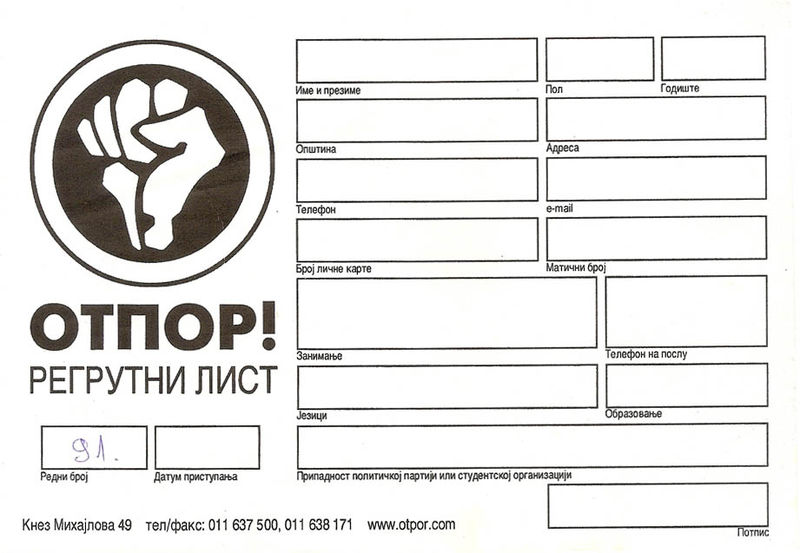
"We trained them in how to set up an organization, how to open local chapters, how to create a 'brand,' how to create a logo, symbols, and key messages," an Otpor! activist
told U.S.-funded media outlet Radio Free Europe-Radio Liberty. "We trained them in how to identify the key weaknesses in society and what people's most pressing problems were—what might be a motivating factor for people, and above all young people, to go to the ballot box and in this way shape their own destiny."
The overthrow of Milošević was accompanied by U.S.-funding for the creation of a robust media apparatus in Serbia, and Popovic’s wife worked at one of the U.S.-funded radio and TV outlets as a journalist and anchor
B92 from 2004-2009.
“By helping Radio B92 and linking it with a network of radio stations (ANEM), international assistance undermined the regime’s direct and indirect control over news and information,” a
January 2004 policy paper released by USAID explained. “In Serbia, independent media supported by USAID and other international donors facilitated the regime change.”
Critics point out that what happened in Eastern Europe was regime change, not revolution in any real sense of the term.
“Modern tactics of electioneering were employed to cast regime change as populist, which took advantage of the unstable and vulnerable situations in those regions following the breakup of the Soviet Union,” he wrote.
Critics Chime In, Popovic Responds
“Srdja is someone I’ve met more than once. He was very supportive of the Bahrain revolution, supportive of the human rights fight,” Alkhawaja said in a phone interview. “When he gave me their information, that’s what surprised me the most.”
Alkhawaja said that at the time she wasn’t aware of what kind of firm Stratfor was, but she became immediately suspicious after reading Stratfor’s questions to her. She never corresponded with Stratfor due to what she felt was the suspicious nature of the emails coming from the firm.
“It was a series of really weird intelligence agency-like questions, given that they knew I was working in a human rights group. They were asking questions like, who’s funding the party coalition, how many members do they have, questions that even I didn’t know the answers to,” she said. “The fact that they asked questions like that, made me question the motive behind the email I received. Thats why I never responded.”
“Whenever we get emails like that or were contacted by people who seemed very interested in asking intelligence agency-like questions, we usually block them, because we know they probably work for the government,” Alkhawaja continued. “Journalists know the kind of work we do so they wouldn’t ask those questions in the first place. I just found the email very weird and thats why I actually never responded.”
In a Skype interview, one of Otpor!’s co-founders, who left the movement and asked to maintain his confidentiality, said his primary concern from the Wikileaks emails was that Popovic was giving out activists’ information to a third party without their prior consent.
An interview with Popovic sang a different tune about CANVAS. He stated, “We definitely wouldn’t jeopardize any of our activists' safety, so we always follow their lead and never expose them to anybody without their consent.”
Popovic also said CANVAS would speak to anyone and everyone—without any discrimination—about nonviolent direct action.
“CANVAS will present anywhere — to those committed to activism and nonviolent struggle, but also to those who still live in the Cold War era and think that tanks and planes and nukes shape the world, not the common people leading popular movements,” he said.
“If we can persuade any decision maker in the world, in Washington, Kremlin, Tel Aviv or Damascus that it is nonviolent struggle that they should embrace and respect – not foreign military intervention, or oppression over own population – we would do that.”
Yet, given Popovic’s track-record—and specifically, who buttered his bread during the long professional career he pursued in activism—critics say Popovic fit like a glove at Stratfor.
“A group of Serbs cannot lead a protest movement anywhere outside Serbia, but his techniques are nonetheless instrumental in helping achieve certain political aims,” Professor Sussman said in an interview. “He also serves as an intelligence gatherer in the process—of use to private and state intelligence agencies. That's what Stratfor saw as his use.”