Sunday, November 24, 2013

State Surveillance, Counter-Terror Powers and Global Securitisation Strategies - Meeting 10th December


Campaign Against Criminalising Communities (CAMPACC), Statewatch, National Union of Journalists (NUJ), Campaign for Press and Broadcasting Freedom (CPBF), Haldane Society of Socialist Lawyers invite you to a
 
PANEL DISCUSSION ON


State Surveillance, Counter-Terror Powers
and Global Securitisation Strategies


Tuesday 10 December 2013, 6.30-8.30pm
Venue: National Union of Journalists, 308-312 Gray’s Inn Road, London WC1X 8DP
 

Speakers:
Michelle Stanistreet, General Secretary, National Union of Journalists (NUJ)
Tony Bunyan, Director, Statewatch, journalist and author the The Shape of things to ComeRob Evans, Guardian journalist and co-author with Paul Lewis of Undercover: the True Story of Britain’s Secret Police
Matthew Ryder QC, Matrix Chambers, representing David Miranda Dr Nafeez Ahmed author, international security scholar, environment writer for The Guardian; latest book, A User's Guide to the Crisis of Civilization And How to Save It.Les Levidow, CAMPACC

Chair:
Kat Craig, Reprieve, Legal Director of the Abuses in Counter-Terrorism (ACT) and Vice-Chair of Haldane Society of Socialist Lawyers
 

‘National security’ has been the common rationale for special counter-terror measures and mass state surveillance.  State methods include: undercover agents, interrogation under Schedule 7, informers and electronic surveillance by the NSA and GCHQ.  These practices systematically breach the right to privacy of one's correspondence.   Recent revelations about pervasive, mass electronic surveillance have provoked public debate on such practices and their political rationale.

These measures have especially targeted migrant communities, Muslims and political activists.  Counter-terror powers also impose various punishments without trial, e.g. 28-day pre-charge detention, freeze on bank accounts, travel restrictions, even revocation of citizenship.

Such extreme powers are not needed to protect the public. Rather, they are used to intimidate, disorganise and stigmatise opposition to state agendas for global domination and permanent war. 


Through a securitisation process, potentially all societal conflicts are portrayed as threats of disorder or of enemies.  Threats – terrorism, extremism and suspicious behaviour – are defined so broadly as to target potentially anyone.  Supposedly to protect us from such threats, ‘security measures’ are becoming all-pervasive, turning us all into suspects.

This public meeting will analyse state strategies and will discuss how various resistances can converge more effectively. 


For background on some issues, see
Statewatch magazine No.10, September, 2013, http://www.statewatch.org/contents/swjournal23n2.html
 <http://www.statewatch.org/contents/swjournal23n2.html
Dr Nafeez Ahmed: http://www.nafeezahmed.com
 <http://www.nafeezahmed.comhttp://crisisofcivilization.com/about/ <http://crisisofcivilization.com/about/ www.iprd.org.uk<http://www.iprd.org.uk

The event is free and open to all!

For information contact: Campaign Against Criminalising Communities (CAMPACC)Estella Schmid e-mail: estella24@tiscali.co.uk <mailto:estella24@tiscali.co.uk   Tel 020 7586 5892  www.campacc.org.uk <http://www.campacc.org.ukTo reserve a seat for the event please contact: Sarah Kavanagh, NUJ senior campaign and communications officer: sarahk@nuj.org.uk <sarahk@nuj.org.ukT: 020 7843 6381


Democracy and Class Struggle welcomes this meeting in London to expose the Global and local Strategies of Tension with Global and local strategy of exposure.

Venezuela Tightens State Control Over its Economy to Combat Inflation


Historic Nuclear Deal with Iran - But Spin War Starts says Pepe Escobar


See Also:
http://democracyandclasstruggle.blogspot.co.uk/2013/11/why-did-france-thwart-iran-nuclear-deal.html

India: Red Salute to Vasantada Ramalingachari (10th death anniversary on November 24th) by Harsh Thakor


                                                               Andhra Pradesh Map - Srikakulam in black in top right


Comrade Ramalingachari was a veteran leader of the Srikakulam  Girijan peasant movement and expired on November 24th,2003.

On November 24th 2013, we commemorate his 10th death anniversary. 

His life reminded you of someone traversing the steepest of cliffs or the densest of forests.

From start to end his life illuminated the spirit of Marxism-Leninsm-Mao Tse Tung Thought. (or Maoism now)

One important aspect in Comrade Ramlingachari’s writings were his defence of the erstwhile C.P.I. (M.L.) Peoples War Group's squad actions or armed resistance  from a critical angle .

One must throw light on the work of the Srikakulam Girijan Sangh re-organized in 1988 which although  a small force  still launched some important struggles.

It critically published leaflets on the subject of armed squad actions of the erstwhile C.P.I.(M.L.peoples War Group with relation to mass movement. It also launched an agitation  save regulation 70, a law which protected the rights of the Girijan tribal community.


Com.Ramalingachari persistenly defended the erstwhile C.P.I. (M.L.) Peoples War group as a genuine revolutionary force unlike many leaders from other factions within the Marxist Leninist camp.

This leaflet is of importance in light of wrong trends in the Communist Revolutionary camp,both of the ‘right ‘and the ‘left ‘variety and on the correct approach to Leninist party building.

Inspite of the most immortal sacricifes and huge building of armed struggle the C.P.I .(Maoist) has not yet developed fully a massline or correct approach to the building of the proletarian party .

It also depicts the contribution of the C.P.R.C.I.(M.L.) in theory and practice however limited the area of work.

Overall this section  staunchly defends the resistance of the C.P.I.(Maoist) today, but from a critical angle. 

Ramalingachari's life is an ideal example of a comrade irrespective of the situation, he stood against the tide.

Red Salutes to Vasanatada Ramalingachari 

(English translation of Telegu leaflet released by the Vasantada Ramalingachari Memorial Committee 10 years ago)

This valiant son of the soil was born in Vizzianagaram on December 21st 1929.

He studied upto high school upto SSLC. Derived inspiration from his elder brother who was in government service in West Godavri distyrict.. Gained revolutionary baptism in the Telangana Peasant Revolutionary Movement.

Started working as a full-time cadre of he Communist Party since 1952. When working for the Communist Party of India he played a major role in party building in Bobbili taluka.and later made an important contribution in building communist revolutionary practice  and forces in Bhadragir agency. 

He even organized the teachers front in support and for 10 years from 1958-68 carried out leadership responsibilities. During his tenure with the C.P.I . and C.P.M., he played a great role in the inner-party struggle against revisionism.

He developed the Srikakulam Girijan movement by moulding the struggling forces combining Marxist-Leninist theory with revolutionary practice.

His work enabled the Srikakulam peasant movement to raise to the level of confronting even the attacks of the state machinery, with an agrarian revolutionary practice or perspective.

Initially he worked for party building in Bobili Taluka. Played an important role in the development of the Communist revolutionary organizational forces and political practices till 1968.


Also influenced teachers, youth,s tudent and agricultural labour fronts. In the North Andhra plain areas.

He stood like a rock against revisionism. Became a state committee member of he Andhra Pradesh Co-ordination Committee of Communist Revolutionaries. Made great efforts in developing the Srikakulam movement to a higher level. 

After the A.P.C.C.C.R was expelled from the A.I.C.C.R he discharged responsibilities from the A.P.C.C.R and went on to work in Kondamodalu in of East Godavri district.

In 1975 when the U.C.C.R.I.(M.L) was formed he was appointed secretary of the A.P.State Commiteee.

Due to the Hyderabad Conspiracy case and the Paravitura Conspiracy case foisted by the govt Comrade Ramalingachari languished in prison for 3 years. 

He gave a statement I the Hyderabad Additional Sessions court in December 1971.This reflected the conditions of the Girijans, an expose the ruling classes. He wrote a famous document titled; Leadership’s criticism regarding the resolution of the regional committee in 1970-1972,a document useful till today. In the time of emergency he went underground.

From 1977 due to the inner differences within the U.C.C.R I he left the organization .However he continued his tenacious work from 1978-1987 leading the Andhra Pradesh Communist Revolutionaries Organising Committee (A.P.C.R.O.C.).


India: Remembering Comrade Kishenji we never forget u johar johar Kishenji anna ku johar


26th November  is comrade Kishenji's birthday we never forget u johar johar Kishenji anna ku johar 
Mallojula Koteswara Rao( Kishenji)
Born  26 November 1956.
Karimnagar district, Andhra Pradesh, India

Democracy and Class Struggle says Comrade Kishenji was murdered two days before his birthday on 24th November 2011 by the Indian State, he is an oustanding revolutionary of the 21st Century and will be remembered long after the comprador clique that runs India is overthrown - we shall never forget you comrade.

Remembering Kishenji his impact on West Bengal by Amit Bhattacharyya


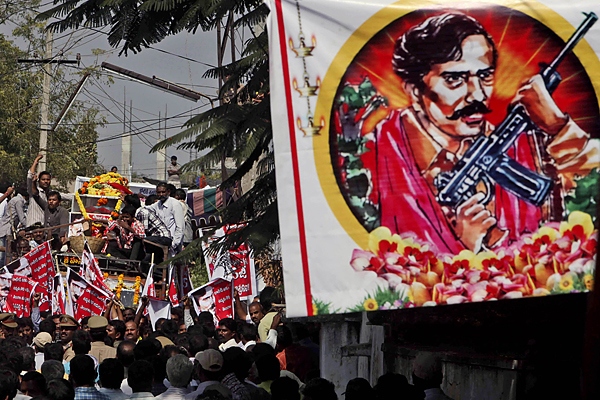
Relatives and supporters accompany the body of Kishenji, a senior Maoist rebel leader killed by government forces in eastern India, during his funeral procession at Peddapally village in Karimnagar District of Andhra Pradesh, India, November 27, 2011.


On 24 November 2011, the body of the Maoist leader Kishanji, with multiple injuries all over the body, was found in the Burishole jungle of the Jhargram area of the West Medinipur district of West Bengal. One of the main operatives of the Chidambaram-Mamata joint forces, Mr. Vijay Kumar, the DG of the CRPF, described it as a ‘clean and successful operation’. The mutilated body bore marks not only of bullet wounds, but wounds of four types. One was the bullet wounds; the second was the wounds caused by sharp weapons; the third was wounds caused by burning; and the fourth was the wound caused by pounding parts of the body such as fingers by heavy instruments. Facts such as these drive home the truth that Kishanji was captured in some other place, tortured to death and then his dead body was placed on the spot and a drama concocted in defence of the so-called encounter theory. The WB chief minister, after keeping mum for three days came out with a theory at a by-election campaign meeting that the joint forces told Kishanji over the microphone to surrender before shooting him down—a claim refuted by the villagers themselves in their conversation with the 22-member investigation team formed by civil rights bodies that visited the spot and adjoining areas on 1 December 2011. And this so-called encounter was engineered at a time when the process of dialogue between the government interlocutors and the Maoist state leadership of WB was on. The revolutionary intellectual, Varavara Rao, one member of the group that came to take Kishanji’s body to his native Peddapally town in Karimnagar district, declared that for the last 43 years he had been witnessing dead bodies—killed either in real or fake encounters—but never before was he the witness to a body that bore marks of so much injury. This brutal killing of the Maoist leader, Kishanji by the Chidambaram-Mamata combined forces will go down in history as a crime against humanity.
The 37-year long revolutionary political life of Mallojula Koteswar Rao could be narrated and analyzed only by those who had been his close comrades-in-arms in times of adversity and joy. For a person like me, who basically belongs to an academic world, who seeks to study the Maoist movement from a distance, and did not have any opportunity to have exchange of views with him, to write on Kishanji is inevitably to confront a lot of difficulties in this attempt.. I would request the readers of this small piece of mine to keep that limitation of mine in mind.
After the death of Kishanji, people of different walks of life have been expressing their opinion about the whole thing, most of which are about his political line. I would not write on his political line(this is not the context for it also), because Kishanji’s political line is no different from CPI(Maoist)’s political line. And comments on the political line should best come from those who themselves take part in revolutionary practice to make those meaningful. While stating so, I also acknowledge the fact that truth and wisdom can also lie in socially-conscious, sensitive people. I do not know much about the context against which the Maoist leader was arrested and killed. In the editorial of Bandibarta(Prisoners’ Bulletin, a journal in Bengali) no.4(November-December 2011 issue), I have expressed my opinion on it. In this piece, I will write on some aspects of the fallen hero and the impact that he as a revolutionary Communist leader had on West Bengal.
Mallojula Koteswar Rao was born in 1954 in Koddapally town in the Karimnagar district of Andhra Pradesh. As a high school student, he actively took part in the movement for a separate Telangana state in 1969. Like many of his contemporaries, the Naxalbari struggle of 1967 and the Girijan struggle in Srikakulam that came in its wake influenced his mind profoundly. He was then a graduate student at SSR College at Karimnagar. In 1974, after the end of the first phase of the CPI(ML) struggle, he joined the party as an activist. He joined the RSU(Radical Students’ Union) and went underground during the emergency under Indira Gandhi regime. He worked in the villages and played an active role in exposing the 20-Point programme of the ruling Congress party. The second conference of the RSU was held in February 1978 and the first conference of the RYL(Radical Youth League) in May 1978. These two gatherings were important in young Koteswar Rao’s political career. He took part in the “to the village” movement—a movement that was initiated after Naxalbari by Charu Mazumdar when he gave the call to the youth and students to go to the village and integrate with the poor and landless peasants as a preliminary step towards revolutionary transformation—a step that subsequently became part of revolutionary communism in India. That appears to be Kishanji’s first step towards baptism in the process of integration with the peasantry. In September , 1978, he took part in a peasant movement known as “Jagityal Joitrajatra” (Victory March to Jagityal) which was the culmination of the mass movement for occupying the land by landless peasantry in as many as 150 villages covering Karimnagar and Adilabad districts. It was this movement that gave birth to such future Maoist leaders as Ganapati, Kishanji and others. He was, by then, the secretary of the CPI(ML)COC, in Karimnagar district. According to media reports, he was associated with the Adilabad-Karimnagar joint committee, Karimnagar district committee, AP state committee as the secretary and took organizational and military responsibilities in many parts of Dandakaranya. From the mid-1990s, he assumed the leadership of the movement in the Jangalmahal region of West Bengal as also in other states. It is said that Kishanji was personally involved in both Singur and Nandigram movements. All of us have heard about his leading role during the historic movement centring Lalgarh. From then on, the name of Kishanji became a household name in West Bengal.
Kishanji called the Lalgarh movement “the second Naxalbari”. From the historical point of view, Naxalbari is unique—a watershed in the history of India. That movement was short-lived in the place of its birth. However, the message of that rising—that of the revolutionary transformation of Indian society through the path of agrarian revolution under the guidance of Mao Tse-tung Thought—spread far and wide. The Lalgarh movement spread throughout the Junglemahal region and was a qualitative leap forward after Singur and Nandigram. What we witnessed in Lalgarh is the blending between the democratic movement of the adivasis, dalits and other lower class people on the one hand, and the armed revolutionary struggle, on the other. A large variety of steps were initiated—such as the formation of the People’s Committee Against Police Atrocities(PCAPA), equal representation of men and women within the PCAPA, men and women youth wings of the PCAPA, fight for dignity despite brutal state repression, anti-liquor movement, fight for a new culture with songs and poems reflecting the struggles of the people and drawing sustenance from the past adivasi rebellions, fight against environmental pollution caused by the establishment of sponge iron factories, adoption of new methods of struggle, flexibility, and along with these, alternative models of development—land distribution, making of dams for irrigation, construction of roads, planting of tube-wells, setting up of health centres and free coaching centres—all these bear the imprint of the DK Maoist model of development. Whether historians or social scientists accept it or not, they keep a safe distance from those movements and are sustained in their intellectual pursuits by such movements and actually owe a lot to those who are the real creators of history.
Two years back, Kishanji became a much-talked about man and media played a role in it. Instances such as Kishanji’s telephonic conversation with the media, the abduction of Atindralal Roy, the OC of Sankrail PS, release of 15/16 women prisoners–hailing from the Junglemahal area—from the Medinipur Central Jail in exchange of the release of the police officer, Kishanji declaring Roy as a prisoner of war and releasing him before the media, appearance of Kishanji in front of the media with one aged adivasi woman whose family has been subjected to police harassment and torture before the release of Roy—all these now have become part of history. That was a time when youngsters sat before the TVs to listen to the voice of Kishanji. Telugu-speaking Kishanji’s Bengali accent, his speech and responses to the media, his boldness, his dedication to the cause he had been fighting for and his self-sacrifice made a deep impression among people irrespective of their views; people treated him with respect, awe and admiration. There was a time when Kishanji was the most attractive personality in the eyes of the media. Some honoured him with the title “Man of the Year”; as he covered his face with a towel for security reasons, he was described also as “the ghost who walks”. There were several reports about where he was or what he was planning to do. There were reports about he being injured in an alleged encounter in the Bankishole jungle.
I can distinctly remember my days at Presidency College, Kolkata in the early 1970s, when Charu Mazumdar became a legend during his lifetime. Many stories were in circulation among the media about his whereabouts. ‘Today he was in Behala, next day he was in Puri; he has narrowly escaped police dragnet’ and the story went on. Charu Mazumdar died in the Lalbazar police lock-up on 28 July 1972. Charu Mazumdar died during a regime that initiated fake encounter killings. Today, Kishanji is killed under a regime that takes its cue from that earlier regime. Since then till 24 November 2011, almost four decades have gone by. No other revolutionary leader during that long period since 1972 could make such an indelible impression on the minds of the people of West Bengal. One may agree or disagree with the ideology and the methods of struggle advocated by Kishanji; however, all the democratic-minded and honest, sensitive people of the country will hold him in high esteem for his unflinching dedication to his cause, his heroic self-sacrifice, intrepidity and martyrdom with the noble aim of creating a new society where human values would triumph over the lust for profits. In the true sense of the term, Kishanji was a leader of the oppressed people; at the same time, he was also one of them—who treated the sufferings of his countrymen as his own; it was his integration with the people and his personal qualities that must have made him what he really was.
A person like me who is both a student and teacher of History, and is engaged in research in the Maoist movement in its present phase, will face utmost difficulty. One of the main architects of the Maoist movement has departed from this world “like”—to borrow Kabir Suman’s words— “a hero”. Personally I wished to take his interview and to have a lengthy discussion with him over several issues relevant to the contemporary political scenario. That possibility no longer exists. It has thus been an irreparable loss to the study of history.
It is not possible for me to assess the extent to which the death of Mallojula Koteswar Rao would affect the Maoist movement. However, the point is that this Naxalite-Maoist movement has been continuing for forty four years in the face of state brutality of the cruelest kind and also gaining in strength. There must have been a strong social base, strong feeling for basic social transformation among the people, a very solid mass base that made it so long-lasting. Otherwise we can never explain this longest surviving communist revolutionary movement in our country. The basis of this movement lies in the people’s resistance against domestic oppression and domination by foreign capital over our economy and plunder of resources by them in collusion with domestic ruling classes. As long as this ground reality exists, people’s hunger for change will not subside. The killing of a revolutionary leader cannot change this general trend of history. This is the law of History.

Source:http://www.icawpi.org/

Friday, November 22, 2013

50 Years after Kennedy Assassination "The Kennedy Brothers Thought the Civil Rights Movement was a nuisance at best" Glenn Ford


Today is the 50th Anniversary of The Kennedy Assassination so I have posted the Michael Parenti classic speech on the Assassination which I do not think has been surpassed called the Gangster Nature of the State, plus Glen Ford who shows how the Kennedy Brothers thought the Civil Rights Movement was a nuisance.

Reality Asserts Itself with Paul Jay, Glen Ford discusses the JFK presidency and its relative indifference towards the black freedom struggle

For the Kennedy Assassination you cannot get better than the speech of Michael Parenti here:


US and UK Block Iraq War Enquiry to protect Bush and Blair Invasion Role


Thursday, November 21, 2013

Northern Ireland : Military Reaction Force (MRF): Time for Truth


The BBC's Panorama programme has uncovered evidence that soldiers from a secret unit used by the British Army during the Troubles in Northern Ireland in the early 1970s, shot unarmed civilians.

This was 40 strong unit operating a terror unit killing unarmed civilians, its operational records have been destroyed. They operated in West Belfast in unmarked cars.

The soldiers operated outside of the so called yellow card of only firing when lives in danger - this rule did not apply to MRF.

The MRF ran a number of front companies in Belfast during the early 1970s.

They included Four Square Laundry (a mobile laundry service operating in nationalist West Belfast) and Gemini Health Studios (a massage parlour on Antrim Road).

The MRF also had an office at College Square. All were set up to gather intelligence on the Provisional  (IRA) and Irish nationalist movement.

The MRF was an application by the British Military of Sir Frank Kitson's ideas on counter insurgency warfare in Northern Ireland and it is thought that he established the unit when in Northern Ireland under the auspices of 39th Infantry Brigade..

For more essential information read here :
http://en.wikipedia.org/wiki/Military_Reaction_Force

You cannot study the activities of the MRF without clearly seeing that Catholic/Protestant sectarian strife was aim of the unit and Britain, as well as inter Republican fighting, - the direct opposite of the British narrative of these events as "peace keeping"

Mr Seamus Mallon is quoted at the BBC has saying :

 "You had killings for which there was no logic. This type of incident where people were shot from a passing car, almost as if for fun.

"But was very clear that there was a strategy behind it and I think the huge question to be asked here is who ultimately authorised it, because it had to be authorised both in operational terms by a senior army figure and in political terms by a senior politician."

The right question are being asked but will we get answers.


Britain/USA and Transatlantic extradition - Dark underbelly of the 'special relationship'


Since 2003, British Citizens have run the risk of being locked up in the US even if they never set foot on American soil.

The extradition imbalance could soon get even more slanted, as UK citizens could now be whisked away to the US on secret evidence under proposed changes to the law.

Is No. 10 selling its own citizens down the river just to keep the UK's so-called "special relationship" with its overlord in Washington?