Wednesday, February 2, 2011
Battle of Tahrir Square rages in Cairo
Update 5:17 p.m. ET: Health Minister Ahmed Sameh Farid has updated the official death toll in today's clashes to three. The violence clashes in Tahrir Square — including gunfire and the use of Molotov cocktails — has injured 637 people, he says. Reuters quotes a doctor on the scene as putting the number of injured at more than 1,500.
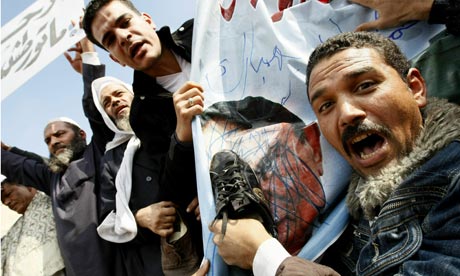
Anti-government demonstrators throw projectiles at pro-government demonstrators during clashes between the two sides in Tahrir square in Cairo, Egypt. (Ben Curtis, AP)
Cairo - They are covered in blood, but they keep returning to what they call "the front", where their fellow anti-government protesters battle regime supporters for control of Cairo's Tahrir Square.
Chaos consumed the symbolic gathering space on Wednesday as supporters of embattled Egyptian President Hosni Mubarak clashed with opposition protesters in running battles that have left at least 610 people injured and one dead.
Two Molotov cocktails thrown by pro-regime supporters land inside the grounds of the famous Egyptian museum, where they are swiftly put out, as the army fires warning shots into the air dotted with rocks thrown by protesters.
"To the museum, to the museum," one man shouts into a megaphone, directing some of the anti-government protesters, who have spent nine days trying to oust Mubarak, to move closer to Egypt's world famous antiquities museum.
From there they launch a barrage of rocks towards regime supporters who have attacked them relentlessly since marching into the square on Wednesday afternoon.
The Mubarak partisans, who earlier charged their targets on camel and horseback, drop concrete blocks onto the crowd from above, and each side wields whatever weapons it has: rocks, batons, iron bars and daggers.
Nurse Aisha Hussein said hundreds of people were being treated for broken bones or gashes requiring stitches at a makeshift clinic in a mosque just off the square.
Blood everywhere
She described a scene of "absolute mayhem", as protesters flooded into the clinic.
"It looks like an abattoir in here," she said. "There's blood everywhere."
Nearby, anti-Mubarak protesters shatter pieces of pavement, breaking them down into pieces that can be carried to "the front" in bags, and then thrown at regime supporters.
A mother, caught in the melee with her children, leaves them in the care of another woman temporarily, so she can take her turn carrying projectiles to the demonstrators.
Mustapha al-Shorbagy, 60, said the actions of Mubarak's supporters showed the president's true colours.
"We've been here since Friday; the blood of more than 100 people has been spilled! And who is responsible? It's the president. How can he set Egyptians one against another? This is not a president, this is a devil!"
After unprecedented protests seeking to end his 30 years of rule, Mubarak announced on Tuesday he would not stand for re-election in September, and pledged to ease the conditions for presidential candidacy.
Clashes orchestrated
But he has not indicated any plans to step down immediately, the key demand of the anti-government protesters locked in bloody clashes with Mubarak's supporters on Wednesday night.
Mubarak's opponents accused the leader's National Democratic Party (NDP) of orchestrating the clashes and showed an AFP reporter four party membership cards they said were taken from demonstrators who began attacking people.
"The pro-Mubarak NDP and the secret police dressed in plain clothes, they invaded the place to get rid of the revolt," protester Mohammed Zomor, 63, told AFP.
The Interior Ministry denied plain-clothes police had entered the square, state news agency MENA said, but the opposition insisted that police had stormed the area, and there were fears that more would move in after dark.
"Members of security forces dressed in plain clothes and a number of thugs have stormed Tahrir Square," three opposition groups said in a statement.
Near the Egyptian Museum, tanks sit with their drivers sealed inside as stones thrown by protesters bounce off their armour and ricochet overhead. Some crew emerge briefly, holding pieces of cardboard as defence against the projectiles.
Nearby, young boys tap out a rhythm with all their might on metal structures "to scare the enemy", they say.
Nureddine Najeh, 25, assessed the violence of Mubarak's supporters as a sign of his weakness.
"He paid these people to attack us," he told AFP. "It's Mubarak's last card. Little by little he is losing control of everything."
Several thousand people remained in the square nearly five hours after sunset, as both sides continued throwing rocks and skirmishing and with army and civilian ambulances coming to take the wounded away.
- AFP
Tuesday, February 1, 2011
Marxism Leninism Maoism - Missing the three magic weapons in the North Afrikan Revolution
In the new revolutionary upsurge in North Africa we do not see the three magic weapons that Mao Zedong said that are required for the science of revolution, the Party, the Army and the United Front.
Whilst there are some Maoist Organisations in North Afrikan and the Arab World they are small at this time.
The masses yearn to go beyond bourgeois democratic neo liberal politics and economics but the communist movement because of the rise of modern revisionism is still weak and not yet capable of becoming the revolutionary leadership.
There is still no Mao from the Nile Delta so feared by the Nasserists, Islamists and the Imperialists.
However Marxism Leninism Maoism is still young and is a powerful ideology that will grow expotentially in periods of revolutionary crisis like the current one has people seek answers has to why the movements are being hi jacked by the elites.
Study the Course on Marxism Leninism Maoism produced by Indian comrades here :
http://nickglais-springthunder.blogspot.com/2011/01/marxism-leninism-maoism-basic-course.html
Socialist Construction - The Chinese Experience

The implementation of the new democratic economic programme started even before nation-wide victory of the revolution. Soon after the Red Army and the Chinese Revolution entered the strategic offensive in 1947, Mao announced and started implementing what was called the three major economic policies of the new-democratic revolution.
These were 1) the confiscation of the land of the feudal class and its distribution among the peasantry, 2) the confiscation of the capital of the comprador bourgeoisie and 3) protection to the industry and commerce of the national bourgeoisie. These policies were immediately taken up for implementation in the vast areas of Northern China which were under revolutionary control and the agrarian reform was completed there by mid-1950. Subsequently the agrarian reform programme was completed in the remainder of the country.
General Line and Step-by-Step Collectivisation: In 1951, the party adopted what came to be known as the general line for socialist construction, for the period of transition from capitalism to socialism. The basic aim set for this period was to accomplish the industrialisation of China together with the socialist transformation of agriculture, handicrafts, and capitalist industry and commerce. The target set to complete this process was roughly eighteen years. This was divided into three years of rehabilitation for recovering from the damage and destruction of the civil war plus fifteen years covering three five-year plans for planned development of the economy.
In accordance with this general line, a ‘step-by-step’ plan was drawn up for the socialist transformation of agriculture. The first step was to call on the peasants to organise agricultural producers’ mutual-aid teams consisting of only a few to a dozen or so households each. These teams had only certain basic elements of socialism like help and co-operation among the members of the team. The second step was to call on the peasants to organise small agricultural producers co-operatives on the basis of these mutual-aid teams. These co-operatives were semi-socialist in nature and were characterised by the pooling of land as shares and by unified management. Then the third step was to call on the peasants to combine further on the basis of these small semi-socialist co-operatives and organise large fully socialist agricultural producers’ co-operatives. The basic principles underlying this step-by-step plan were voluntary participation and mutual benefit. The peasants were to be persuaded to voluntarily participate in this process of collectivisation.
The first step of mutual-aid teams had started in the revolutionary bases even before the nation-wide victory of the Revolution. The second step towards elementary co-operatives took place in the years 1953-55. The third step of transition to advanced co-operatives came about in 1956. There was a literal upsurge of socialist transformation in the countryside. Simultaneously, in the early months of 1956, a related movement rapidly took ahead and completed the process of nationalisation of businesses. Thus China’s industry and commerce was transferred from private ownership to ownership by the whole people far ahead of schedule.
Mao’s Dialectical Approach to the Process of Socialist Construction: The general line was basically reliant on the Soviet model of socialist construction. The emphasis on industry and particularly on heavy industry was the central direction of the First Five Year Plan of 1953-57. Further there was a tendency to uncritically adopt all Soviet policies. With the rise of modern revisionism in the Soviet Union (and particularly after the revisionist 20th Congress of the CPSU in February 1956), the revisionist tendencies in the CPC were immediately strengthened. In 1956 a campaign was started from within the party to ‘oppose rash advances’—i.e., to stall the process of socialisation. At same time the revisionist theory of productive forces gained ascendancy within the party, with the prime representative being the party general secretary, Liu Shiao-chi. The representatives of this trend upheld the Kruschevites, negated the class struggle and concentrated attention towards building modern productive forces, primarily through heavy industry.
Their argument was that the productive forces are the main motor of change and it was the backward productive forces in China that were the main factor holding back the development of the country. Changes in production relations should wait till after the productive forces had been developed enough. The cooperativisation of agriculture should wait until industries had developed enough to provide machinery for the rural mechanisation. All these proposals negated the importance of production relations and the class struggle. It would lead to growth of revisionist and bureaucratic trends and the growth of a new exploiting class.
Seeing the Soviet experience and realising the revisionist danger Mao immediately launched a struggle to defeat these trends which at that time controlled the party. His first step in this struggle was his speech of April 1956, On the Ten Major Relationships. In this speech, Mao for the first time made a clear-cut critique of the Soviet pattern of socialist economic construction. While referring to the relationship between heavy industry on the one hand and light industry and agriculture on the other, Mao stressed that “We have done better than the Soviet Union and a number of East European countries. …Their lop-sided stress on heavy industry to the neglect of agriculture and light industry results in a shortage of goods on the market and an unstable currency.” Similarly he criticised the Soviet policy of “squeezing the peasants too hard”. He also attacked the dogmatists within the CPC who “copy everything indiscriminately and transplant mechanically” while learning from the experience of the Soviet Union and other socialist countries. He also criticised those who were following the example of Kruschev in indiscriminately criticising Stalin. He upheld Stalin as a great Marxist with 70% achievements. Thus through this extensive critique of the Soviet revisionists and the mistakes in Soviet socialist construction, Mao led the struggle against the then dominant revisionist line of productive forces within the CPC.
However the biggest contribution of Mao’s speech was its major advancement of the understanding of the process of socialist construction and socialist planning. By presenting the problems of socialist construction as ten major relationships, Mao brought dialectics and contradictions to the centre of the process of building socialist society. He showed how socialist construction involved not merely the mechanical implementation of targets of production and distribution, but a dialectical understanding of the main contradictions in the process, and the mobilising of all the positive forces to achieve socialism. Thus he said, “It is to focus on one basic policy that these ten problems are being raised, the basic policy of mobilising all positive factors, internal and external, to serve the cause of socialism… These ten relationships are all contradictions. The world consists of contradictions. Without contradictions the world would cease to exist. Our task is to handle these contradictions correctly.”
Mao followed it up the next year with his work On the Correct Handling of Contradictions Among the People. In it he continued the development of the dialectical understanding of the process of socialist construction. Primarily he also placed the class struggle at the very core of the process. He asserted that the “class struggle is by no means over…the question of which will win out, socialism or capitalism, is not really settled yet.” With this he began the struggle against the revisionist sections in the Party who were saying that class struggle no longer existed under socialism. This marked the beginning of a country-wide Rectification Movement, the Anti-Rightist Movement. During this period many high-level cadre had to present their self-criticism before the masses, millions of students involved themselves in manual labour to integrate with the workers and peasants, all party cadres in the factories and agricultural co-operatives had to participate in manual labour, workers began to participate in decision making in their factories, a socialist education campaign started among the peasantry. Through this process the Party was brought closer to the people and rightist trends that were growing, both within the Party and outside were checked.
Great Leap Forward and the Birth of People’s Communes: With the progress of the rectification movement, the rightists in the party were thrown on the defensive. This led, in 1958, to a rectification of the erroneous productive forces theory which had dominated the Eighth Party Congress in1956. The prime mover of this theory, Liu Shiao-chi, was forced to admit before the Second Session of the Eighth Party Congress in May 1958, that, throughout the period before completion of the building of a socialist society, the principal contradiction was between the proletariat and the bourgeoisie, between the socialist road and the capitalist road. His report also mentioned the Great Leap Forward, which had then begun. There had been major advances on every front in socialist construction. Industry, agriculture and all other fields of activity had registered greater and more rapid growth.
Aside from rapid growth however, the Great Leap Forward was a major change in the priorities of the earlier plans and general line. The general line of the Great Leap Forward had been formulated at a Central Committee meeting held at the end of November 1957. It changed the emphasis on heavy industry and aimed at the simultaneous development of agriculture, heavy and light industry. It aimed at reducing the gap between town and countryside, between worker and peasant, and between worker and peasant on the one hand and the intellectual and manager on the other hand. It aimed at not merely an economic revolution but a technological, political, social and cultural revolution to transform the city and countryside.
In 1958 started the building of the people’s communes. The process first started spontaneously when neighbouring peasant associations in a drought affected area made a plan to merge together their labour and other resources to implement an irrigation project. Their merger was given the name commune by Mao. Mao encouraged such formation and this immediately led to a rapid spread of communes throughout the country. They were formed by the merger of neighbouring co-operatives in order to undertake large-scale projects such as flood control, water conservancy, afforestation, fisheries, and transport. In addition, many communes set up their own factories for making tractors, chemical fertilisers, and other means of production. The movement to set up people’s communes grew very rapidly. The CC of the CPC announced in its famous Wuhan Resolution of December, 1958 that “Within a few months starting in the summer of 1958, all of the more than 740,000 agricultural producers’ co-operatives in the country, in response to the enthusiastic demand of the mass of peasants, reorganised themselves into over 26,000 people’s communes. Over 120 million households, or more than 99 percent of all China’s peasant households of various nationalities, have joined the people’s communes.” Summing up the political essence, the CC went on to say: -
“The people’s commune is the basic unit of the socialist social structure of our country, combining industry, agriculture, trade, education, and military affairs; at the same time it is the basic organisation of the socialist state power. Marxist-Leninist theory and the initial experience of the people’s communes in our country enable us to foresee now that the people’s communes will quicken the tempo of our socialist construction and constitute the best form for realising, in our country, the following two transitions.
“Firstly, the transition from collective ownership to ownership by the whole people in the countryside; and,
“Secondly, the transition from socialist to communist society. It can also be foreseen that in the future communist society, the people’s commune will remain the basic unit of our social structure.”
Thus the commune movement represented a tremendous advance which basically completed the process of collectivisation of agriculture. However the expectation of the commune taking ahead the process of the transition to full public ownership and communism could not be fulfilled to that extent. Also attempts at setting up urban communes could not be consolidated.
In the earliest period of the commune movement during the Great Leap, there were certain ‘left’ errors. Mao in his speech in February 1959 called it a ‘communist wind’. These ‘left’ errors, which Mao identified, were mainly of three types. The first was the levelling of the poor and the rich brigades within the commune by making the whole commune into one accounting unit. This meant that shares of the peasant members of richer brigades (the former advanced co-operative) would be smaller than the share they would receive soon after the commune was formed. They would thus resent the formation of the commune and their participation would not be voluntary. The second error was that capital accumulation by the commune was too great and the commune’s demand for labour without compensation was too great. When larger amounts are kept aside for capital accumulation the share that the peasant gets is lower. Similarly more labour without compensation can only come where the consciousness has been raised to that extent. The third error was the ‘communisation’ of all kinds ‘property’. In some areas attempts were made to even bring minor property of the peasant like hens and pigs under the commune. This too was opposed.
These errors were soon corrected. The production brigade (former advanced co-operative), was kept as the basic accounting unit, and in 1962, this was brought to an even lower level, that of the production team. However, though the perspective remained always of raising the level of ownership and accounting to higher levels, as a process of greater socialisation and transition towards communism, this did not achieve success. The basic accounting and ownership unit continued till 1976, to remain at the lowest level—the production team.
Struggle against the Capitalist Roaders: Though the ‘left’ errors were soon corrected, the hold of the capitalist roaders, led by Liu Shiao-chi, remained strong within the party’s higher levels. The two-line struggle was represented in direct and indirect ways. In July 1959, Peng The-huai, then Defence Minister, launched a direct attack on the Great Leap Forward, criticising what he called its “petty-bourgeois fanaticism” and desire “to enter into communism at one step” Mao repulsed these attacks and defended the politics of the Great Leap. However, though Peng was defeated, the other capitalist roaders continued their attacks through indirect means.
One method was through veiled defence of Peng and attacks on Mao in the media. This was through articles and also through plays and cultural performances intending to show how Peng was an upright comrade who had been victimised. The other method was to stall or divert the implementation of key policies decided at the highest levels. A principal example was sabotage of the programme of socialist education and the decision to launch a Cultural Revolution, taken by the Tenth Plenum of the CC in 1962. Though this was formally agreed to by the capitalist roaders, they ensured through their control within the party structure, to ensure that there was no mass mobilisation. They tried to turn the Cultural Revolution in the direction of academic and ideological debate rather than class struggle.
Mao, throughout this period (1959-65), fought the battle at various levels. He realised on the basis of the Russian experience, the very real danger of the restoration of capitalism. He, therefore, on the basis of a major study of the politics and economics of Kruschevite revisionism, drew the theoretical lessons of this experience for the education of the Chinese and the international proletariat. Through the struggle of the Great Debate against Kruschev’s modern revisionism Mao tried to rally around the revolutionaries around the world and in China. Through his works like Critique of Soviet Economics and the CPC’s analysis of Kruschev’s Phoney Communism and its Historical Lessons for the World, he tried to inculcate in the party cadre the theoretical foundations for a fight against revisionism and restoration.
However he mainly tried to draw the masses into the struggle to defend and develop socialism and prevent restoration of capitalism. Besides his earlier mentioned programme for socialist education, he also gave slogans for socialist emulation of the Tachai and Tach’ing experiences as model experiences in building socialism. But when all attempts to mobilise the masses were diverted by the party bureaucracy, Mao succeeded after tremendous efforts in unleashing the energies of the masses through the Great Proletarian Cultural Revolution. It was the culmination in practice of Mao’s development of the Marxist principles of socialist construction.
For more om Marxism Leninism Maoism
Mao on New Democratic Revolution here:
http://democracyandclasstruggle.blogspot.com/2011/01/path-of-revolution-for-colonies-and.html
Mao on the Party here :
http://democracyandclasstruggle.blogspot.com/2011/01/mao-on-party.html
The Hi Jacker Government in Tunisia shows its claws
A few hours after the remaking of the the government that has hijacked our people’s revolution, the newly appointed police chiefs and security apparatuses-known for their allegiance to the old regime-started a savage attack on non- violent activists sitting,for a few days in Al-Qasbah (govermental headquarters). They used prohibited tear-gas bombs, side arms, trained dogs, sticks, chains…”RCD militias” joined them to beat and even use fire arms against the unarmed militants, chasing them through the capital’s streets and lanes.
It seems that the illegitimate hijacker government aims, through bloody repressive means,at terrorizing our people and disable its resistance so that to prove its power, re-enact its apparatuses to control the people, steal its wealth and go back to its dictatorial and corrupt methods.
What happened during the last few days (27/28/29 Jan) has proved that the hijacker government took no real positive measures to freeze RCD’s bank accounts which they still use to employ militias to terrorize non-violent militants. It has been also proved that the new government together with RCD’s members helped Ben Ali’s former followers and groups flee the country by giving them cover and refusing to bring them to justice. They also use the media and press to discredit the revolution so as to divide people and show militant teachers as enemies of the nation and of pupils.
Given that, we the undersigned unions, condemns the attack carried out by the hijacker government police on those occupying Al-Qasbah and calls for an investigation of what happened in order to hold the perpetrators of such an act . Besides we express our condemnation of RCD’s militias’ attacks on some educational institutions, teachers and unions’ headquarters. We also support people’s demands to dissolve the RCD due to the crimes committed and still perpetrated against the Tunisian people. In addition, we call for an immediate establishment of a national council to protect the revolution. We also condemn the media for siding with the government and giving the public misleading information.
We, therefore, call the Tunisian people, militants, political parties and all elements of of the civil society to continue their struggle so as to achieve the Revolution’s primary objectives: freedom, democracy and social justice.
Glory to our martyrs – Long live our people’s struggle
- Ridha Ashtioui, General Secretary of the General Union of Media Counsellors, School and University Orientation.
- Hfaidth Hafaidth. the General Secretary of the General Union of Basic Education.
- Sami Attahri, the General Secretary of the General Union of Secondary Education.
[Translated from Arabic by Tessy Cat and Nadim Mahjoub]
Slavoj Zizek - Why fear the Arab revolutionary spirit? The western liberal reaction to the uprisings in Egypt and Tunisia frequently shows hypocrisy and cynicism

What cannot but strike the eye in the revolts in Tunisia and Egypt is the conspicuous absence of Muslim fundamentalism. In the best secular democratic tradition, people simply revolted against an oppressive regime, its corruption and poverty, and demanded freedom and economic hope. The cynical wisdom of western liberals, according to which, in Arab countries, genuine democratic sense is limited to narrow liberal elites while the vast majority can only be mobilised through religious fundamentalism or nationalism, has been proven wrong. The big question is what will happen next? Who will emerge as the political winner?
When a new provisional government was nominated in Tunis, it excluded Islamists and the more radical left. The reaction of smug liberals was: good, they are the basically same; two totalitarian extremes – but are things as simple as that? Is the true long-term antagonism not precisely between Islamists and the left? Even if they are momentarily united against the regime, once they approach victory, their unity splits, they engage in a deadly fight, often more cruel than against the shared enemy.
Did we not witness precisely such a fight after the last elections in Iran? What the hundreds of thousands of Mousavi supporters stood for was the popular dream that sustained the Khomeini revolution: freedom and justice. Even if this dream utopian, it did lead to a breathtaking explosion of political and social creativity, organisational experiments and debates among students and ordinary people. This genuine opening that unleashed unheard-of forces for social transformation, a moment in which everything seemed possible, was then gradually stifled through the takeover of political control by the Islamist establishment.
Even in the case of clearly fundamentalist movements, one should be careful not to miss the social component. The Taliban is regularly presented as a fundamentalist Islamist group enforcing its rule with terror. However, when, in the spring of 2009, they took over the Swat valley in Pakistan, The New York Times reported that they engineered "a class revolt that exploits profound fissures between a small group of wealthy landlords and their landless tenants". If, by "taking advantage" of the farmers' plight, the Taliban are creating, in the words of the New York Times "alarm about the risks to Pakistan, which remains largely feudal," what prevented liberal democrats in Pakistan and the US similarly "taking advantage" of this plight and trying to help the landless farmers? Is it that the feudal forces in Pakistan are the natural ally of liberal democracy?
The inevitable conclusion to be drawn is that the rise of radical Islamism was always the other side of the disappearance of the secular left in Muslim countries. When Afghanistan is portrayed as the utmost Islamic fundamentalist country, who still remembers that, 40 years ago, it was a country with a strong secular tradition, including a powerful communist party that took power there independently of the Soviet Union? Where did this secular tradition go?
And it is crucial to read the ongoing events in Tunisia and Egypt (and Yemen and … maybe, hopefully, even Saudi Arabia) against this background. If the situation is eventually stabilised so that the old regime survives but with some liberal cosmetic surgery, this will generate an insurmountable fundamentalist backlash. In order for the key liberal legacy to survive, liberals need the fraternal help of the radical left. Back to Egypt, the most shameful and dangerously opportunistic reaction was that of Tony Blair as reported on CNN: change is necessary, but it should be a stable change. Stable change in Egypt today can mean only a compromise with the Mubarak forces by way of slightly enlarging the ruling circle. This is why to talk about peaceful transition now is an obscenity: by squashing the opposition, Mubarak himself made this impossible. After Mubarak sent the army against the protesters, the choice became clear: either a cosmetic change in which something changes so that everything stays the same, or a true break.
Here, then, is the moment of truth: one cannot claim, as in the case of Algeria a decade ago, that allowing truly free elections equals delivering power to Muslim fundamentalists. Another liberal worry is that there is no organised political power to take over if Mubarak goes. Of course there is not; Mubarak took care of that by reducing all opposition to marginal ornaments, so that the result is like the title of the famous Agatha Christie novel, And Then There Were None. The argument for Mubarak – it's either him or chaos – is an argument against him.
The hypocrisy of western liberals is breathtaking: they publicly supported democracy, and now, when the people revolt against the tyrants on behalf of secular freedom and justice, not on behalf of religion, they are all deeply concerned. Why concern, why not joy that freedom is given a chance? Today, more than ever, Mao Zedong's old motto is pertinent: "There is great chaos under heaven – the situation is excellent."
Where, then, should Mubarak go? Here, the answer is also clear: to the Hague. If there is a leader who deserves to sit there, it is him.
Source: Guardian
Source: Guardian
Samir Amin on Tunisian Revolution - Interview with Aydinlik Magazine

Professor Samir Amin, respected political thinker, economist and writer, evaluates developments in Tunisia in an interview with Aydinlik Magazine. We also asked Samir Amin his views about Hu Jintao’s visit to USA and currency policy of the China. We present a broad summary of the interview with Amin, who answered our questions from Dakar by telephone.
POPULAR MOVEMENT
AYDINLIK: How do you interpret the movement in Tunisia?
SAMIR AMIN: The events of Tunisia must be interpreted as a very powerful popular movement uprising, a general uprising. About 80 per cent of the population of the country in many areas including in the capital were out in the streets for 45 days and continue to do so. They carried on their protests in spite of the repression and did not give up. This movement has political, societal and economic dimensions. Ben Ali regime was one of the most repressive police regimes in the world. Thousands of people in Tunisia were assassinated, arrested and tortured, but Western powers best friend never allowed these facts to be known. The Tunisian people want democracy, respect of rights.
Economic and social factors were also influential in the uprising of the people. The country experiences rapidly escalating unemployment, particularly of youth, including educated young people. The standard of living of the majority of the population is decreasing, in spite of the growth of the GDP praised by World Bank and international Agencies. Growing inequality explains it. The influence of the mafia type of organisation is also another important factor. The system was managed to the almost exclusive benefit of the Ben Ali family and its organisation.
There is another aspect of the movement that is very interesting. The Islamic influence was not effective in the uprising. Tunisia is really a secular country. People manage to keep religion and politics separate. This is very important and positive. It was said Ben Ali protected the country from fundamentalist Muslims. He used this argument very effectively for many years. Actually it wasn’t Ben Ali but the people that protected the country from fundamentalists.
The fact that the army wasn’t against the people gave strength to the people in the streets. The Ben Ali government gave support and financial aid to the police not the army. This is why the police played such an important role in the suppression of the events in the past.
IT IS NOT EASY TO ESTABLISH A DEMOCRATIC AND SECULAR REGIME IN TUNISIA
AYDINLIK: Who or which power leading this movement?
AMIN: I want to emphasise again this movement doesn’t belong to a particular group of people. This is a popular general movement. There are no foreign countries or groups behind it. It is social in essence. However it must be said that the Western powers will try to create an Islamic alternative and will try to support a movement of this sort in order to avoid a really democratic alternative. They already have started to do it, re introducing in the country the language of ‘Saudi Arabia’ as some commentators of the Tunisian people have already said.
It is very difficult to try to guess what the future holds for the country. For sure the establishment of a democratic and secular regime is not easy. Assuming the best – that is a democratic government supported by the people – (and that is not absolutely guaranteed), such a government will be confronted with the economic and social challenge: How to associate this democratisation of the political management with social progress? That is not easy. Tunisia’s ‘success’ for some time was based on three sources: The delocalisation of some light industries from Europe, tourism, mass out migration to Libya and Europe. Now those three channels have reached their ceiling and even start to be reversed. By which macro policy they could be replaced? Not easy to imagine for a small country, vulnerable and with little resources (no oil!). Solidarity and South-South cooperation might turn to be vital for an alternative. The Western powers will do all they can to have the democratic regime unsuccessful in this respect, and create therefore conditions favourable for a false ‘Islamic alternative’, labelled ‘moderate’.
CHINA NEVER GİVE UP ITS POLICIES
AYDINLIK: China President Hu Jintao met with Obama in Washington. Before going to USA, Hu Jintao said that the ‘system dominated by dollar is the product of past’. What is your opinion?
AMIN: China may smile towards the Americans but the will never compromise their policies. The winner of the Hu Jintao-Obama meeting was Hu Jinto, as was expected. China did not make any concession with respect to their independent management of their currency, the yuan. The life expectancy of the dollar that rules the international monetary system will come to an end, sooner or later. Chinese are well aware of this. Yet for the time being China doesn’t suggest to create a different alternative global currency (Chinese understand that this is not mature and therefore remains an illusion). China is concentrating at the moment on developing relatively free and independent regional alliances. China will struggle for such realistic possible answers to the challenge: Reinforcing regional agreements in Asia and Latin America, not on a global level.
BROUGHT TO YOU BY PAMBAZUKA NEWS
* This is a translation of an article that first appeared in Aydinlik Magazine.
The Nasser Revolution by Harry Braverman (1959)
Democracy and Revolution publishes this article not because we agree with the views of the author but because it gives essential background to the current role of the military in Egypt. When the smoke of the Egyptian revolution cleared away, it was easy to see who were the losers: the monarchy and the landed pashas. But who were the winners? What is the military regime doing inside the country, now that Egypt rules itself? |
HOW Egypt, one of the world’s poorest and weakest countries, became a country of importance in half a decade is pretty well known. The army regime that deposed King Farouk had, at first, no other aim than to come to terms with the West in order to get arms – chiefly to threaten or use against Israel – and to get economic aid for industrializing the country. The protracted negotiations with Washington, however, always seemed to add up to one thing: Nothing but mouth-watering promises would be forthcoming until Egypt agreed to join the Western military bloc and to permit American bases and military missions on its soil. But the young officers in charge of the country were not disposed to imperil the independence they had just begun to establish. They thus started the triangular game of playing off the major cold-war antagonists against each other. In 1955, Nasser participated in the Bandung Conference, and later the same year announced the purchase of arms from the Soviet bloc. He negotiated with both sides for aid in building a high dam at Aswan, and while Washington reneged on its commitment, the Moscow string to Nasser’s bow is now bringing results. In the meanwhile, the new regime answered Western withdrawal from its earlier commitment on the Aswan Dam by taking over the Suez Canal, and saved itself from imperialist wrath with the help of the Russian counter-balance. More recently, Egypt has joined with Syria and Yemen to form the United Arab Republic, has won a battle in Iraq, and in general, by a policy of impudent independence and bold maneuvers, has raised its own strength on the Middle Eastern chessboard far above its former rating as despised and ignominious pawn.
All of this has been told in the headlines of the last five years. But far less information has been forthcoming about the state of affairs in Egypt itself. Hard as it is for Western readers to piece together an accurate picture from the scraps and fragments of the daily and periodical press, it becomes well-nigh impossible in the present state of our informational services. As in so many other fields, the cold war has driven truth into hiding: Nasser is a ‘fascist-Hitlerite dictator’ in pursuit of ‘foreign adventures’ to distract his people from their poverty; he is the chief ‘aggressor’ in the Middle East. Or, on the other hand, he is a ‘peace-loving Nehruite’ and a ‘colonial revolutionary.’ These Hollywoodized stereotypes of ‘good guy’ and ‘bad guy’ add very little to our knowledge of the complex forces at play in Egypt. We are thus fortunate in having a fine new book, Egypt in Transition (Jean and Simonne Lacouture, Criterion Books, New York, 1958, $7.50), which gives an uncommonly complete and sensitive picture of the developments since the coup against the old regime in July 1952. The authors, a French couple, have supplemented their years of residence and observation in Egypt with exhaustive research, and have assembled the whole with careful objectivity, not to say skepticism. Although it carries the story up to as late as February 1958, it has already been published and acclaimed in France, and made available in this joint British-American edition. Anyone who can’t get the details, problems, and policies of the new regime straight has only himself to blame, now that this book is on the market.
POST-World War II Egypt was in the all-too-common position of a nation whose social classes find it impossible to muster the strength to get out of their impasse. Of the peasantry, which embraces the vast majority of the population, there is hardly any need to speak; it was, and still remains, almost entirely sunk in the immemorial poverty, disease, and debility of the Nile Valley, mustering barely enough energy to keep alive, and all but dead to the national problems of Cairo and Alexandria. Even the hope of a solution to the land problem had been virtually extinguished by the peculiar Egyptian situation, in which the entire agricultural economy is concentrated in a thin strip of alluvial mud bordering the Nile, resulting in a rural overcrowding as bad as that to be found anywhere in the world. It was not the peasantry which took the lead for change; the ferment came chiefly among the city classes.
Both World Wars put huge Western armies on Egyptian soil, and at the same time sharply reduced the import of foreign goods. As would be expected, the result was a considerable growth in Egyptian industry to meet the new market and the curtailed supplies. Where, before the first World War, Egypt seemed nothing but an immense cotton plantation for the benefit of the textile trade and a fascinating playground for archaeologists, it now began to take on a Western appearance. Egyptian industry and commerce, even on a small scale, meant inevitably the undermining of the feudal orders and the encroachment of a new social arrangement, with a middle and upper class of trade and manufacture, and a city working class. Along with this came the usual accompaniment: nationalism, radicalism, strivings of independence and social reform. Revolts in the inter-war period won a measure of independence, including even the evacuation of British troops from Egyptian territory outside the Canal Zone, but Britain retained the final say in all major matters of foreign and domestic policy, both by formal agreement and informal pressures.
After the second World War, an increasing popular pressure, from the working class which had increased in size by 35-40 percent during the war, from the nationalistic capitalists, from the students, and from the vast miscellaneous throngs of the major cities – so hard to describe in social terms but so important to the popular politics of the Middle East – made the status quo ever harder to maintain. Demonstrations shook the regime, but even when relative calm prevailed, the internal rot, weakness, and loss of confidence of all the major forces in the ruling structure pointed to doom. The Wafd, an all-national party which ran the parliamentary system, managing to combine pashas and nationalist capitalists m one coalition, had lost much of its popular aura by its capitulation to the British during the war. The king, Farouk, had transformed his entourage into a Florentine hotbed of nepotism, sybaritism, and pimping. The British, the third element in the power structure, were on the defensive throughout their colonial empire, the object of universal detestation in Egypt, and badly weakened by the war.
THE outburst of the Cairo masses on January 26, 1952, which the entire center of the city was burned to the ground, including most of the foreign and fashionable structures, brought matters to a head. In October of the preceding year, Mustafa Nahas, head of the Wafd ministry, had submitted a project for abrogating the Anglo-Egyptian Treaty of 1936, in order to satisfy the universal popular demand to be free of any form of occupation. Soon thereafter, Egyptian partisans began guerilla attacks on the British forces in the Canal Zone, attacks which culminated on January 19, 1952, in an almost frontal daylight assault on the garrison at Tel El Kebir, the largest British munitions depot in the Middle East. As the Egyptian auxiliary police were standing idly by or even siding with the insurgents, the British commander sought revenge by an attack on the police barracks, massacring about fifty in the process. It was this which brought on the rising excitement, the union boycotts, the student demonstrations, and finally the burning of Cairo. While the Lacoutures bring much evidence to bear of provocation by the monarchy, the fascist ‘Green Shirts,’ and the Moslem Brotherhood, there is little doubt that, whatever the forces at work behind the scenes, the explosion in Cairo on January 26 was the first day of a popular revolution. On July 26, Farouk was forced to abdicate.
Subscribe to:
Posts (Atom)